Staring at a blinking cursor, wondering how to talk about yourself without sounding like a résumé stapled to the bottom of a sales flyer? Here’s the secret: an About Us page just needs to tell visitors who’s behind your business, why it exists, and why they can trust you — a short story, proof that you deliver, and one clear next step. That’s it. No Pulitzer-worthy autobiography required.
And it’s worth getting right. Web designer Victor Thomas, who manages more than 200 Google Analytics accounts, wrote in 2022 that the About page is usually the second-most visited page on a site, right behind the homepage. A strong About page can help visitors feel like they’ve met a founder, not just a logo.
In this guide, we’re breaking down the simple building blocks of a trust-boosting About Us page. We’ll also tour 11 examples you can steal ideas from and explore some copy prompts (plus a few AI shortcuts) to help you power through writer’s block. Ready to turn that intimidating blank screen into your site’s welcoming meet-and-greet? Let’s get started.
What an About Us page actually does
An About Us page is your site’s gut check: visitors click it to confirm there are real, competent humans behind the buy button. Think of it as the digital version of a “nice to meet you.” It’s one of the first clicks people make after your homepage, and they arrive with one question in mind: can I trust these people?
So what does that traffic actually do for you?
| Why visitors click | What it does for your business | How to capitalize on it |
| Gut-check trust | Puts a human face on your brand and lowers perceived risk | Use real photos, founder quotes, and a mission statement written in plain English |
| Test relevance | Shows you “get” the customer’s problem, nudging them deeper into your content marketing funnel | Lead with a value proposition framed around the visitor, not your résumé |
| Explain the business | Explains who runs the site and what the business does | Name the people behind the business and describe what it does in plain language |
| Assist conversions | Reassures hesitant buyers while your story is still fresh | End with one low-friction call to action (CTA), like a demo, newsletter, or product quiz |
The bottom line: Ignoring your About Us page is like showing up to a networking event and refusing to shake hands. Get it right, and you give those visitors the information they need to decide whether to trust your business.
Anatomy of a trust-building About Us page
Below is a six-part blueprint you can drop straight into WordPress and customize in an afternoon. Each element stacks deliberately, moving a visitor from “Who are you?” to “Shut up and take my money!”
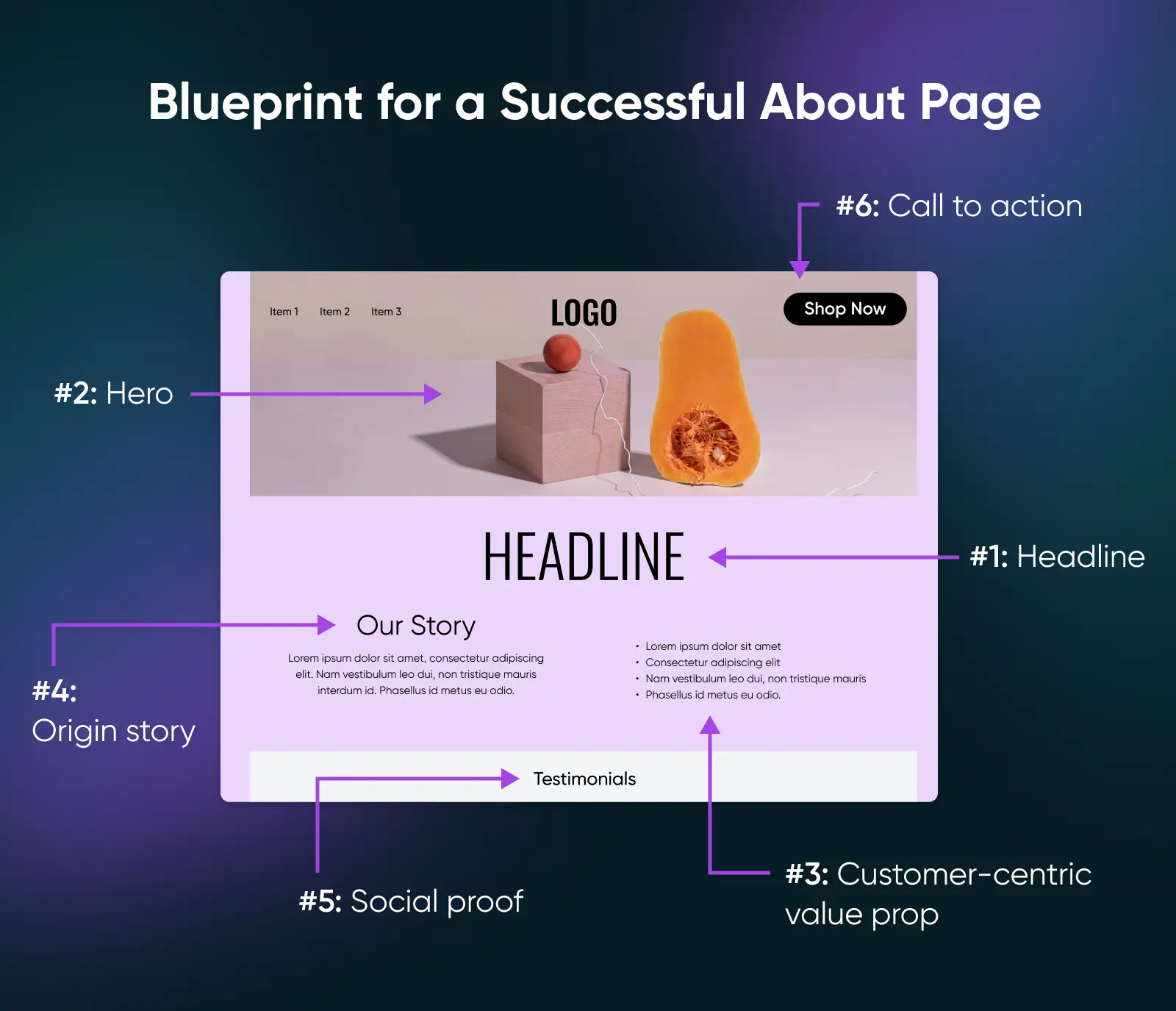
1. Hook or headline
Why it matters: Stops the scroll. For example, “Turning thrift-store finds into statement pieces since 2018.”
How to build it: Borrow a proven copywriting formula like “Pain-Agitate-Solution” and speak to the reader’s goal, not your ego. You might even draft a few options and A/B test them to land on the best one.
2. Hero image or micro-video
Why it matters: People buy from people. A real photo of you, your team, or your workspace makes the business feel human in a way stock photography never can. Get it wrong (a generic stock handshake, say) and the page reads as anonymous, which is the exact problem it exists to solve.
Pro-tip: Shoot a five-second GIF-style loop on your phone (you packing an order, roasting beans, sketching code, etc.) for a micro-video that’s low-budget yet effective.
3. Customer-centric value proposition
Why it matters: Instantly clarifies the “What’s in it for me?”
How to build it: One or two sentences that start with a verb and include a tangible result (for example, “We build WordPress sites that load in under one second and rank on page 1”). Follow that up with one bullet row of quick-scan proof points, like how many years you’ve been in business, how many projects you’ve shipped, your five-star reviews, etc.
4. Your founder or origin story
Why it matters: Stanford marketing professor Jennifer Aaker puts it plainly: “Stories are remembered up to 22 times more than facts alone.”
How to build it: Use the classic story-spine pattern in three short paragraphs: Once upon a time… / Until one day… / Ever since then… Keep the spotlight on the problem you solve, not the medals you’ve won.
5. Social proof stack
Why it matters: Anyone can claim to be great. Social proof lets your customers, reviewers, and the press say it for you, which can be more convincing than saying it yourself.
How to build it: Mix testimonial snippets, trust badges, and “as seen in” logos, but limit your social proof to around five items at most to avoid visual clutter, and link each logo to its source for authenticity.
6. Clear call to action
Why it matters: Visitors need the next step while your story is fresh. A great About page with no CTA is a firm handshake followed by silence.
How to build it: Use a single primary CTA button. Place it above the fold and after the story so it’s always within reach on mobile.
11 About Us page examples that nail it
Want to write your About Us page like a pro? Skim these examples to learn from some of the best. (Live pages change; a few have evolved since we screenshotted them in 2023, and we’ve noted where.)
1. Yellow Leaf Hammocks
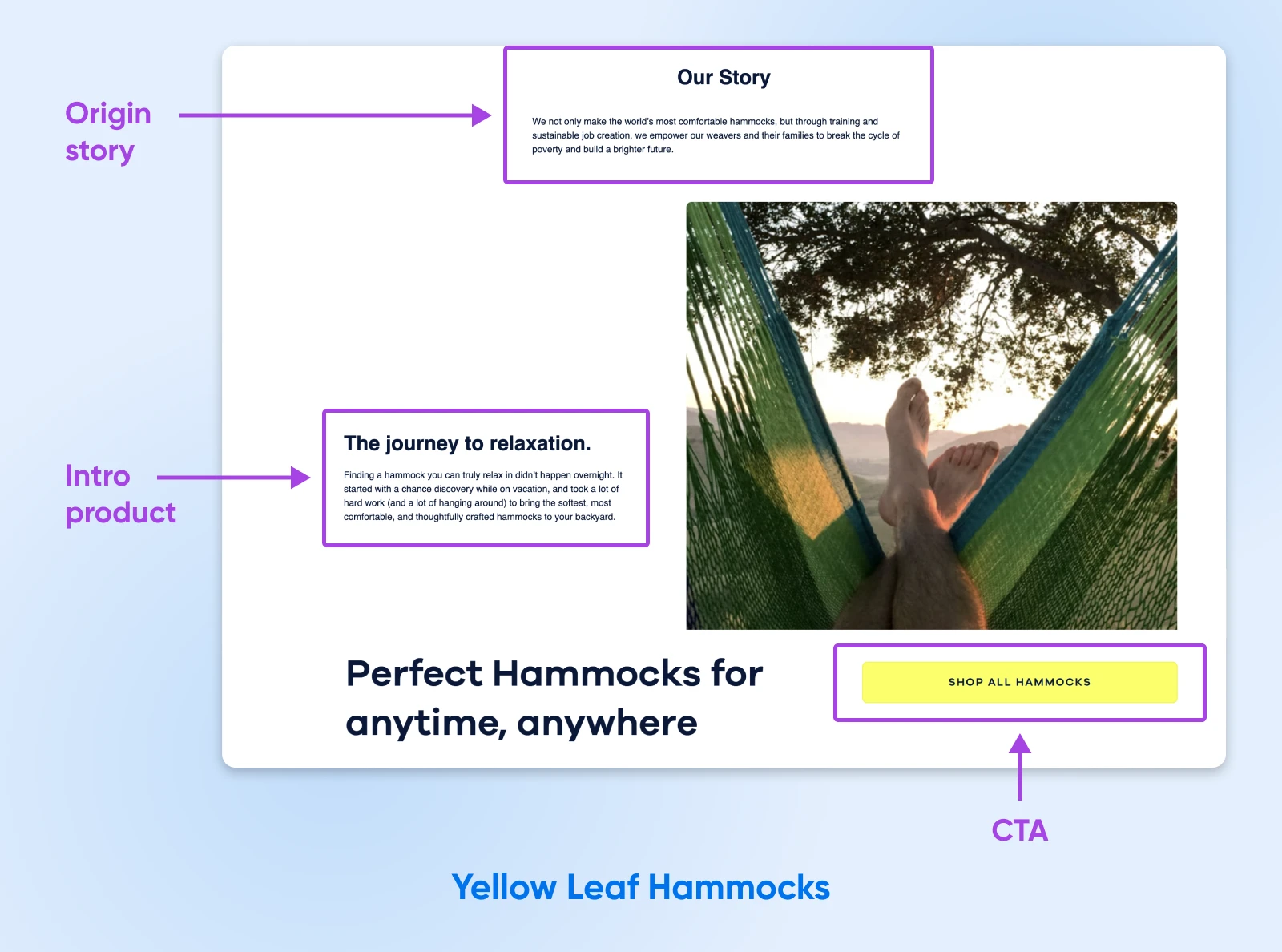
Yellow Leaf Hammocks opens with a video, then tells the story of the people who make the product: expert craftswomen of the Mlabri Tribe in the hills of Northern Thailand, and the company’s mission of creating weaving jobs that help their families break the cycle of poverty. Mission first, product second, and then a gentle shop CTA.
Key takeaway: Lead with your mission if your company exists to change something. People say they care: in Havas’ 2021 Meaningful Brands survey of over 395,000 people worldwide, 73% said brands must act now for the good of society and the planet.
2. Hiut Denim Co.
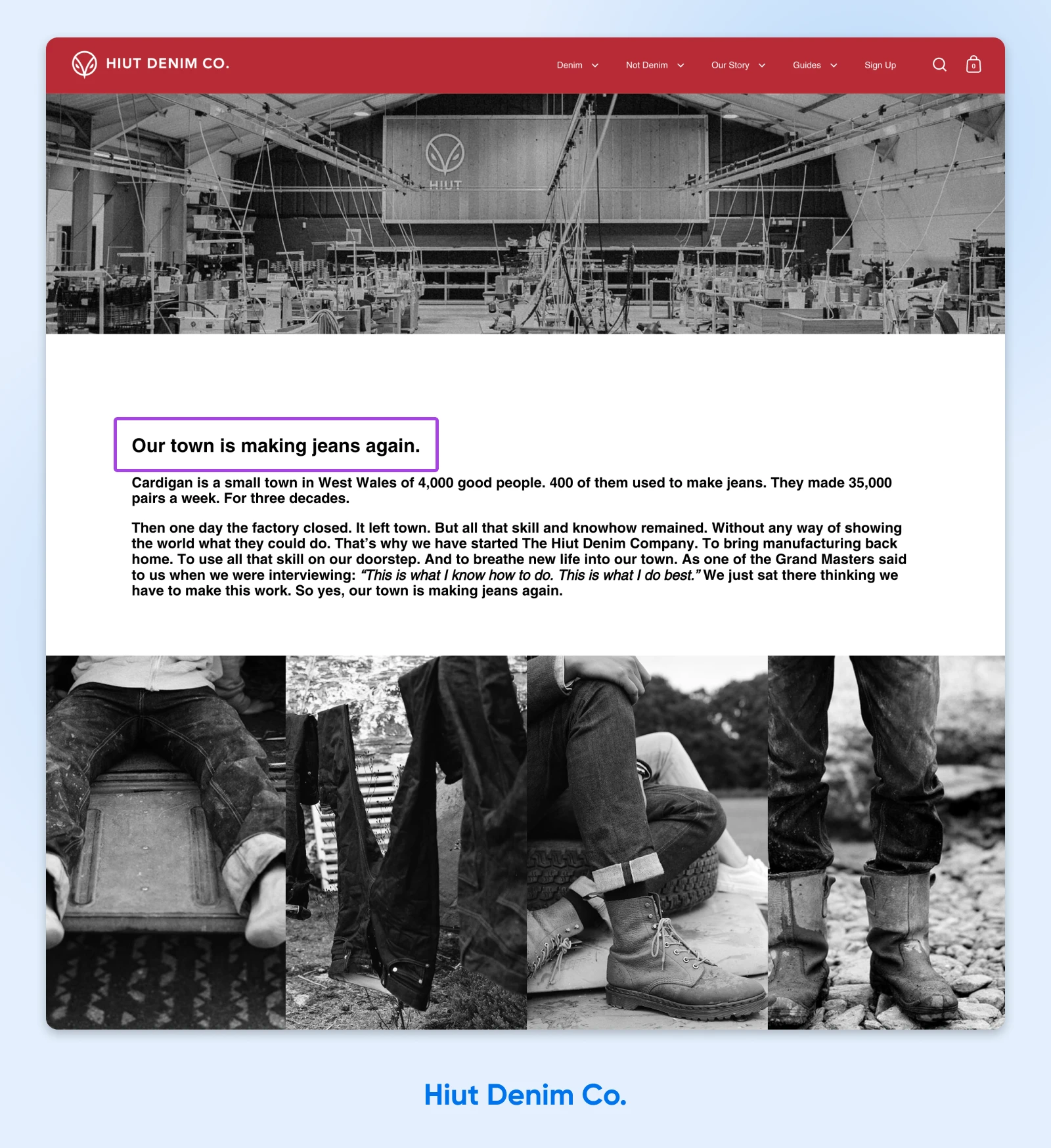
Hiut Denim Co. tells a town-revival tale with real numbers: in the 1960s, the jeans factory in Cardigan (Aberteifi), Wales employed more than 400 makers producing around 35,000 pairs a week. Production moved offshore in 2002, and Hiut was founded in 2011 to put that skill back to work. The page has been redesigned since our screenshot, but the hometown story is still its spine.
Key takeaway: Tell a place-based story if your business has strong hometown roots.
3. Pip’s (formerly Pipcorn)
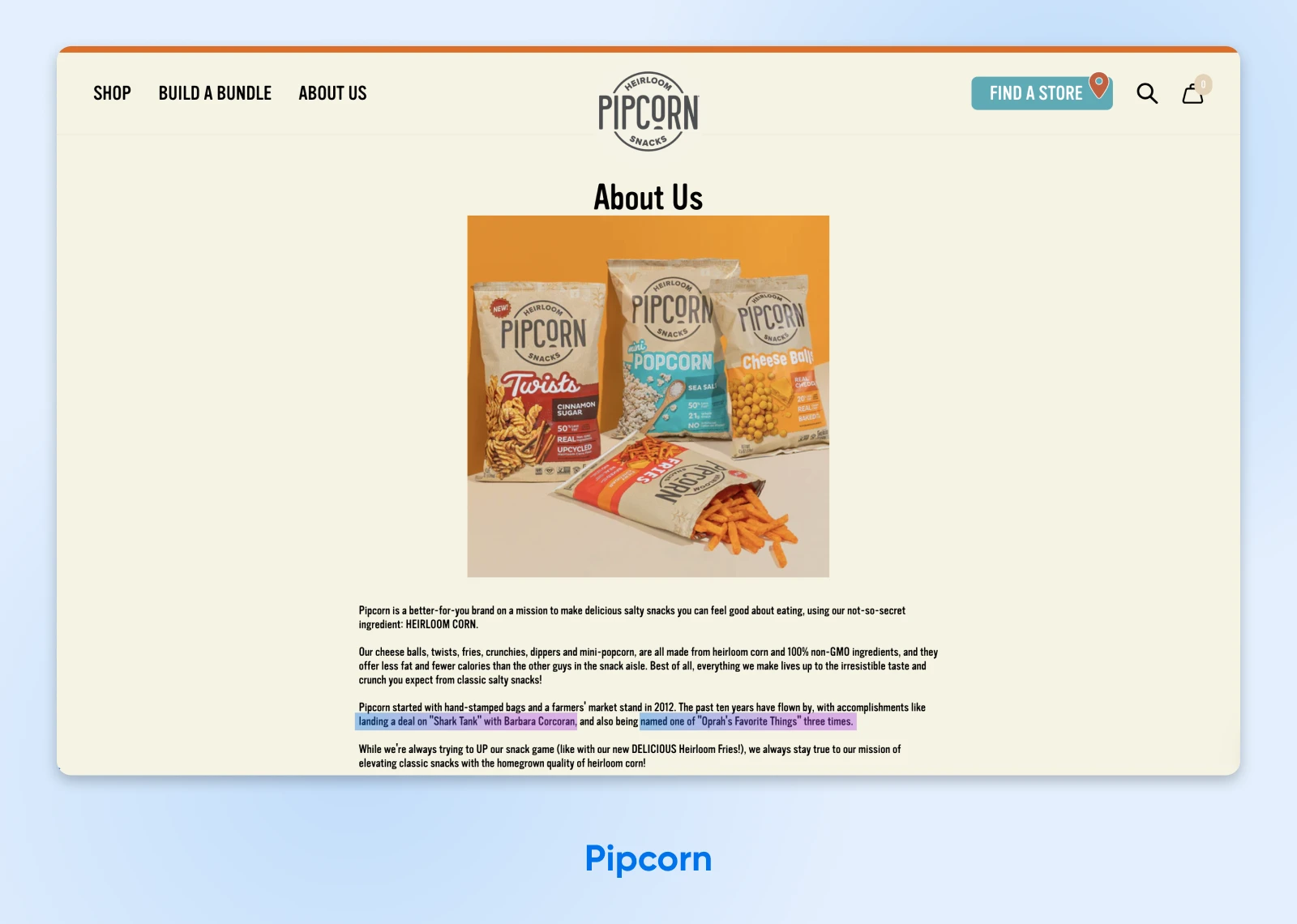
Pipcorn has since rebranded to Pip’s, but the About page still leans on origin: the founders discovered heirloom corn seeds in 2012, which landed them a deal on Shark Tank. The page then doubles as a mini-explainer on what heirloom corn actually is, keeping things snackable and credible.
Key takeaway: A tiny timeline can offer big proof if you have a viral product or a company that blew up quickly.
4. Blueland
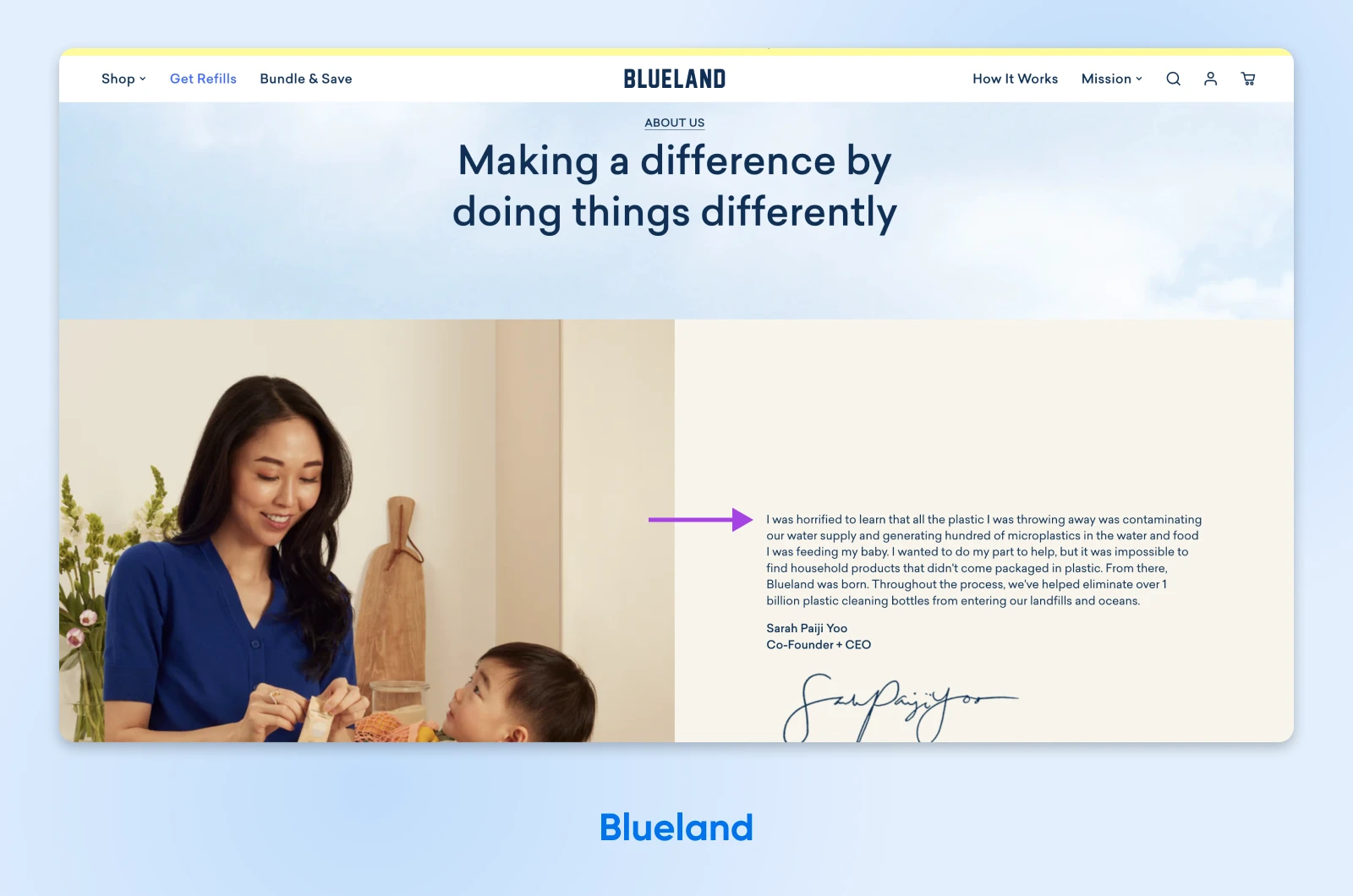
Co-founder and CEO Sarah Paiji Yoo tells Blueland’s founding story in first person: as a new mom, she was horrified to learn that microplastics are found in almost everything, including the water she was mixing with her son’s baby formula. The page pairs that personal stake with a hard number: the company says it has helped divert over 1 billion plastic cleaning bottles from landfills and oceans.
Key takeaway: Stats can tell a story, especially if you personalize them.
5. Wistia
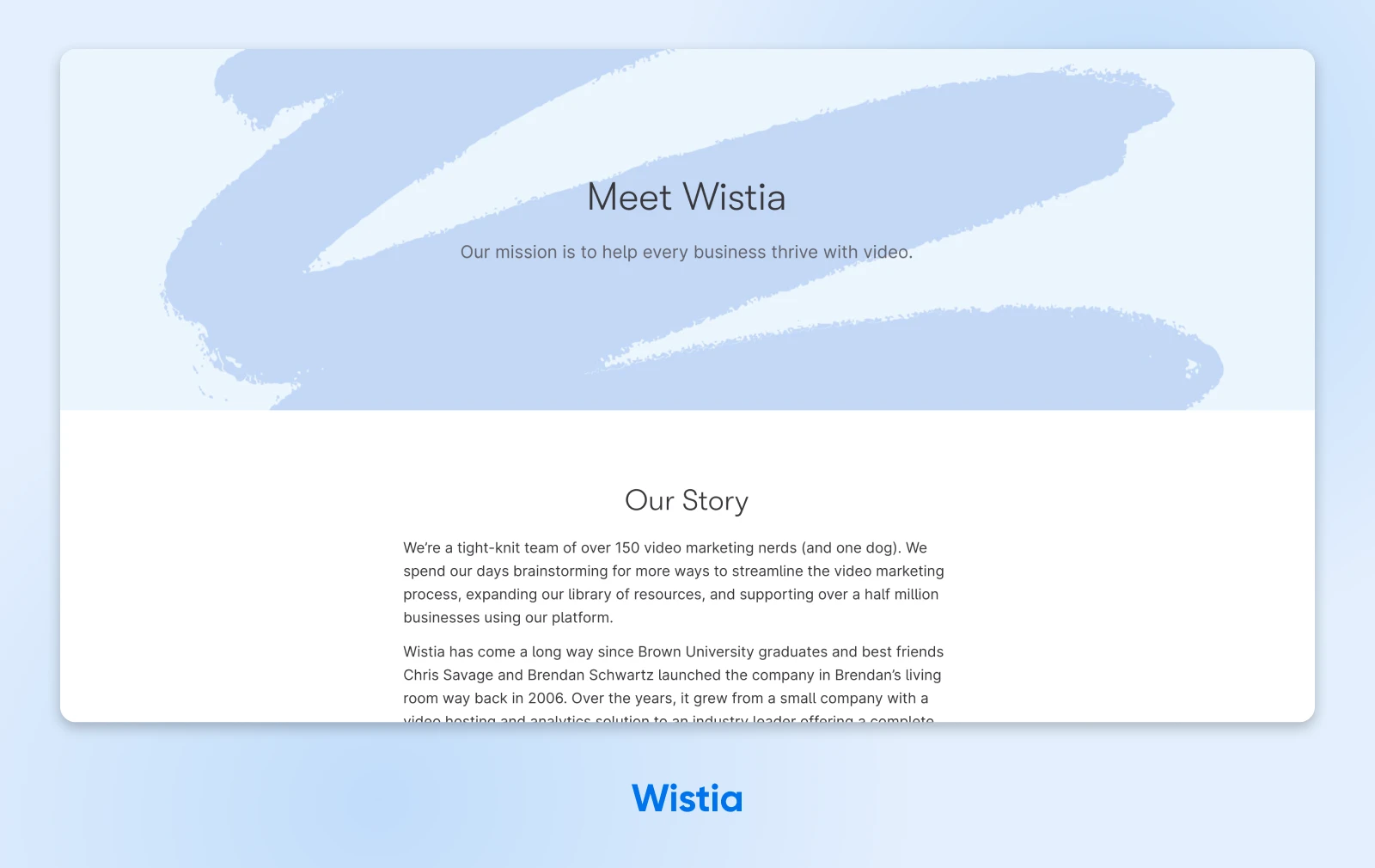
Wistia keeps things sweet and simple. There are no gimmicks here, just a one-line mission (“help every business thrive with video”) and the story of the company’s roots: two Brown University friends, Chris Savage and Brendan Schwartz, launching the company from a living room in 2006.
Key takeaway: Don’t overthink it. Your mission should shine on your About page, so put it front and center.
6. Basecamp
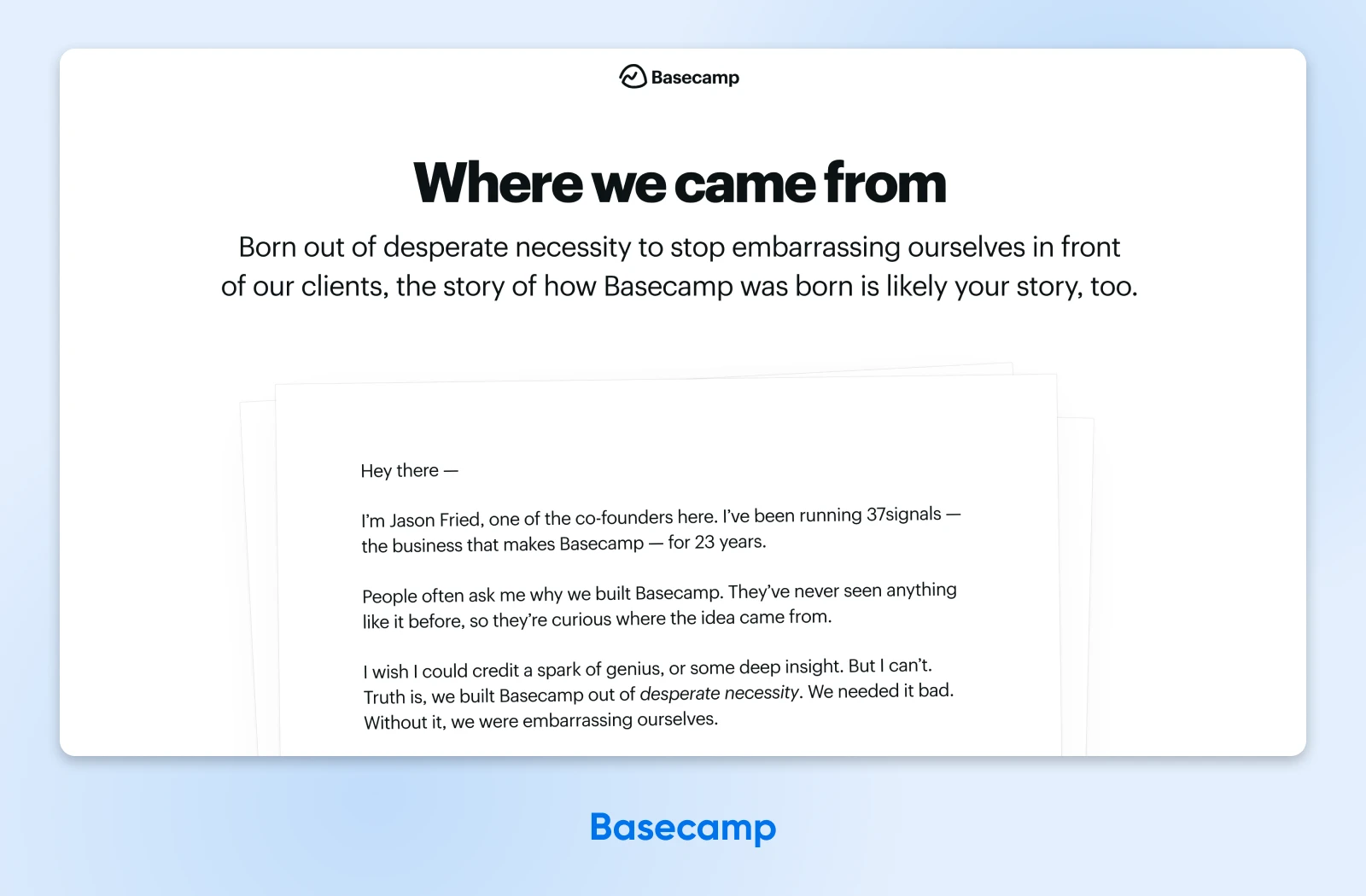
Co-founder Jason Fried narrates a failure-to-fix story as a personal letter: his design firm kept dropping balls in front of clients, so the team built the project management tool they couldn’t find anywhere else. He even signs off with his actual email address.
Key takeaway: Telling your story in first person makes it sound like a chat with a friend, not more corporate-speak.
7. Help Scout
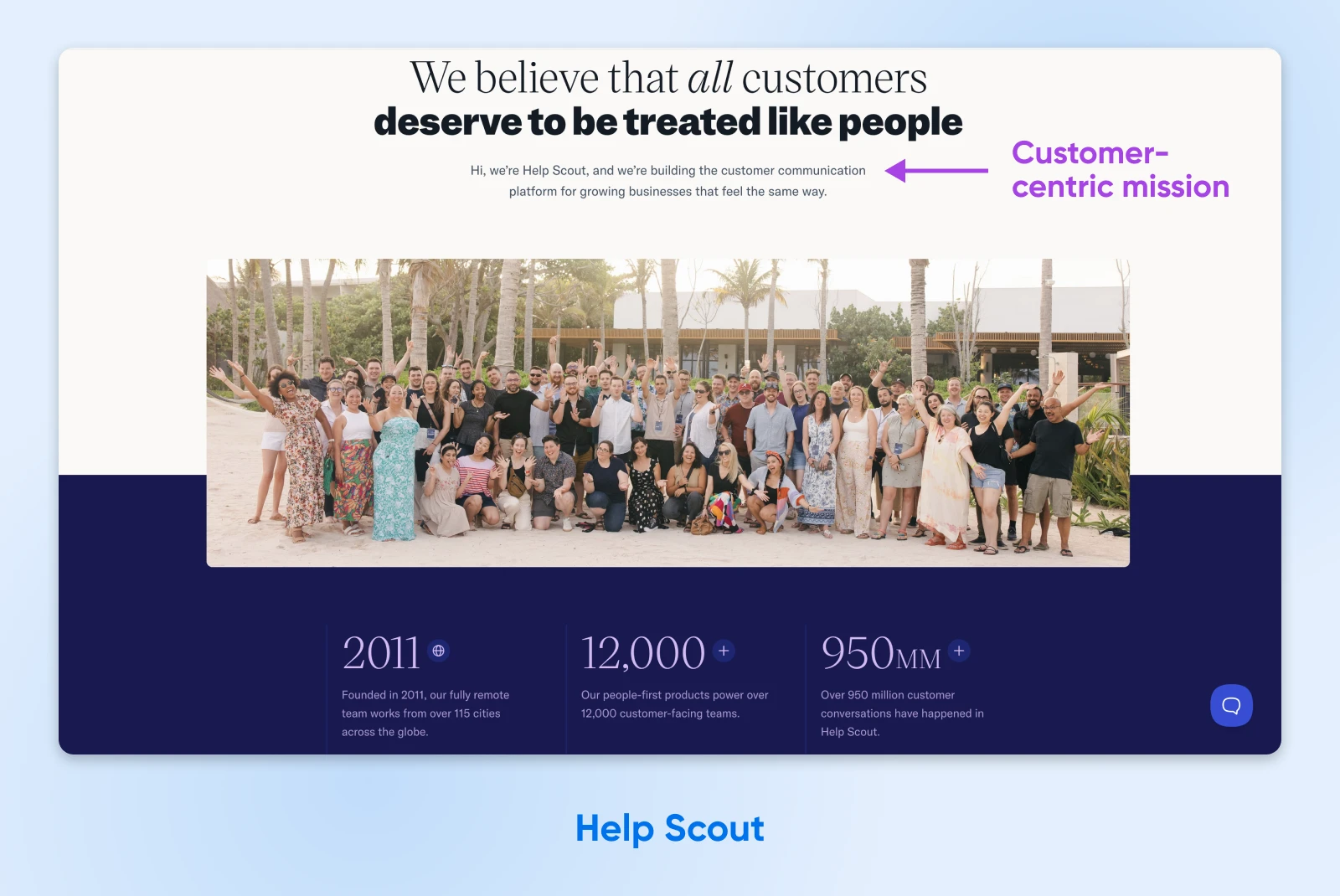
Help Scout leads with a one-line, customer-centric belief (“all customers deserve to be treated like people”), then backs it with quick-scan stats: founded in 2011, a fully remote team working from over 115 cities, and more than 950 million customer conversations on the platform.
Key takeaway: Show the humans, then prove the scale.
8. Bombas
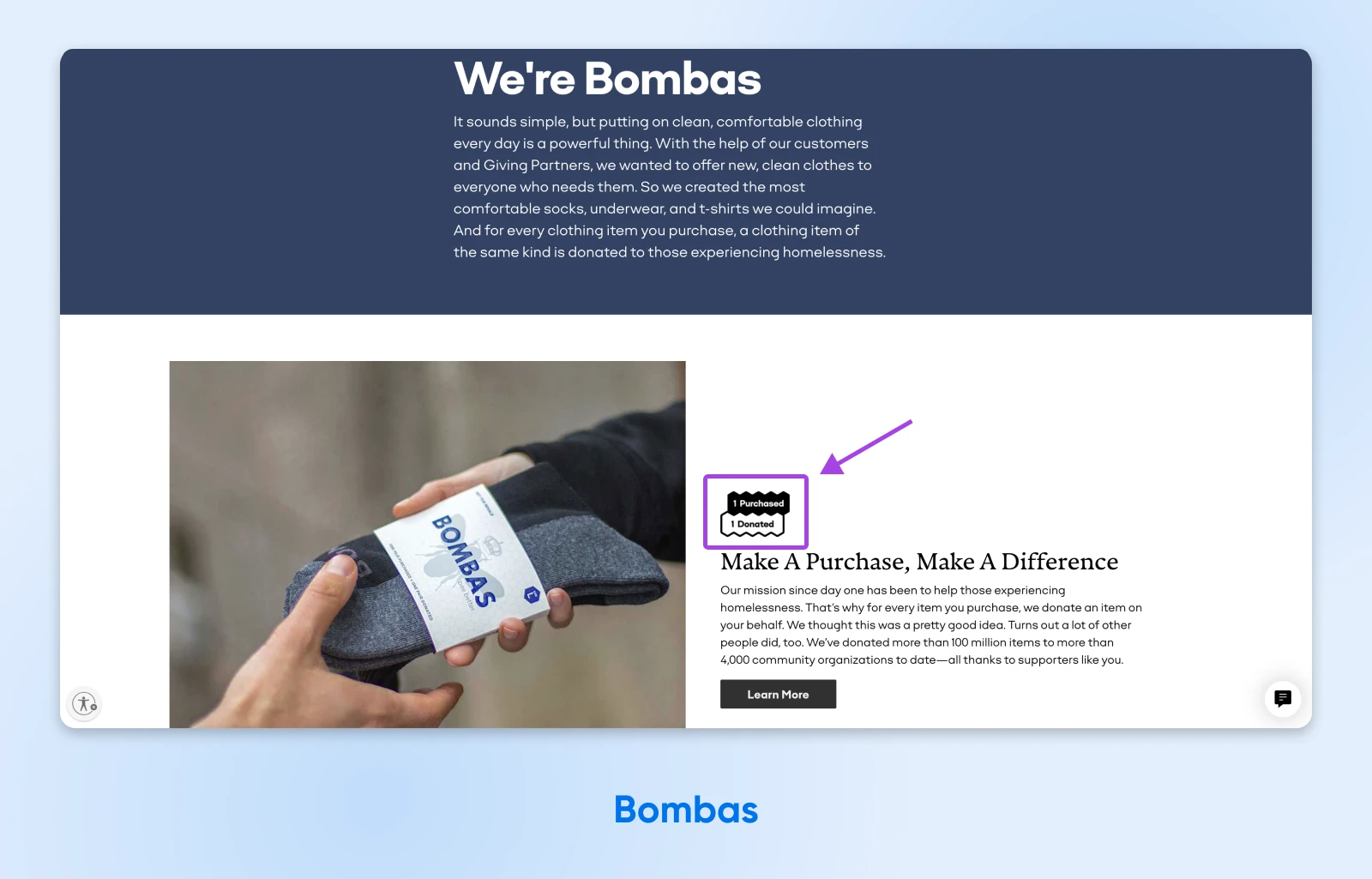
When we captured this page in 2023, Bombas led with its “one purchased = one donated” pledge and linked to an impact report where customers could see what their purchases had funded. The lesson holds regardless of layout: put the cause where nobody can miss it.
Key takeaway: If your company is mission-based, lean into it with a cause-driven hook.
9. Bark
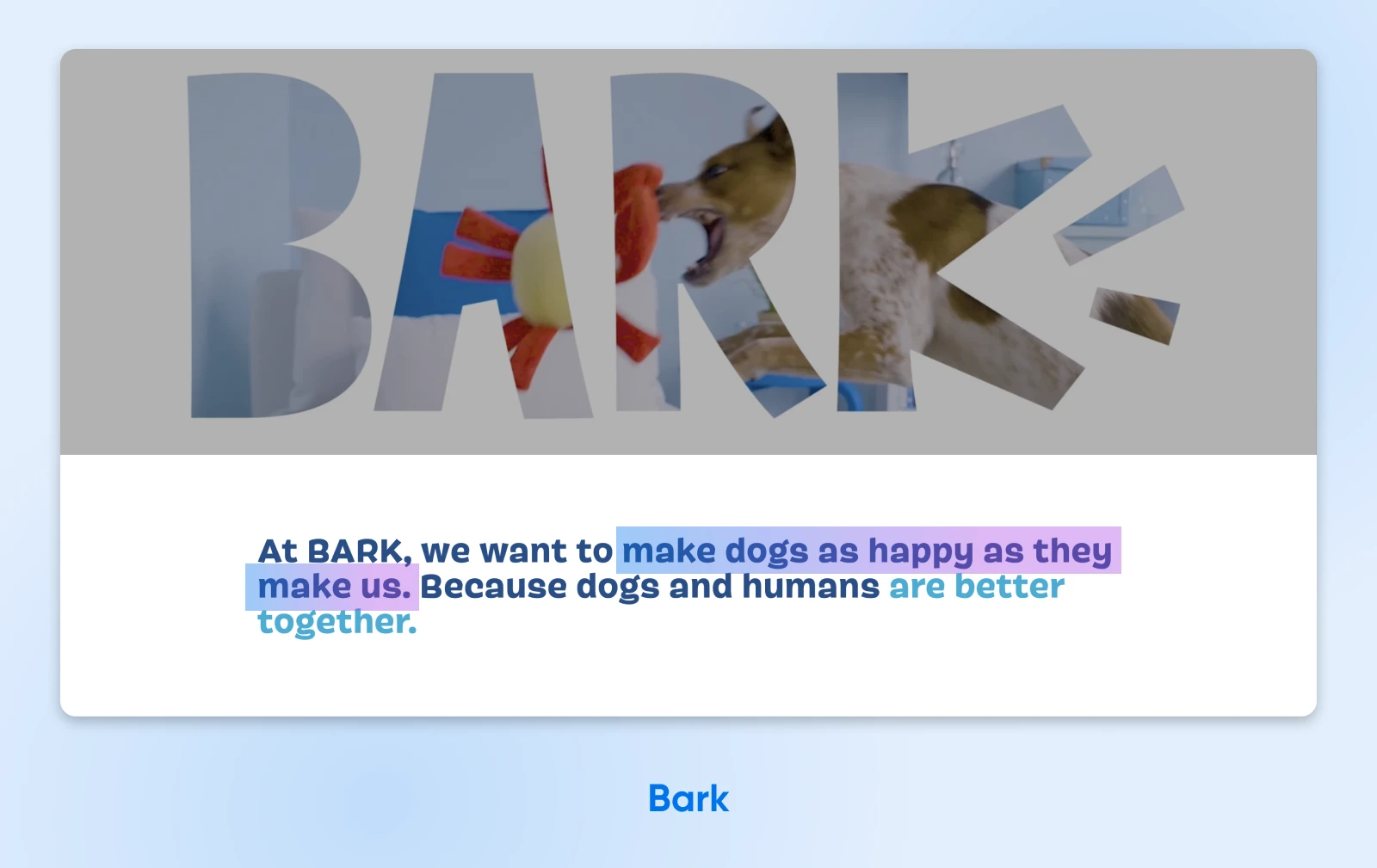
Bark’s About page sounds exactly like its customers: the mission is “make all dogs happy,” and the page jokes that the company is now “Co-Owned by Dogs” (“It’s a legal nightmare but we’re running with it”). The playful copy mirrors the brand’s voice on every other channel.
Key takeaway: Mirror your audience’s joy.
10. Warby Parker
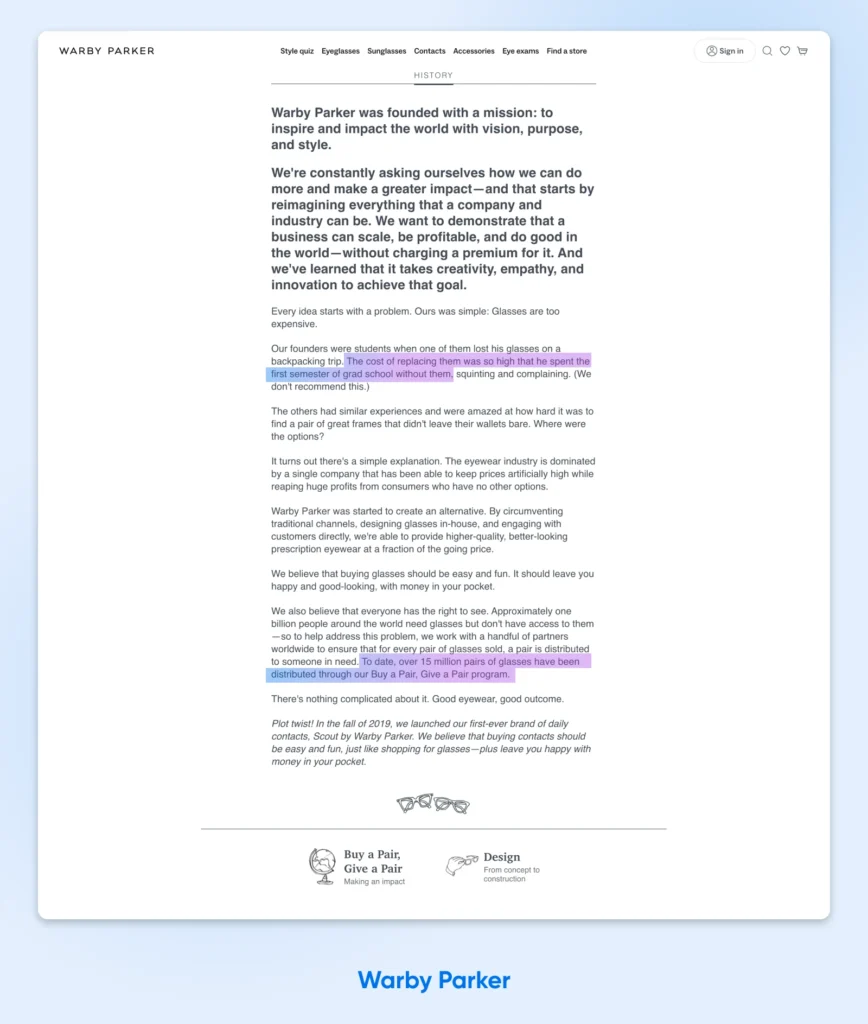
Warby Parker frames (pun intended) the whole page around one problem: glasses are too expensive. The story starts with a founder losing his glasses on a backpacking trip and squinting through a semester of grad school, then shows the fix, including the Buy a Pair, Give a Pair program that distributes a pair of glasses to someone in need for every pair sold.
Key takeaway: If your brand solves a big problem, use your About page to call attention to it.
11. Ugmonk
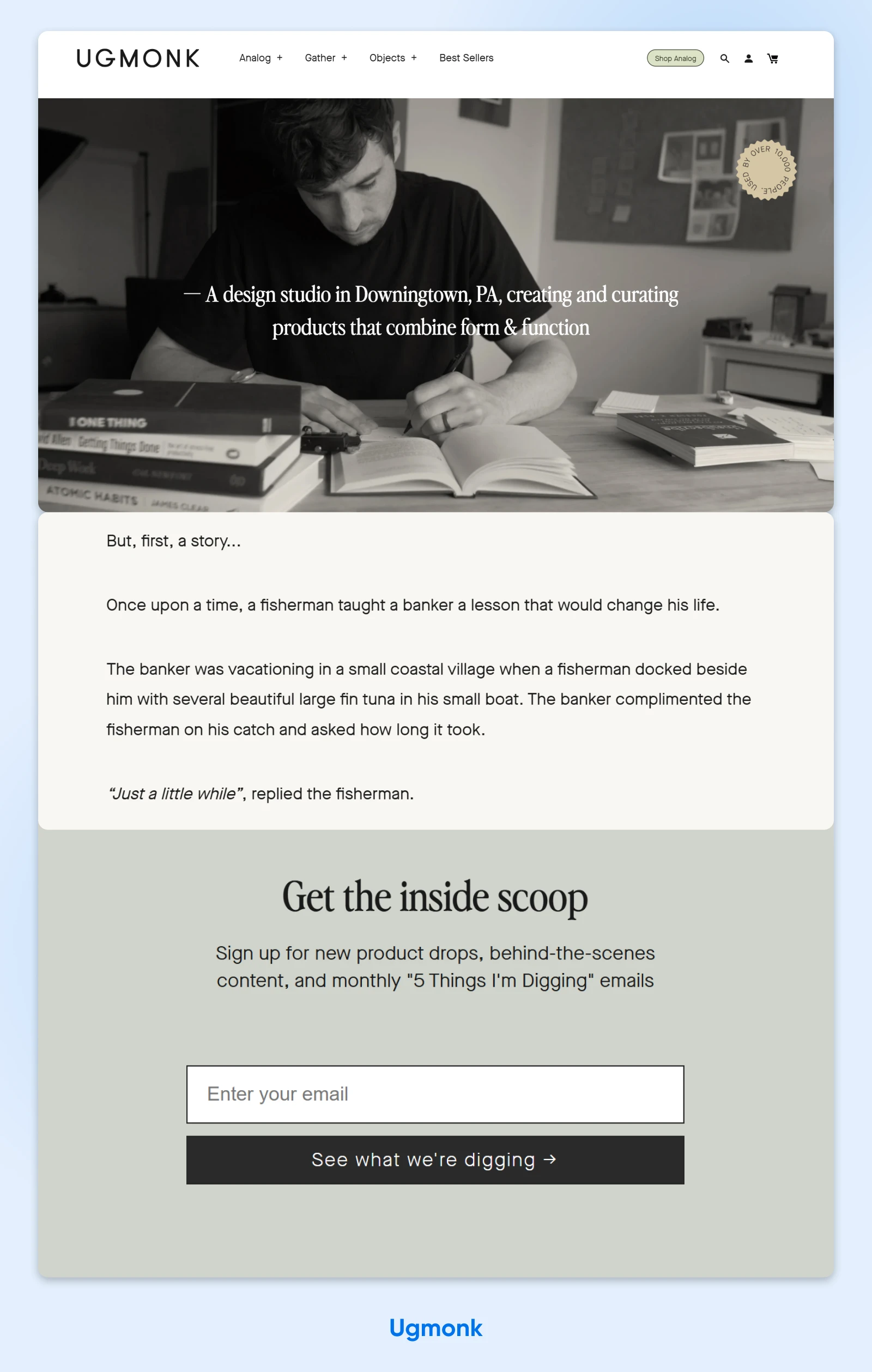
In our 2023 capture, founder Jeff Sheldon opens with a short parable, intersperses studio photos that show Ugmonk’s design-studio roots, and finishes with a newsletter opt-in.
Key takeaway: Tell a micro-story to capture visitors’ attention (and don’t let it go until they get to the end of the page).
Ready to start? Pick one takeaway from this list that resonates with you and plug it into the anatomy checklist from the previous section. Iterate one element at a time to keep the process light, fast, and authentically you.
Get unstuck when writing your About page
Writer’s block doesn’t care how exciting your origin story is. Kick it to the curb with these quick-start prompts and AI writing tools, all designed to help you fill a blank page in minutes.
5 prompts to spark real-talk copy
1. Origin-story Mad Lib
Copy this frame: “Back in ___, I was frustrated by ___, so I decided to ___. Today our customers get ___.”
Replace the blanks in one go — no editing allowed. That’s the whole beauty of Mad Libs. Before you hit publish, though, read it out loud to yourself. If anything sounds stiff, go ahead and chop it.
2. Day-in-the-life mirror
List three problems your best customer wakes up with. Next to each, write how your product removes the headache. Turn the list into a “We get it” opening paragraph for your About page.
3. Before-and-after snapshot
Pick one customer photo or testimonial. Use it to inspire you to draft two sentences: life before your product or service, and life after your product or service.
Then, use that customer photo or testimonial as the hero or headline for your About page. Your two sentences can either be the hero photo caption or the opening paragraph.
4. Three-email test
Pretend a friend sent you an email asking what you do. Draft a casual reply (75 words, tops). Paste it into your About page. You can give it a bit of polish, but don’t spend a ton of time editing or overwriting.
5. Review remix
Copy a five-star review from Google or Etsy. Highlight the phrase that nails your value. Open with that quote, then add, “Here’s why this matters…”
3 AI helpers to speed things up
1. Remixer, DreamHost’s AI website builder
Describe your business in plain language and Remixer plans and builds a complete site (DreamHost’s average: 2–3 minutes to generate one), then lets you keep tweaking it until it fits your brand.
To get started: Try Remixer free for 30 days, no credit card or domain required, and edit the generated About copy until it sounds like you. The trial previews your site on a remixer.ai subdomain; you upgrade when you’re ready to publish.
2. ChatGPT
ChatGPT can expand bullet points, suggest headlines, or help you tighten up your copy.
To get started: Paste one prompt (for example, “Rewrite this in a friendly, 8th-grade reading level”). From the output, keep the parts that sound like you, and delete the rest.
3. Jasper
Jasper is an AI platform built specifically for marketing copy, with settings that keep the output consistent with your brand voice.
To get started: Feed it 3–4 facts about your business, generate a few variants, and blend the best lines.
About Us page FAQ
How long should an About Us page be?
Long enough to answer “Who are you, and why should I trust you?” There’s no ideal word count. Use enough space to explain who you are, why the business exists, and why visitors should trust you; length becomes a problem when it buries your proof and call to action.
What should I write on an About Us page?
Six things: a hook or headline, a real photo or short video, a customer-focused value proposition, your origin story, social proof (testimonials, reviews, press mentions), and one clear call to action. Write it in the same voice you’d use to describe your business to a friend.
What is a good welcome message for a website?
A good welcome message is one or two sentences that say what you do, who it’s for, and what to do next. For example: “We make small-batch dog treats in Portland. Take the 30-second quiz to find your pup’s flavor.” Avoid “Welcome to our website” on its own — it greets without informing.
Do I have to show my face?
No. Real photos of people build credibility fastest, but a well-shot product or workspace image can do the job if you’re camera-shy. The one thing to avoid is generic stock photography, which signals the opposite of authenticity.
Should an About Us page be in first or third person?
For solo founders, first person (“I”) feels authentic. For growing teams, first-person plural (“we”) works fine. Third person tends to read as stiff and corporate. Whatever you choose, stay consistent from headline to CTA.
Can I let AI write the whole thing?
AI drafts are a great start, but readers notice when copy feels generic. Use AI for structure and a first pass, then add the specifics only you know: names, dates, mistakes, and the moment you decided to start. That’s the part visitors actually came for.
Let DreamHost help perfect your About page
You know what’s next. Lead with a hook, back it up with a human story, show proof, and finish with one clear next step. Keep it fast, accessible, and always evolving through data-driven tweaks.
Need the site around it? Every DreamHost web hosting plan includes a free handcrafted starter website — a four-page WordPress site built by real humans, not templates — plus 24/7 support from an in-house team. Prefer the DIY route? Remixer, DreamHost’s AI website builder, is free to try for 30 days with no credit card required.
Starting from zero? Our beginner’s guide to making a website walks you through everything else, About page included.

Is Your Website Driving Potential Customers Away?
First impressions happen in under 50 milliseconds. This 42-page playbook gives small business owners practical tactics to look as credible as the big players — no agency, no redesign budget required.
Get The Playbook