Kevin Renskers had paid for Plausible's cloud since July 2020. In February 2026 he moved his sites to Plausible Community Edition (CE) on his own server. One of them normally gets about 200 unique visitors a day, and after the move the dashboard showed more than 5,000 on some days. He put the jump down to bots. The next day he wrote that he'd moved all his sites to Umami, and the inflated numbers came with him.
Umami and Plausible CE side by side
| Umami (self-hosted) | Plausible Community Edition | |
|---|---|---|
| License | MIT | AGPLv3. The tracker script on your site is MIT |
| What runs on the server | The Umami app and PostgreSQL (2 containers) | The Plausible app, PostgreSQL and ClickHouse (3 containers) |
| Published requirements | PostgreSQL 12.14 or newer, and Node.js 22 or newer since 3.1.0. No RAM minimum | Docker, a CPU with SSE 4.2 or NEON, and 2 GB of RAM recommended |
| Funnels, journeys and revenue | Included | Not in CE. On Plausible's cloud they're in the Business plan |
| Session replay and heatmaps | Included. Replays since 3.1.0, heatmaps with scroll depth since 3.2.0 | Plausible doesn't list them |
| Scroll depth | Shown on heatmaps | Its own metric since 3.0.0 |
| Google Search Console | Not in any release. Umami's development code adds it as a Cloud integration | Yes, through a Google OAuth app you set up |
| Other cloud-only features | Email reports and the streaming API | SSO, the sites API and data center IP blocking |
| Bot filtering | A user-agent list (the isbot library), plus IP ranges you add yourself | User agents and referrer spam |
| Release pace | 5 releases from April to September 2026 | Twice a year. Latest v3.2.1, May 15, 2026 |
| Support | No paid support listed for self-hosting. Paid Umami Cloud plans include email or chat support | Community only |
From each project's docs, pricing pages, GitHub repositories and release notes, checked in October 2026. If you'd rather pay for the cloud, Plausible's Starter plan lists $9 a month for up to 10k monthly pageviews. Our guide to Plausible pricing at your traffic, next to Fathom and Umami Cloud covers the higher tiers.
Bots inflate the counts in both tools
Renskers' jump from 200 to 5,000 isn't something either tool solves on its own. Self-hosted Plausible filters on user agents and referrer spam, while Plausible's cloud also blocks about 32,000 data center IP ranges. Umami relies on the isbot library, which checks the browser's user-agent string, and Renskers found it caught the most obvious crawlers and let through anything posing as a regular browser.
What worked for him was a set of Cloudflare rules, all available on Cloudflare's free plan, and they block known bots, empty user agents and traffic from data center networks before it reaches the analytics endpoints. His count fell from 2,000 to 5,000 visitors a day to about 500. The data center rule only sees the analytics requests because he serves Umami's script and API through his site's own domain. Without Cloudflare, self-hosted Umami's IGNORE_IP setting takes a comma-separated list of IP addresses and CIDR ranges to leave out of your stats, so you can add data center ranges yourself.
What each one puts on your server
Umami's official Compose file runs two containers, the app and PostgreSQL 15. Since version 3, PostgreSQL's the only database Umami's docs support, and the install docs ask for PostgreSQL 12.14 or newer. They still list Node.js 18.18, but Umami's 3.1.0 release notes raised the minimum to Node.js 22 because of Prisma 7, and its Docker image runs Node.js 22 too. Umami doesn't publish a memory or CPU minimum.
Plausible CE's Compose file runs three: the Plausible app, PostgreSQL 16 and ClickHouse 24.12, and ClickHouse is why CE needs a processor with SSE 4.2 or NEON instructions. Plausible recommends at least 2 GB of RAM so the three don't crash when memory runs out, and the Compose file already mounts ClickHouse settings meant for small machines. ClickHouse's own usage recommendations say it can run on as little as 2 GB, though a setup that small needs extra tuning and can only ingest at a low rate.
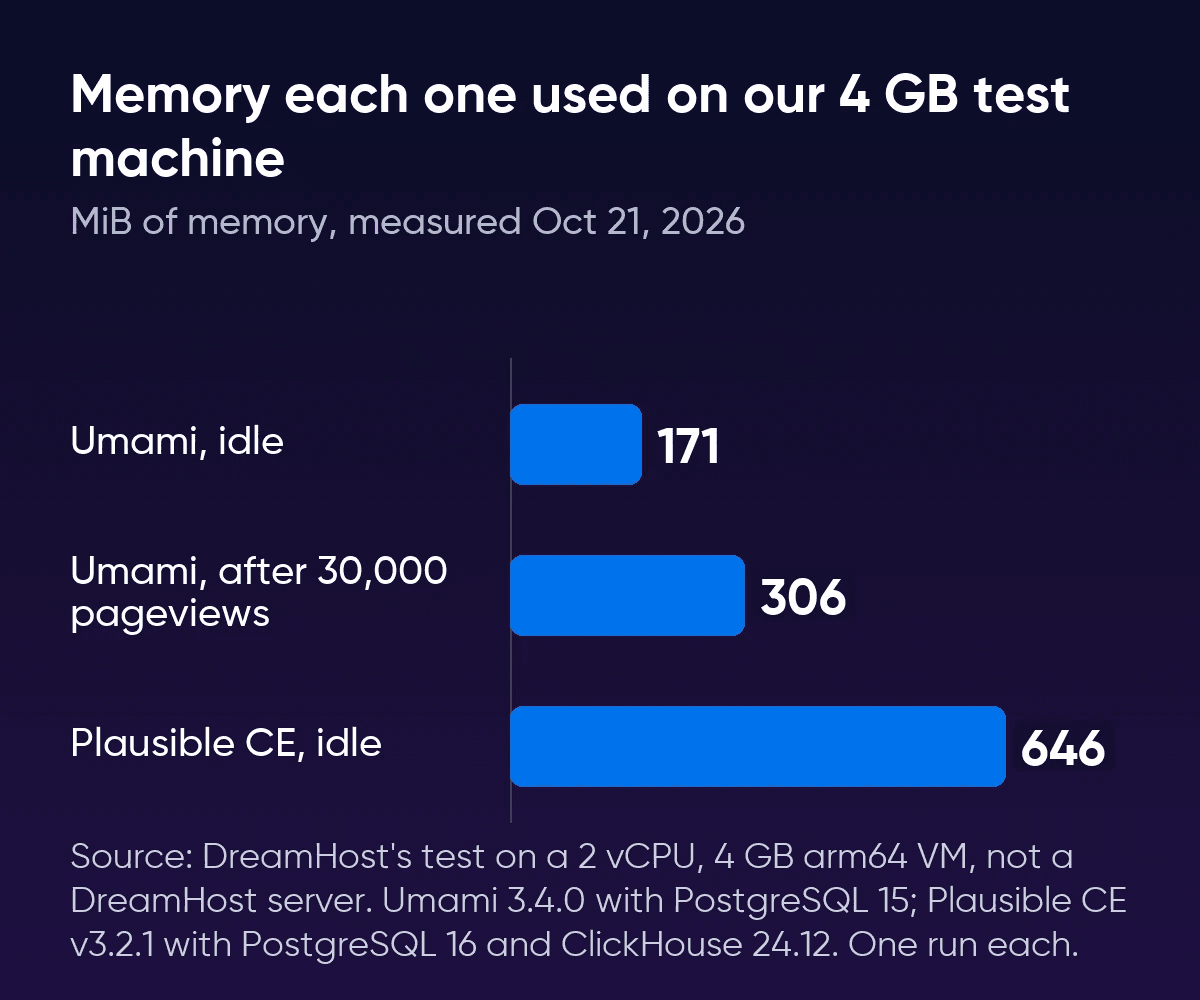
We ran both on Oct 21, 2026, each from its own Compose file, on our test machine with 2 vCPU and 4 GB (arm64), not a DreamHost server. That was Umami 3.4.0 with PostgreSQL 15, and Plausible CE v3.2.1 with PostgreSQL 16 and ClickHouse 24.12.
| On our test machine | Umami 3.4.0 | Plausible CE v3.2.1 |
|---|---|---|
| Memory at idle, 10 minutes after start | 171 MiB | 646 MiB, with ClickHouse using 202 MiB of it |
| CPU at idle | About 0% | 3.6% |
| Container images on disk | 1.86 GB | 1.36 GB |
| Data after the first start, empty | About 9 MB | 75 MB |
We also sent Umami 30,000 test pageviews in under three minutes. It counted every one, memory sat at 306 MiB afterward, and the database grew about 1 KB per pageview. We didn't load-test Plausible, because that needs an account and a site made through its web sign-up. So its 646 MiB is an idle figure. It doesn't contradict Plausible's 2 GB recommendation, which covers running with data and queries. Each tool ran once, with no repeats.
ClickHouse earns its memory at volume. It's built for fast analytics queries, and Aaron Becker's comparison expects it to beat PostgreSQL at scale, though with considerably more RAM.
What the self-hosted versions leave out
Plausible keeps several features for its cloud and lists them itself. CE has no marketing funnels, user journeys, ecommerce revenue goals, SSO or sites API, and there's no paid support for it, only the community.
Umami's pricing FAQ names two cloud-only features, email reports and the streaming API. Everything else on Umami's report list, from funnels, journeys and revenue to session replays and heatmaps, runs on your own server, though Umami Cloud sells replays and heatmaps only from its Business plan up.
Plausible still does a few things Umami doesn't:
- CE pulls search terms from Google Search Console and can import your GA4 history. Both need a Google OAuth app that you set up yourself in your Google account. There's no Search Console link in any Umami release. On October 14, 2026, Umami's maintainer closed a community pull request for one and said Search Console support had landed in Umami's development code
as a Cloud integration.
As written, that code turns the page off on self-hosted servers. - CE has reported scroll depth as its own metric since version 3.0.0, which also added teams, engagement time and segments.
Renskers chose Umami and still calls Plausible's dashboard cleaner and more modern.
If neither tool suits you, our list of open-source tools you can run yourself also covers Matomo.
Updates and backups
Plausible lists installation, upgrades, capacity, uptime and backup as the self-hoster's job. Umami's pricing FAQ says its cloud handles infrastructure, updates, and maintenance for you,
so on your own server that work is yours too.
CE is a long-term release that comes out twice a year, and its latest is v3.2.1 from May 15, 2026. CE doesn't backport fixes, so upgrading is the only way to get them, and a major upgrade can come with data migrations and a new ClickHouse image.
Umami ships more often: it put out five releases between April 16 and September 17, 2026, from 3.1.0 to 3.4.0. A faster pace also means more updates to apply.
Backups are simpler on Umami, where all of its data sits in one PostgreSQL database, and a standard database dump covers it. CE has two databases to back up, PostgreSQL and ClickHouse. A Hacker News user who left Plausible in 2022 didn't want ClickHouse's "admin overhead" on top: With Umami I only need Postgres.
The license question
Umami is MIT-licensed. Plausible CE is AGPLv3, and the AGPL's network clause applies when you modify the program: people using your changed version over a network must be offered its source code. If you run CE unchanged for your own sites, the license text doesn't ask that of you, though we're reading the text here and aren't giving legal advice. Plausible releases the tracker script that goes on your pages under MIT, to avoid issues with AGPL virality.
Which one to run
Choose Umami if
You want replays, heatmaps and funnels on your own server, and you'd rather back up one PostgreSQL database than look after ClickHouse.
Choose Plausible CE if
Search Console data and Plausible's one-page dashboard matter more to you than funnels, and you're comfortable running ClickHouse.
Choose a cloud plan if
You'd rather not install updates yourself. Both vendors' clouds apply updates for you, and Plausible's cloud also blocks data center traffic.
Plausible isn't in the app library on DreamHost's VPS page, so you'd install CE yourself. Start with Plausible's install guide.
If you pick Umami
A DreamHost VPS with Umami comes with Umami, PostgreSQL 15 and Caddy 2 on Debian 13, and Caddy handles HTTPS with a Let's Encrypt certificate it requests for the server's IP address at first boot. The image creates your admin login at first boot. You'll read your login over SSH.
The image ships Umami 3.2.0, which isn't the newest, and running umami-update moves you to the current release (3.4.0, out September 17). The command warns that a database migration can be one-way, so run umami-backup first. That backup is a database dump on the same disk, and it won't leave the server unless you copy it off. DreamHost support is available 24/7 for the hardware, network and connectivity. Umami, the operating system and the backups are yours.
Umami doesn't publish a minimum size, so our picks are guidance: Stack 4, the smallest plan the Umami image comes on, for a few sites, and Stack 8, the plan DreamHost labels for apps running in production,
for a busy one. Neither Umami nor DreamHost publishes a traffic level where you'd need to move up. The database lives on the server's root disk, so check how fast it grows over the first month, especially with replays turned on, which our test didn't record.
Umami and Plausible FAQs
Is Plausible Analytics self-hosted?
Plausible Community Edition is the free version you run on your own server. Plausible's main product is its paid cloud service, which is also its only funding. CE costs nothing, and you pay for your own server and backups.
Does self-hosted Umami have session replay?
Self-hosted Umami has both. Session replays arrived in Umami 3.1.0 and heatmaps in 3.2.0, and both run on your own server. Umami says it keeps replays for 30 days.
Is Umami free to self-host?
Running it yourself costs nothing beyond the server, since Umami is MIT-licensed. If you're coming from Google Analytics, Umami vs Google Analytics covers what carries over from GA4.
Can I move my Plausible CE history into self-hosted Umami?
There's no built-in way. Umami's maintainer says self-hosted Umami has no import feature, and that bringing in outside data means writing your own script to load it into the database. Umami Cloud runs imports from its Pro plan up, and its import page lists self-hosted Umami exports and CSV files as the sources.
Sources
- Self-hosted web analytics, Plausible, Oct 15, 2026. plausible.io/self-hosted-web-analytics
- Plausible Community Edition (README), Plausible (GitHub), Oct 15, 2026. github.com/plausible/community-edition
- Plausible CE compose.yml, v3.2.1, Plausible (GitHub), Oct 15, 2026. github.com/plausible/community-edition/blob/v3.2.1/compose.yml
- Plausible releases, Plausible (GitHub), Oct 15, 2026. github.com/plausible/analytics/releases
- Upgrade, Plausible CE wiki (GitHub), Oct 9, 2026. github.com/plausible/community-edition/wiki/upgrade
- Google integration, Plausible CE wiki (GitHub), Oct 9, 2026. github.com/plausible/community-edition/wiki/google-integration
- Plausible Analytics README (license), Plausible (GitHub), Oct 9, 2026. github.com/plausible/analytics/blob/master/README.md
- GNU Affero General Public License v3, Free Software Foundation, via Plausible (GitHub), Oct 9, 2026. github.com/plausible/analytics/blob/master/LICENSE.md
- Plausible pricing, Plausible, Oct 15, 2026. plausible.io
- Usage recommendations, ClickHouse, Oct 9, 2026. clickhouse.com/docs/guides/oss/best-practices/tips
- Installation, Umami docs, Oct 15, 2026. docs.umami.is/docs/install
- Environment variables, Umami docs, Oct 15, 2026. docs.umami.is/docs/environment-variables
- docker-compose.yml, Umami (GitHub), Oct 15, 2026. github.com/umami-software/umami/blob/master/docker-compose.yml
- Umami v3.4.0 package.json, Umami (GitHub), Oct 15, 2026. github.com/umami-software/umami/blob/v3.4.0/package.json
- Umami v3.4.0 Dockerfile, Umami (GitHub), Oct 15, 2026. github.com/umami-software/umami/blob/v3.4.0/Dockerfile
- Umami v3.1.0 release notes, Umami (GitHub), Oct 15, 2026. github.com/umami-software/umami/releases/tag/v3.1.0
- Add Google Search Console page (commit b93246b73), Umami (GitHub), Oct 15, 2026. github.com/umami-software/umami/commit/b93246b73269b161fd2189af4a08cbb9846e7a96
- Umami v3, Umami, Oct 9, 2026. umami.is/blog/umami-v3
- Pricing, Umami, Oct 15, 2026. umami.is/pricing
- Replays, Umami docs, Oct 9, 2026. docs.umami.is/docs/replays
- Heatmaps, Umami docs, Oct 9, 2026. docs.umami.is/docs/heatmaps
- Import data, Umami docs, Oct 15, 2026. docs.umami.is/docs/cloud/import-data
- Umami releases, Umami (GitHub), Oct 15, 2026. github.com/umami-software/umami/releases
- Google Search Console integration (pull request 4117, closed Oct 14, 2026), Umami (GitHub), Oct 15, 2026. github.com/umami-software/umami/pull/4117
- Comment on importing into self-hosted Umami, Mike Cao, Umami (GitHub), Oct 9, 2026. github.com/umami-software/umami/issues/2653#issuecomment-2040970801
- How to import data to self-hosted Umami, Mike Cao, Umami (GitHub Discussions), Oct 9, 2026. github.com/umami-software/umami/discussions/2199#discussioncomment-11991063
- Umami LICENSE, Umami (GitHub), Oct 9, 2026. github.com/umami-software/umami/blob/master/LICENSE
- Self-hosting Plausible broke my analytics, Kevin Renskers, Loopwerk, Oct 9, 2026. loopwerk.io/articles/2026/plausible
- Umami vs Plausible, Kevin Renskers, Loopwerk, Oct 9, 2026. loopwerk.io/articles/2026/umami-vs-plausible
- Protect your analytics with Cloudflare, Kevin Renskers, Loopwerk, Oct 15, 2026. loopwerk.io/articles/2026/protect-analytics
- Umami vs Plausible vs Matomo for self-hosted analytics, Aaron J. Becker, Oct 9, 2026. aaronjbecker.com/posts/umami-vs-plausible-vs-matomo-self-hosted-analytics
- Comment on switching from Plausible to Umami, Hacker News, Oct 9, 2026. news.ycombinator.com/item?id=31310448
- Umami on VPS, DreamHost, Oct 15, 2026. dreamhost.com/hosting/vps/umami