By September 12, one Hermes user's Nous Portal wallet had gone down by $36.19 for the month. A single day took $19.30 of that, and Hermes's morning spend report put that day at $0.02. Hermes's own estimates for the same stretch added up to $21.04, according to their report on GitHub.
What Hermes sends before you type
Apart from small side calls, every model call starts with the same load: Hermes's system prompt plus the schemas for about 20 tools it offers the model. Hermes's docs say it's 4,000 to 8,000 tokens. On our test install of Hermes v0.22.2, it came to about 12,200 tokens from the command line. The tool schemas made up about 9,000 of it. From Telegram the system prompt is shorter, and the total comes to about 11,800.
Providers bill by the token, a word or part of a word, and quote prices per million tokens, with input (what Hermes sends) and output (what the model writes) priced separately. We measured it with hermes prompt-size and a mock model that logged Hermes's requests, as the method at the end of the page explains.
That load goes out with every call, so even a small task you give Hermes multiplies it. We had Hermes write a three-line morning briefing from the Hacker News front page, which took four model calls. The three main calls each resent the fixed prompt and grew as the feed's text carried forward, at about 12,500, 14,600 and 14,800 tokens. The whole task used about 42,200 input tokens. Hermes skipped one repeat: when the same command returned the same output twice, it didn't resend it and sent a short note pointing back to the first result instead.
At our caching rate, that input costs about 1.4 cents on Claude Sonnet 5.5. A briefing a day won't reach 50 cents a month in input. What the model writes back decides the rest, at $10 per million output tokens.
The workload behind every price
Every number below starts from the typical coding session
in Hermes's guide to running a local model: about 100,000 input tokens and 20,000 output tokens. We call 10 sessions a month light use, 30 daily use and 90 heavy. A session of Sonnet 5.5 comes to about 23 cents in tokens, so you can multiply by your own count. The same guide puts a Claude Sonnet session at about 80 cents without showing its math, and our lower figure counts caching at today's prices.
Hermes keeps prompt caching on, so after the first call that fixed prompt bills at the cache-read price: $0.10 per million tokens on Sonnet 5.5, against $2 for fresh input. We billed 90% of input as cache reads and 10% as cache writes, or at the input price for models without a write price. For Claude, Hermes v0.22.2 ships with Anthropic's five-minute cache, which writes at 1.25 times the input price, so that's the rate we used. Version 0.22.4, released October 21, still does. Setting cache_ttl to 1h raises writes to twice the input price, and Hermes's docs say it only pays off when your turns are more than five minutes apart. A third setting, auto, picks the hour-long cache for sessions a person types into and the five-minute one for subagents and cron jobs. A user's DeepSeek billing export from August showed 98% of input tokens coming from the cache, so our 90% sits on the cautious side. With no caching at all, Sonnet 5.5's tokens would come to $4, $12 and $36 at the three volumes.
Paid tools aren't in these numbers. Web search, image generation and browser use bill per call on top of tokens. OpenRouter lists web search for these Claude models at 1 cent a call.
What a month of the model costs
Claude Sonnet 5.5 costs the same on both catalogs, so the table shows both ways you could pay for it: per token and on a Portal plan.
| Monthly use | Sonnet 5.5, per token | Sonnet 5.5, Portal Plus | Kimi K2.6, per token | Hermes server, Stack 4 |
|---|---|---|---|---|
| Light: 10 sessions (1M in, 0.2M out) | $3.14 | $20.00 | $1.68 | $8.99/mofor 3 months, then $15.99/mo |
| Daily: 30 sessions (3M in, 0.6M out) | $7.82 | $20.00 | $3.45 | |
| Heavy: 90 sessions (9M in, 1.8M out) | $22.22 | $20.00 | $8.74 |
Hermes's docs still name Claude Sonnet 4.6 the best general-purpose agentic model. At $3 in and $15 out it costs half again as much, $11.74 a month per token at daily use. On our test install, Hermes listed Claude Opus 4.6 as its model before we set anything up, so check which model yours starts on. Left there, you'd spend about $18 a month in tokens at daily use. Going the other way, OpenRouter lists Claude Haiku 5.5 at $0.10 in and $0.50 out per million tokens on October 22, so daily use comes to about $0.36 in tokens, or $1.16 with the card fee. We priced it but didn't test how well it runs Hermes's tools.
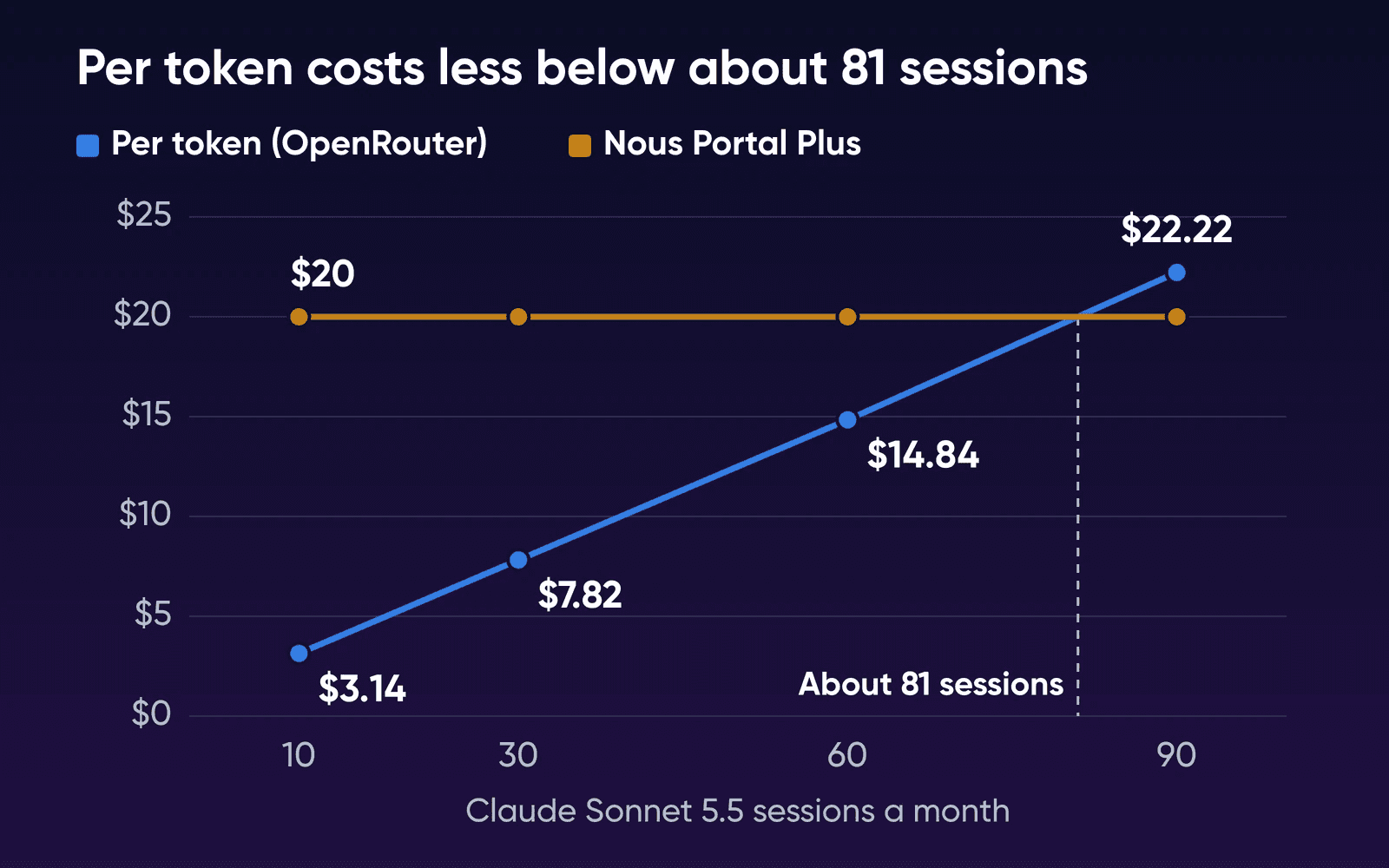
Once you count caching, output is most of the bill. At daily use, $6.00 of Sonnet 5.5's $7.02 in tokens is output, so the length of the model's answers moves your bill more than the length of the conversation. OpenRouter adds its card fee to every credit purchase: 5.5%, with a $0.80 minimum. If you buy credit once a month, that's the $0.80 in each light and daily bill and $1.16 of the heavy Sonnet one. OpenRouter passes model prices through without markup, so a direct Anthropic key would pay the $7.02 without the fee.
For a model priced the same on both, paying per token costs less until your tokens pass about $18.96 a month. On Sonnet 5.5 that's about 81 sessions, close to three a day. At 60 sessions you'd still pay $14.84 per token. Past 81 sessions Plus costs less, since its $20 buys $22 of credit. The credit's used up at about 94 sessions. After that you'd top up, and since Nous's page doesn't say a top-up buys credit dollar for dollar, that part is our assumption.
What the $20 Portal plan buys
A Nous Portal plan is a monthly subscription paid out as credit. Plus costs $20 a month and gives you $22 of credit, which you spend at catalog prices on models and hosted tools. Only $10 of unused credit rolls over. Super costs $100 for $110 of credit and Ultra $200 for $220. At our Sonnet 5.5 rate, Super only beats paying per token past about 400 sessions a month. Top-ups come in preset amounts from $10, or an amount you type.
Portal lists lower prices than OpenRouter for some models, per Nous's catalog and OpenRouter's on October 22:
| Per million tokens, in / out | Nous Portal | OpenRouter |
|---|---|---|
| Kimi K2.6 | $0.4493 / $1.892 | $0.65 / $3.41 |
| Gemma 4 31B | $0.10 / $0.34 | $0.20 / $0.40 |
| DeepSeek V4 Flash | $0.05 / $0.45 | $0.091 / $0.182 |
DeepSeek V4 Flash costs more on Portal for output. Nous's Kimi price is up from $0.4323 and $1.82 when we first priced it on October 16. Its entry still shows an original
price of $0.95 and $4.00, so that discount may end. At these volumes the discount saves less than the plan costs, as the table below shows. The GitHub report above also found Portal charging one DeepSeek route 11 times the input rate its catalog listed, so check your wallet against the catalog after your first week.
The other reason you'd take a plan is the Tool Gateway, which covers web search, scraping, image generation, browser use and speech, each priced per use from the same credits. Hermes's docs call Portal the recommended way to run Hermes.
| Nous Portal Plus | OpenRouter, per token | Local model on your server | |
|---|---|---|---|
| Kimi K2.6, a month of daily use | $20.00 ($1.47 of credit used) | $3.45 | Not priced |
| Gemma 4 31B, a month of daily use | $20.00 ($0.50 of credit used) | $1.64 | $0 in tokens |
| DeepSeek V4 Flash, a month of daily use | $20.00 ($0.42 of credit used) | $0.99 | Not priced |
| Token prices | Catalog prices, some Portal-only discounts | The provider's price, no markup | None |
| Monthly minimum | $20 | None | None |
| Card fee | None listed | 5.5%, $0.80 minimum | None |
Where the tokens go
Subagents use the most. Hermes's delegation docs say a parallel batch of them typically burns the large majority of a run's tokens, and suggest you give delegated work a cheaper model than the main chat. Side tasks such as session titles, context compression and screenshot reading also go to your main model unless you set a cheaper one under auxiliary in the config. Our briefing made one of those calls.
Scheduled jobs add up too, because they keep running while you're away.
Cron jobs run repeatedly and autonomously, so a modest per-run cost can accumulate unnoticed.
You can give a cron job a small pre-check script that runs before the model does. When the script's last line of output is this, Hermes skips the agent for that run, and the wakeAgent check itself costs $0:
{ "wakeAgent": false }That suits a job that polls every few minutes but only needs the model when something's changed. On our VM, a script-only cron job created with --no-agent ran on schedule with no model connected at all. The same cron docs warn that carrying the browser and delegation tools into a small news job bloats the tool list sent on every call. Tool schemas were most of the fixed prompt we measured, so give each job only the tools it uses.
Each /model switch mid-conversation resets the prompt cache, so the next message re-reads the whole conversation at the full input price. On OpenRouter you spend credit you've bought, so by our reading a runaway job stops when that balance runs out, as long as you leave its automatic top-up off.
Running a local model instead
Hermes Agent VPS Hosting doesn't ship with a model. Hermes calls your provider's API, and the product page says no model runs on the server itself. With root access you can add one by installing Ollama and pointing Hermes at it, as Hermes's local-model guide describes.
That guide picks gemma4:31b for agent work. It's the only one of the four models in its table that can call tools, which Hermes needs to run commands and browse. It needs about 20 GB of disk and 24 GB of memory or more. On our plans that's Stack 32, with 32 GB of memory and 8 vCPU. Stack 16's 16 GB won't hold it. Hermes also needs the model's context set to at least 64,000 tokens. Before you go local to save money, weigh what Stack 32 adds over Stack 4 in the plan list against the Gemma 4 31B row in the comparison table above.
On a CPU, a 31B model writes about 2 to 5 tokens a second, per Hermes's docs, and the same guide says large cloud models do noticeably better on very complex multi-step work. At 20,000 output tokens a session, that's 67 to 167 minutes of writing each time, or 33 to 83 hours a month at daily use. Your model also has to read the fixed prompt on every call, so on slow hardware the first turn can sit silent for minutes.
Local model
- No token bill at any volume
- Prompts and data stay on your server
What it asks of you
- Stack 32 instead of Stack 4, for gemma4:31b
- About 2 to 5 tokens a second on CPU, so one to three hours of writing per session
Which way to pay
Pay per token if
Your monthly token spend stays below what a Plus plan costs. In our pricing, that covered daily Sonnet 5.5 use and every Kimi or Gemma month. Buy OpenRouter credit once a month, since its minimum card fee applies to each purchase.
Take a Nous Portal plan if
You run Claude Sonnet 5.5 for more than about 81 sessions a month. It also suits you if you want web search, images and browser use on the same balance as your models.
Run a local model if
Your jobs can run overnight and your data shouldn't leave the server. You'll need Stack 32, and on CPU you'll wait one to three hours of writing per session.
What the server bill covers
On our test VM (not a DreamHost server), Hermes idled at about 557 MiB after 10 minutes, with its gateway and dashboard running and no key. The VM still had about 3 GB of its 4 GB free. Its median CPU use stayed under 1%, and the image took about 4.5 GB of disk.
| How the model runs | Measured on our test VM | Plan |
|---|---|---|
| API model: Hermes and its dashboard | About 557 MiB idle, under 1% CPU | Stack 4 |
| API model, plus messaging gateways and heavier jobs | Not measured (the next plan up) | Stack 8 |
| Local gemma4:31b through Ollama | Not measured (24 GB or more, Hermes docs) | Stack 32 |
Nous's Docker docs put the container's minimum at 1 GB of memory, 1 CPU core and 500 MB of disk for its data, with 2 to 4 GB and 2 cores recommended. The product page's own guidance is to start on Stack 4 and move up when you add gateways or heavier jobs. Nous's Docker example caps the container at 4 GB of memory and 2 CPUs, the same size as Stack 4.
Hermes keeps its memory, skills and session history on your server's root storage, and the product page says that storage isn't guaranteed to survive a rebuild, so sync those files somewhere else. Updates and patching are up to you. DreamHost support is available 24/7 for the hardware, network and connectivity, you manage the OS, software and configuration, and the product page calls Hermes itself community-supported open source. If you're still choosing an agent, see Hermes vs OpenClaw, tested side by side, or, if you already pay for Claude Code, Hermes Agent vs Claude Code.
Hermes Cloud is Nous's hosted alternative. It's billed daily from Nous credit: compute by the second while your agent runs, storage whether it runs or not, and models and tools on top. Its prices don't show outside Nous Portal, so sign in there to compare.
How we measured
DreamHost ran the test on October 16, 2026, on a Linux VM through Colima on an Apple-silicon Mac. The VM ran Ubuntu 24.04.4 on arm64, with 2 vCPU, about 4 GB of memory and Docker 29.5.2. Hermes v0.22.2 ran in Nous's official container, pinned by digest. We used Nous's Docker example with the gateway, the dashboard and the example's 4 GB and 2 CPU caps. We didn't put an API key, account or messaging token into it. Memory and CPU figures are the median of 12 docker stats samples taken 5 seconds apart, 2 and 10 minutes after start, from a single run. The dashboard answered 10 seconds after the start command.
For the prompt, hermes prompt-size gave the system prompt and tool schemas in bytes. We counted tokens on the first request Hermes sent to a small mock model on the same VM, which logged every request. For Telegram, the tool schemas are the same, and we scaled the shorter system prompt by its byte count. For the briefing, the mock asked Hermes to fetch the Hacker News feed twice with curl, then answered. Gemma on OpenRouter has no cache price, so all its input is billed at the input price. Token counts use OpenAI's o200k tokenizer, and Claude, Kimi and Gemma each count a little differently.
The run didn't produce a dollar figure: every price on this page is our arithmetic on the two model catalogs. We re-checked every price, plan and source on October 21, 2026, and only Nous's Kimi K2.6 price had moved. Hermes v0.22.4 came out on October 21, and we didn't rerun the test on it. On October 22 we re-read both model catalogs, and only Nous's DeepSeek V4 Flash input price had moved, to $0.05. We also checked every DreamHost plan, price and product statement here against the live Hermes Agent VPS Hosting page. A real model may call more or fewer tools than our mock did, and the briefing's output side isn't measured. Our servers run AMD EPYC processors, which are x86. Our Hermes image runs on Debian 13 behind Caddy rather than in the container setup we tested, so treat the memory figures as a close stand-in. It was a fresh install that didn't have any memory or history yet, and Hermes adds memory to the prompt as it fills. We didn't run a local model.
Hermes Agent cost FAQs
Is Hermes Agent free?
Yes. Hermes is open source under the MIT license, and you can run it anywhere at no charge. You pay your model provider for tokens, unless you run a local model, and you pay for the machine Hermes runs on.
What's the cheapest model to use with Hermes?
Nous Portal's Free plan runs free models only, 8 in its catalog on October 21, 2026. OpenRouter's free Gemma 4 31B allows 50 requests a day, or 1,000 after a $10 credit purchase, and Hermes makes several calls per turn. Our cheapest paid model, DeepSeek V4 Flash, costs $0.99 a month at daily use, mostly OpenRouter's $0.80 card fee.
Can I use my Claude or ChatGPT subscription with Hermes?
Not Claude Pro: it can't sign in, and Claude Max only spends extra-usage credits you buy, per Hermes's docs. A ChatGPT plan can sign in, though Hermes's docs don't say what it draws on. If you mostly want several Claude agents at once, compare Claude Code agent teams with Paperclip.
Is the Nous Portal subscription worth it?
Plus is worth it once you're past about $19 a month in tokens, around 81 Claude Sonnet 5.5 sessions, or if you want web search, images and browser use billed from the same credit. Below that, paying per token costs less.
What's the best local model to use with Hermes?
Hermes's Ollama guide picks gemma4:31b, the only model in its table that can call tools. It needs 24 GB of memory or more, so it takes Stack 32, and on a CPU it writes about 2 to 5 tokens a second.
How do I see what Hermes is costing me?
Start with your provider's dashboard, then Hermes's own numbers. Inside Hermes, /usage and /insights show spend, and a one-shot run with --usage-file writes a grand total that includes Hermes's background calls. Compare the two after your first week.
Sources
- Hermes Agent VPS Hosting, DreamHost, read Oct 22, 2026. dreamhost.com/hosting/vps/hermes-agent
- Nous Portal: plans and model prices, Nous Research, read Oct 22, 2026. portal.nousresearch.com
- Nous inference API model catalog, Nous Research, read Oct 22, 2026. inference-api.nousresearch.com/v1/models
- Hermes Cloud, Nous Research, read Oct 21, 2026. portal.nousresearch.com/cloud
- OpenRouter model catalog, OpenRouter, read Oct 22, 2026. openrouter.ai/api/v1/models
- FAQ: fees and free models, OpenRouter, read Oct 21, 2026. openrouter.ai/docs/faq
- Nous Portal, Hermes Agent docs, read Oct 21, 2026. hermes-agent.nousresearch.com/docs/integrations/nous-portal
- AI Providers, Hermes Agent docs, read Oct 21, 2026. hermes-agent.nousresearch.com/docs/integrations/providers
- Configuration, Hermes Agent docs, read Oct 21, 2026. hermes-agent.nousresearch.com/docs/user-guide/configuration
- Run Hermes Locally with Ollama, Hermes Agent docs, read Oct 21, 2026. hermes-agent.nousresearch.com/docs/guides/local-ollama-setup
- Local LLM guide, Hermes Agent docs, read Oct 21, 2026. hermes-agent.nousresearch.com/docs/guides/local-llm-on-mac
- Slash commands, Hermes Agent docs, read Oct 21, 2026. hermes-agent.nousresearch.com/docs/reference/slash-commands
- CLI Commands, Hermes Agent docs, read Oct 21, 2026. hermes-agent.nousresearch.com/docs/reference/cli-commands
- Scheduled Tasks, Hermes Agent docs, read Oct 21, 2026. hermes-agent.nousresearch.com/docs/user-guide/features/cron
- Delegation, Hermes Agent docs, read Oct 21, 2026. hermes-agent.nousresearch.com/docs/user-guide/features/delegation
- Docker, Hermes Agent docs, read Oct 21, 2026. hermes-agent.nousresearch.com/docs/user-guide/docker
- FAQ, Hermes Agent docs, read Oct 21, 2026. hermes-agent.nousresearch.com/docs/reference/faq
- Hermes Agent releases, Nous Research (GitHub), read Oct 21, 2026. github.com/NousResearch/hermes-agent/releases
- Hermes default settings, v0.22.4 source, Nous Research (GitHub), read Oct 21, 2026. github.com/NousResearch/hermes-agent/blob/v0.22.4/hermes_cli/config_defaults.py
- Token usage tracking underreports actual API spend (issue #87450), Hermes Agent (GitHub), read Oct 21, 2026. github.com/NousResearch/hermes-agent/issues/87450
- Spend accounting understates real Nous billing (issue #108936), Hermes Agent (GitHub), read Oct 21, 2026. github.com/NousResearch/hermes-agent/issues/108936
- Show per-job token usage and average cost on the Crons dashboard (issue #106615), Hermes Agent (GitHub), read Oct 21, 2026. github.com/NousResearch/hermes-agent/issues/106615
- gemma4 tags, Ollama, read Oct 21, 2026. ollama.com/library/gemma4/tags