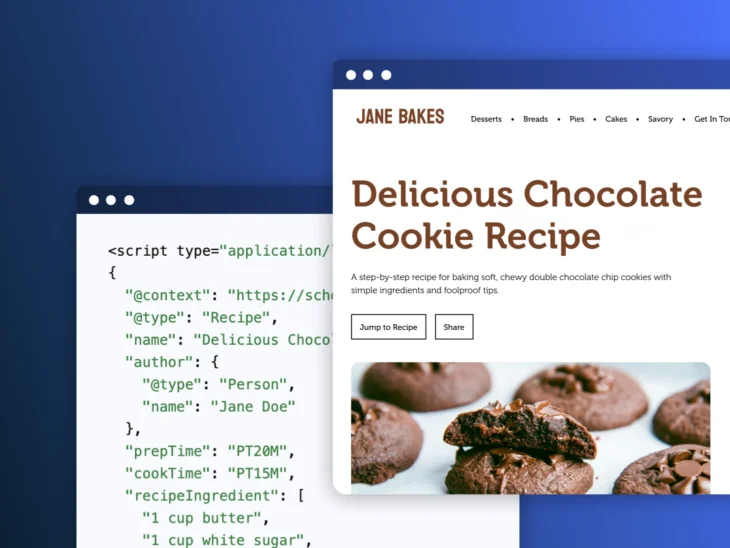
Entities could explain why ChatGPT keeps citing a competitor instead of your brand.
If you paste an article in the Google Natural Language API (the same technology Google uses to understand content), it will extract all the elements or “entities” based on its understanding.
Here’s what it extracted for a demo snippet:
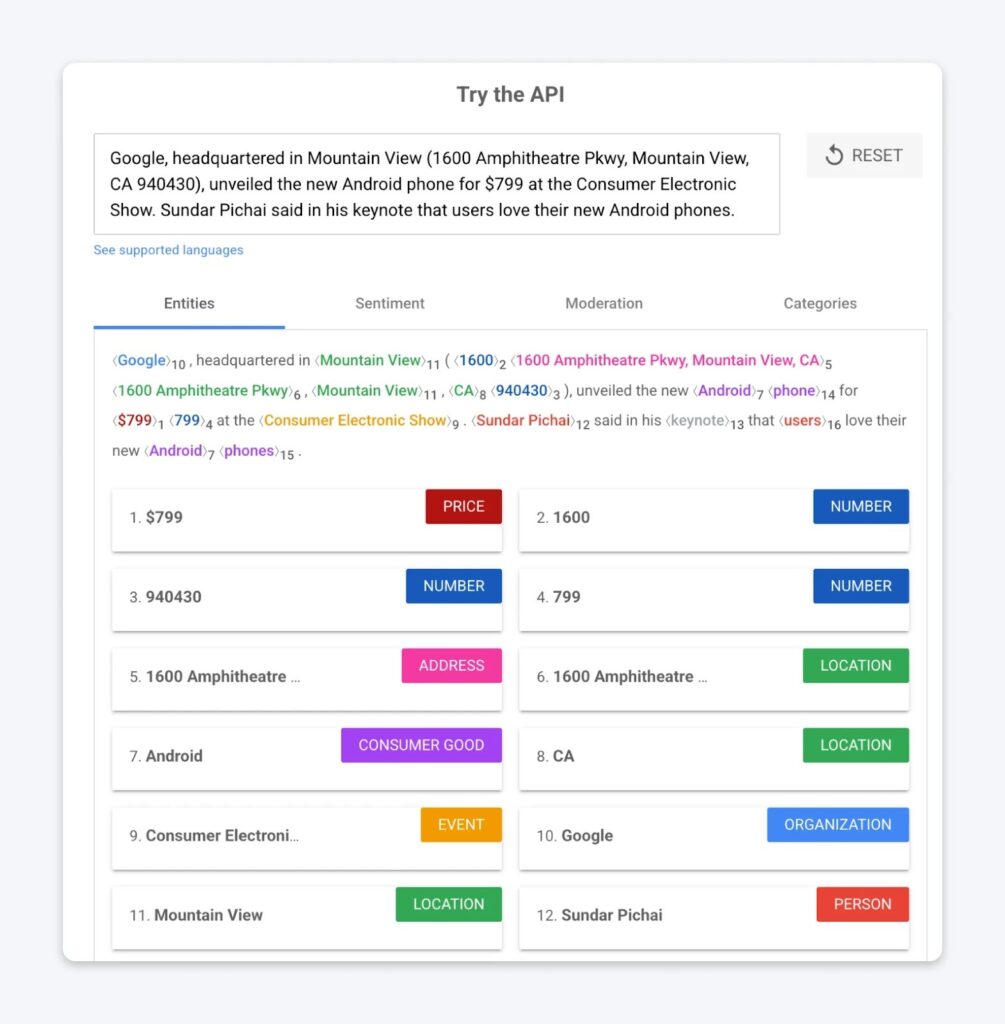
Try it with your blog and an outranking competitor’s blog. More likely than not, your competitor built a richer semantic network that AI interprets as “more comprehensive understanding of WordPress security.”
This is what’s happening behind the scenes every time AI decides which content to cite, and with AI-referred traffic up 527% year-over-year and 89.7% of ChatGPT citations going to recently updated pages, understanding this matters.
Here’s what you’ll learn:
- How search engines and AI systems use entities to understand content beyond keyword matching
- What entities are, and why they matter for both traditional search engine optimization (SEO) and AI-powered search
- How to extract and analyze entities from your web pages using practical tools
- Strategies for optimizing your content to improve entity recognition and salience
- How entities connect to schema markup and AI optimization
What Are Entities (and Why Should You Care)?
An entity is a distinct, uniquely identifiable concept: a person, place, organization, product, idea, or any “thing” that exists independently. Unlike keywords, which are just text strings, entities represent actual concepts that AI systems understand across different contexts.
The difference matters.
The keyword “apple” is just five letters. But “Apple” as an entity could refer to either the fruit or Apple Inc., the technology company. AI systems use contextual signals (surrounding words, metadata, schema markup, and external references) to distinguish between these two completely different entities.
What AI Sees on Your Page Right Now
The fastest way to understand entity extraction is to see it happen. Google’s Natural Language API reveals exactly how AI systems interpret your content.
Google’s Natural Language API (free method):
- Go to Google Cloud’s Natural Language API demo page.
- Paste in your article text.
- Click Analyze.
Here’s what you’ll see:
- Entity name: The actual concept identified (e.g., “WordPress,” “content management system”).
- Entity type: Classification, like Person, Organization, Consumer Good, Location, Event, or Concept.
- Sentiment: The emotional tone associated with this specific entity (positive, negative, or neutral based on how it’s discussed in the text).
- Salience score: A number between 0 and 1 showing how central this entity is to your content’s meaning. A score of 0.85 means this concept is fundamental to understanding your page. A score of 0.12 means it’s mentioned but peripheral.
- Wikipedia URL: When available, this shows Google connected your entity to its Knowledge Graph.
- Mentions: How many times and where the entity appears.
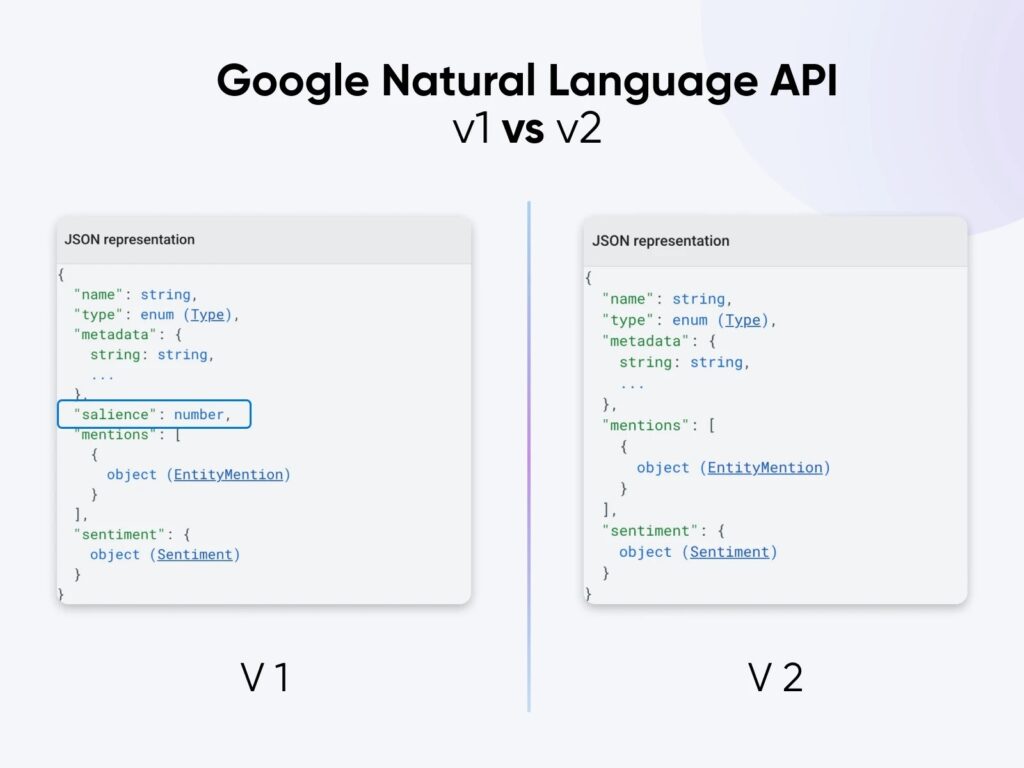
👉Note: Google’s Natural Language API v2 has removed the salience score from the API response. However, you can still see the salience score number in API v1.
What To Look For in Your SEO Entity Analysis Results
Run your highest-traffic article through the API right now. Here’s what to check:
- Do related entities make sense together? For WordPress security content, you’d expect to see entities like “security plugins,” “vulnerabilities,” “SSL certificates,” and “two-factor authentication.” If you’re seeing random, disconnected concepts, your content lacks semantic coherence.
- Are important concepts missing? Compare your entity list to competitor pages ranking well. Missing entities often reveal content gaps that weaken your authority.
- Do entities have Knowledge Graph connections? Entities with Wikipedia URLs are well-established in AI systems’ understanding. Novel entities or brand names might not have these connections yet, which is fine — but it helps to know.
- Is your primary topic the highest salience entity? If you wrote about “email marketing automation” but “marketing” scores higher than “email marketing automation,” you have a focus problem. AI doesn’t clearly understand your main topic.
👉Try this: Before reading further, analyze one of your pages and see what AI actually extracts. The rest of this guide will make more sense when you’re looking at your own entity profile.
How Is Entity Optimization Different From Traditional SEO?
Entity optimization focuses on semantic meaning and relationships rather than keyword density and exact-match phrases.
Traditional SEO asks “what keywords rank for this topic,” while entity-based SEO asks “what concepts does this topic involve, and how do they relate?”
Why Both Approaches Matter
Entity optimization doesn’t replace keyword research.
It enhances what SEOs have been doing for over a decade now. You still need to understand what terms people use to search for information. Instead of optimizing for exact keyword matches, you need to optimize for the concepts and ideas those keywords represent.
For instance, a piece targeting “WordPress security” should naturally include related ideas like “WordPress vulnerabilities,” “security plugins,” “brute force attacks,” “two-factor authentication,” and “SSL certificates.”
Mind you, these aren’t just LSI keywords we’d throw around the article (in fact, any relevance of LSI keywords has been dismissed many times over by John Muller).
Entities are ideas that paint the complete picture and cover the topic comprehensively.
How Do Search Engines Identify Entities in My Content?
Search engines use Natural language processing (NLP) to analyze your content and extract entities through a process called Named Entity Recognition (NER). These AI systems examine not just individual words but their context, relationships, and connections to known concepts in vast knowledge databases.
For instance, when you publish a blog post about email marketing for Shopify stores, here’s what happens behind the scenes.
- Text analysis: NLP breaks content into tokens (individual words and phrases), identifying nouns and linguistic markers that signal entities.
- Entity recognition: The system determines which terms represent distinct concepts. “Shopify” becomes a company entity, and “email marketing” becomes a concept entity.
- Entity classification: Each gets classified by type (Person, Organization, Location, Product, Event, Concept).
- Knowledge Graph matching: AI compares identified items against massive knowledge databases to connect your content to existing understanding of those concepts.
- Salience scoring: Each entity receives a score (0 to 1) indicating how central it is to your content’s main topic.
What Entity Extraction Means for Your Content
The entity extraction process reveals whether AI systems can clearly understand what your content is about.
If your page about WordPress security mentions “WordPress” only once at the beginning and then uses vague pronouns like “it” or “the platform” throughout, AI systems struggle to recognize WordPress as your primary topic with high salience.
On the other hand, if you naturally reference related items (“WordPress plugins,” “WordPress core updates,” “WP security best practices”), you’re building rich semantic context that helps AI systems understand both your main topic and how it connects to the broader ecosystem.
How To Fix Your Content for Better Entity Recognition
Now that you’ve seen what AI extracts from your pages, here’s how to improve those results.
Strengthen Your Primary Entity Signals
Your main topic should appear prominently throughout your content. If you’re writing about WordPress security, ensure your opening paragraph establishes both clearly:
“WordPress powers 43% of all websites, making it the world’s most popular content management system. This popularity also makes WordPress security a major concern for millions of site owners.”
This snippet identifies WordPress as a content management system (helping AI classify it correctly), connects it to the security concept, and provides context. When you continue discussing “WordPress security vulnerabilities” or “WordPress security plugins” later, AI systems understand these as related mentions, reinforcing your primary topic.
Along with the content, you need to use the primary subject in your title, opening paragraph, subheadings, and conclusion. Articles that mention “WordPress” twice and then switch to vague pronouns break the thread AI systems follow to understand focus.
✔️Quick check: Count how many times your primary entity appears in the first 200 words, in your subheadings, and in your conclusion. Fewer than five mentions across these zones means weak entity signals.
Build Your Entity Ecosystem
AI systems map relationships between concepts. So, content on a topic like “Shopify inventory management guide” becomes stronger when you discuss concepts such as SKU tracking, inventory forecasting, stock alerts, multi-location inventory, and inventory sync with sales channels.
This broad coverage demonstrates you understand how the ecosystem works.
When you discuss Shopify’s inventory features, you can mention how inventory data connects to fulfillment services, how stock levels trigger automated reorder points, and how inventory reports integrate with accounting software to further strengthen your authority. Each additional connection shows AI systems you understand how concepts interact.
🎯Action step: Choose a pillar article. List your primary entity, then map 10-15 related entities that should appear in comprehensive coverage. Search your article for each. Missing entities represent content gaps that weaken your semantic authority.
Increase Entity Salience Through Focus
Salience measures how central something is to your content. A salience score near 1.0 means that concept is essential to understanding your page. Front-loading important topics in your opening paragraph helps because AI systems weigh content positioning heavily.
You also have to focus on the topical measure. Introducing unrelated concepts can dilute your primary subject’s salience. A “WordPress performance optimization” article that digresses into theme design aesthetics introduces design-related topics that compete with performance ones for attention.
🎯Validation method: Run a key page through Google’s Natural Language API v1. Check the salience scores — if your intended primary entity isn’t scoring highest, you have a focus problem. Restructure to frontload your primary entity and reduce tangential sections.
Also, since salience score is deprecated from the Google Natural Language API v2, one of the community members suggested other features to measure the relevance of an entity.
Eliminate Entity Ambiguity
Ambiguous references create confusion. “Apple” could be the fruit or the technology company. “Python” might be a programming language or a snake.
Providing qualifying context on first mention helps: “Apple Inc. released new iPhone features” instead of just “Apple released new features.”
You can also link to authoritative sources like Forbes or official websites to reinforce classification, especially for lesser-known items or brand names without strong Knowledge Graph connections.
Schema markup takes this further by explicitly declaring what exists on your page with structured data AI can parse accurately.
How Do Entities Connect to Schema Markup and AI Optimization?
Schema markup provides explicit entity information that AI systems can read directly, bypassing the need to infer entities through natural language analysis. Think of it as the difference between having AI guess what your content means versus telling it exactly what entities exist and how they relate.
Regular HTML says “DreamHost offers managed WordPress hosting.”
AI has to analyze that sentence, identify “DreamHost” as likely a company, “WordPress” as a platform, and “managed hosting” as probably a product. There’s interpretation involved, which introduces uncertainty.
With schema markup you explicitly declare: DreamHost is an Organization entity with specific attributes (name, logo, founding date, social profiles). WordPress is a SoftwareApplication entity. Managed hosting is a Product entity with defined pricing, availability, and features.
The relationship between them gets structured as offering/provider connections.
GEO Benefits You Get With Schema
Schema automatically translates to a better generative engine optimization (GEO) for your website. It helps your site with:
- Higher citation confidence: AI platforms trust structured data over inferred information, making schema-equipped pages 3x more likely to be referenced.
- Knowledge Graph inclusion: Schema connects your content to Google’s Knowledge Graph, which feeds information into AI models.
- Cross-platform visibility: Your schema data appears across ChatGPT, Perplexity, Google AI Overviews, and Claude because all these systems prioritize structured information.
Key Schema Types for Entity Optimization
- Organization schema: Defines your business entity with name, logo, contact information, and social profiles.
- Person schema: Establishes people as entities with credentials, affiliations, and expertise areas.
- Product schema: Describes products with detailed attributes including price, availability, and reviews.
- Article schema: Marks up content with headline, author, date published, and article body.
- LocalBusiness schema: Includes address, hours, geographic coordinates, and service areas.
Each type helps AI systems understand not just what entities exist on your page, but how they relate to each other and to broader knowledge graphs.
Why Schema Matters for AI
Content with well-implemented schema gets cited more frequently by AI platforms because systems can confidently identify what the content discusses. When ChatGPT or Perplexity generates an answer, structured data provides definitive information that they can trust.
Schema also connects your content to Google’s Knowledge Graph, increasing your chances of appearing in Knowledge Panels. As AI systems become more sophisticated, they rely increasingly on structured data for extraction. Pages without schema force AI to guess. Pages with schema provide certainty.
What Role Do Entities Play in AI-Powered Search Results?
AI-powered search platforms like ChatGPT, Perplexity, Google AI Overviews, and Claude break down user queries into concepts and relationships, then search for content with strong coverage and clarity.
When someone asks ChatGPT “What’s the best email marketing tool for Shopify stores with a priority on deliverability?”, the AI system decomposes this query into multiple searches:
- Email marketing tools (product category)
- Shopify (platform)
- Email deliverability (attribute)
- Integration requirements (relationship)
The AI then searches for content that discusses these together, evaluating which sources provide the most comprehensive and authoritative coverage of these specific combinations.
Optimizing for AI Platform Visibility
To increase your chances of being cited:
- Cover concept ecosystems thoroughly by exploring attributes, related ideas, and ecosystem connections.
- Update content regularly when you have a new features launch, products update, or industry standards that can be shared.
- Create clear structures using headings like “How WordPress Plugins Improve Security” instead of “How These Tools Help.”
- Build authority across platforms by getting mentioned in Reddit discussions, YouTube videos, podcasts, and product reviews. Maintain consistency by using the same names across all content.
How To Optimize Content for Better Entity Recognition?
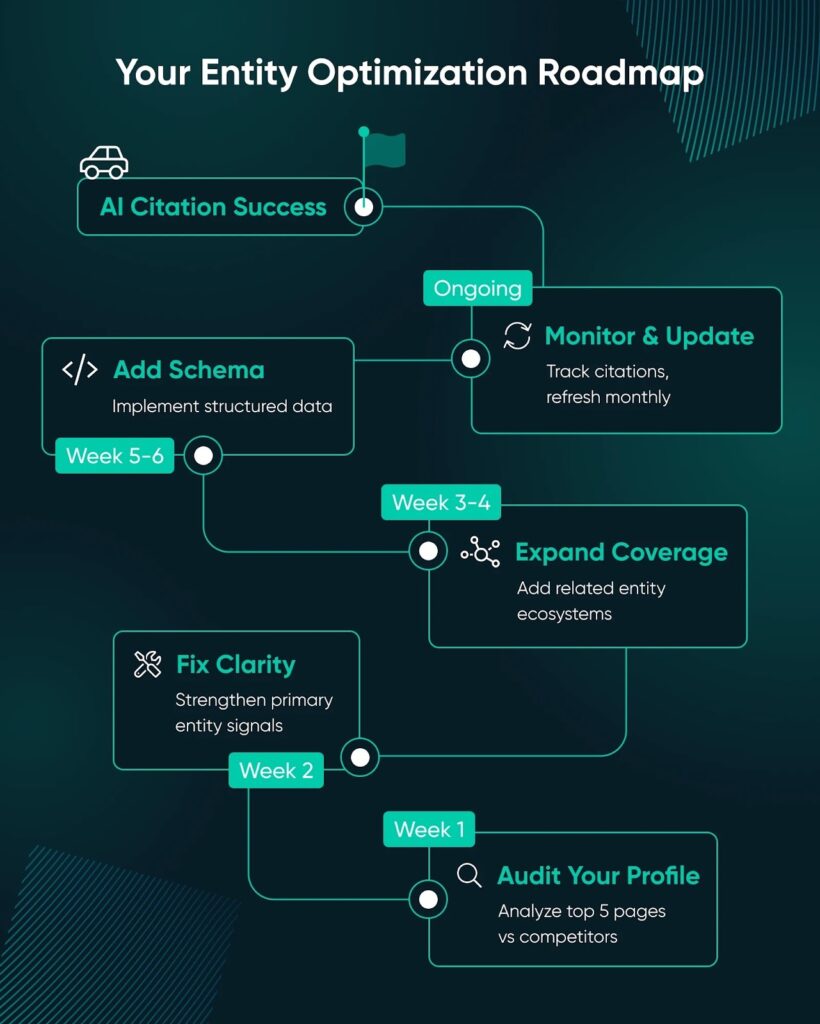
Entity optimization can become part of your SEO strategy as both of the tasks are interlinked.
Start with an audit of your most important pages, identify gaps in coverage, and systematically improve signals through content updates and schema implementation.
Week 1: Audit Your Entity Profile
Run your top 5-10 pages through Google’s Natural Language API.
You’re looking for three things:
- Whether your primary entity is actually being recognized as primary,
- What related concepts are missing compared to competitors; and
- Which pages have the biggest gap between what you think they’re about versus what AI thinks they’re about.
Week 2: Fix Entity Clarity
Don’t expand coverage yet. Fix clarity on pages where AI misunderstands your primary topic. This usually means strengthening your opening paragraph, adding your main entity to subheadings where you currently use pronouns, and cutting tangential sections that introduce competing concepts.
One well-focused page outperforms three unfocused ones in AI citations. Always.
Weeks 3-4: Expand Entity Coverage
Begin to expand entity coverage, but only on pages that already have strong primary entity recognition. Map the semantic ecosystem around your topic: what related concepts should comprehensive coverage include?
And add sections that naturally incorporate these missing entities and their relationships. A 1,500-word article with strong entity relationships beats a 3,000-word article with weak ones.
Weeks 5-6: Implement Schema
Schema markup amplifies the work you’ve already done.
- Start with Article schema (headline, author, publication date),
- Then add Organization or Person schema,
- Then Product schema if relevant; and finally,
- Validate everything with Google’s Rich Results Test.
But remember, schema without good content doesn’t help. Good content with schema is how you compound visibility.
Ongoing: Monitor Performance
Entity optimization is an ongoing project. Track Knowledge Panel appearances, monitor which pages AI platforms cite, and watch rich result impressions in Search Console.
When concepts in your industry change, like new features launch, standards shift, or terminology updates, your content needs to reflect that within 30 days.
Quick Wins You Can Implement Today
- Update title tags with clear subjects: “10 WordPress SEO Tips for Better Rankings” beats “10 Tips for Better Results.”
- Add definitions: When introducing important concepts, provide one-sentence definitions to establish context.
- Link to Wikipedia or glossary: For established topics, link to their Wikipedia pages to help AI confirm classification.
- Use descriptive file names: Use “wordpress-security-dashboard.jpg” instead of “screenshot1.jpg,” for example.
Entity-First Thinking Wins in AI-Powered Search
Search changed when AI started reading for comprehension instead of keyword matching.
ChatGPT, Perplexity, and Google AI Overviews aren’t looking for pages that repeat the right phrases. They want sources that actually understand the topic through rich entity relationships and semantic clarity.
What makes this change to entity-first work in your favor is that it rewards what readers already value: comprehensive coverage, clear focus, and authoritative depth.
You’re making your expertise readable to the systems that decide who gets cited and who gets ignored.
If you want to be one of the winners right now, treat entities as content architecture.
- Map concept ecosystems before writing.
- Build semantic connections through internal linking, and use schema markup to make their authority machine-readable.
- Above all, make sure you update content monthly because AI platforms clearly prefer fresh entity data over static keyword targets.
AI will get better with understanding context, deeper than what it is right now. The question is whether your content demonstrates the kind of comprehensive understanding that survives increasingly sophisticated analysis.
Start there.
Frequently Asked Questions (FAQs)
How are entities different from keywords?
Keywords are text strings people type. Entities are the concepts those keywords represent. “Apple” is a keyword, but “Apple Inc.” and “apple (fruit)” are distinct concepts. AI uses context to determine which concept a keyword references.
Do I need to abandon keyword research?
No. Keyword research shows what terms people type so you can identify the concepts that matter to your audience. But when optimizing content, optimize for the concepts those keywords represent, not just exact phrase matches.
Can entity optimization hurt my rankings?
When done properly, no. Maintain natural language while strengthening signals. And don’t remove keywords — only focus on providing better, more specific context.
What page to optimize first?
Focus on high-value pages first: homepage, key service pages, cornerstone content. Once those foundations are solid, expand systematically.

Unbeatable WordPress Hosting
Reliable, lightning-fast hosting solutions specifically optimized for WordPress.
See More