
Imagine you’re walking down the street and a billboard tells you, “It’s like milk, but made for humans.”
If you’re tapped into the alternative milk world at all, you’d probably immediately recognize that as Oatly’s brand voice. It goes far beyond the logo; it’s the irreverent, self-aware humor that shows up everywhere they communicate.
What is brand voice?
Brand voice is the distinct, consistent personality your brand expresses across every piece of communication: the word choices, rhythm, and attitude that make your writing recognizable. It isn’t your logo, your color palette, or your tagline, though all of those should support it.
And most of all, brand voice is definitely not something you find by copying a competitor or using vague, safe language.
If your voice feels impersonal or inconsistent, customers may not trust you. And if they can’t trust you, why would they engage with, or buy from, you?
For example, HubSpot’s social media team saw a huge boost in LinkedIn growth (an 84% rise) after updating their voice to “speak to the next generation of marketing or sales reps.”
Lookin’ for that kind of impact?
Keep reading.
How to create a brand voice in 7 steps
All you need now is clarity, a few hours, and a willingness to make decisions. Let’s get started.
1. Start With Who You Are, Not What You Sell
What does your business believe?
For example, Patagonia believes the planet matters more than profit. This belief is the engine of the brand voice.
Write down three to five values that are genuinely true of your business.
For example, if you run an accounting service for freelancers, your values might be clarity, speed, and maximizing savings without sacrificing quality.
2. Know Exactly Who You’re Talking To
Your brand voice is less about you and more about how you show up for your customer. And you can’t show up well for someone you don’t understand.
Create a simple profile of your ideal customer. Think beyond demographics. What do they worry about? What do they roll their eyes at? What makes them feel seen?
For more insights, look at the language your best customers use in reviews, DMs, and emails. The words they reach for are often the words your brand should be using, too.
When your voice mirrors the way your customer already thinks and speaks, communication feels effortless. For both of you.
3. Define Your Voice in Concrete Terms (Not Vague Adjectives)
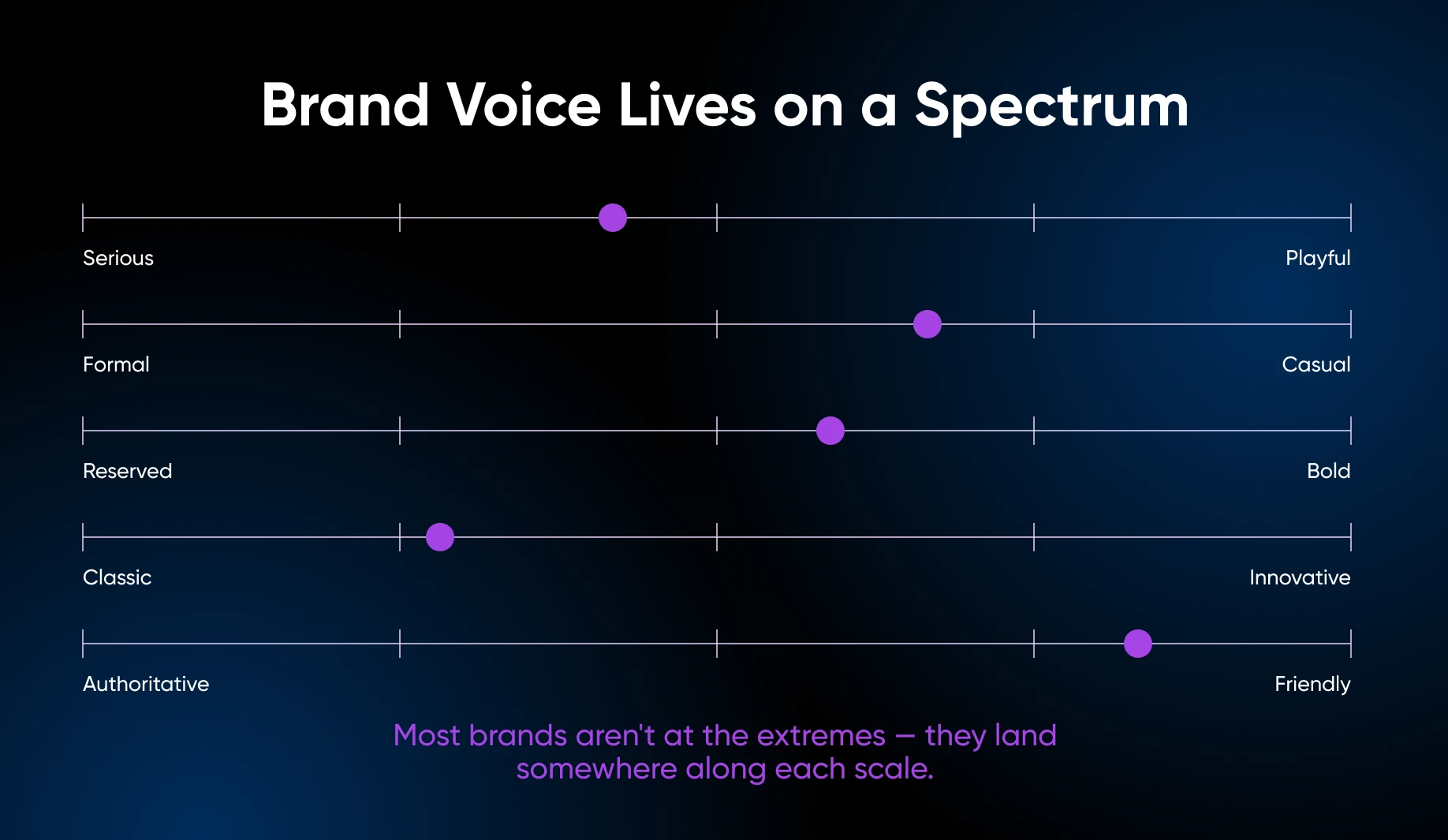
Define your voice through contrast. For every trait you claim, clarify what it means and what it doesn’t.
Here’s a simple framework:
- We are [warm], but not [sappy or over-the-top].
- We are [direct], but not [cold or blunt].
- We are [knowledgeable], but not [jargon-heavy or intimidating].
This “we are/but not” structure forces specificity and gives you something you can actually test your writing against. Three to four traits like this are plenty.
4. Do a Quick Audit of What You’ve Already Published
Before you build anything new, figure out what you’re already doing right.
Pull up your last ten social posts, your About page, and a recent email.
Read them out loud. Do they sound like the same person wrote them? Do they sound like you?
Sort your existing content by engagement (likes, comments, saves) and ask yourself what your voice was doing in the pieces that resonated most. That’s often where your real brand voice is already hiding.
5. Write It Down: Create a Simple Brand Voice Guide
This is the step most small business owners skip, and it’s the reason their voice drifts the moment they hire a VA or start using AI tools to help with content.
Thankfully, you don’t need a 40-page brand bible. You just need a one-to-two page document that includes:
- Your three to four voice traits (with the “we are/but not” contrast for each).
- A short paragraph describing your ideal customer.
- Five to ten words and phrases you love and use often.
- Five to ten words and phrases you actively avoid.
- Two or three examples of on-brand writing (could be your own, could be a brand you admire).
Keep it somewhere accessible. A Google Doc works perfectly.
Hiring help? This guide is also your briefing document. Hand it to every freelancer, VA, or agency on day one, along with two annotated examples: one that nails your voice, one that misses, and a line on why. Then review their first draft against your “we are/but not” traits before it goes live.
6. Make AI Sound Like You: Turn Your Voice Guide Into AI Guardrails
Here’s where that one-page guide earns its keep twice. The same document that briefs a freelancer also keeps AI writing tools from flattening your marketing into generic output.
Whichever tool you use, the process is the same:
- Paste the guide in as standing instructions. Your voice traits (with their “we are/but not” contrasts), your loved words, and your banned words go wherever your tool stores custom instructions, a system prompt, or a brand voice setting.
- Feed it a real writing sample. Give it 500 or more words of your own best copy, like a favorite email or your About page, so it picks up your rhythm and not just your rules.
- Spot-check every draft. Read the output against your “we are/but not” list before it ships. If a draft comes back warm but sappy, name the trait it broke and regenerate.
The guide does the heavy lifting; you stay the editor. That’s the difference between marketing that sounds like you and marketing that sounds like everyone else’s AI.
7. Apply It Everywhere, Consistently
Your brand voice lives in your email subject lines, your DM replies, your out-of-office messages, your product descriptions, and even your error messages.
When your website sounds like a law firm and your Instagram sounds like a group chat, customers notice — even if they can’t quite name what feels off.
Pick one new touchpoint each week to check. Rewrite your email footer. Update your Instagram bio. Revise the auto-reply on your inquiry form.
How to tell your brand voice is working
The same way HubSpot did: with a before-and-after.
Before you roll out the new voice, jot down a baseline: followers, likes, comments, saves, email replies — whatever numbers your platforms already give you. Check the same numbers again after 60 to 90 days. You’re looking for a trend, not an overnight spike.
Then, once a quarter, re-read a handful of recent posts and emails against your voice guide. If something could have been written by any business in your industry, that’s your cue to tighten up before the drift becomes permanent.
See It Live: Strong Brand Voices in Action
Sometimes the fastest way to understand a concept is to see it done well. Here are a few brands that have built unmistakable voices worth studying.
Fenity
Fenity is a women’s fashion brand that started as a dorm-room project and grew into a recognized online label.
The tagline “Nostalgic for the 90s, Designed for now” does a lot of work in very few words. It tells you exactly who this brand is for and what it believes about fashion.
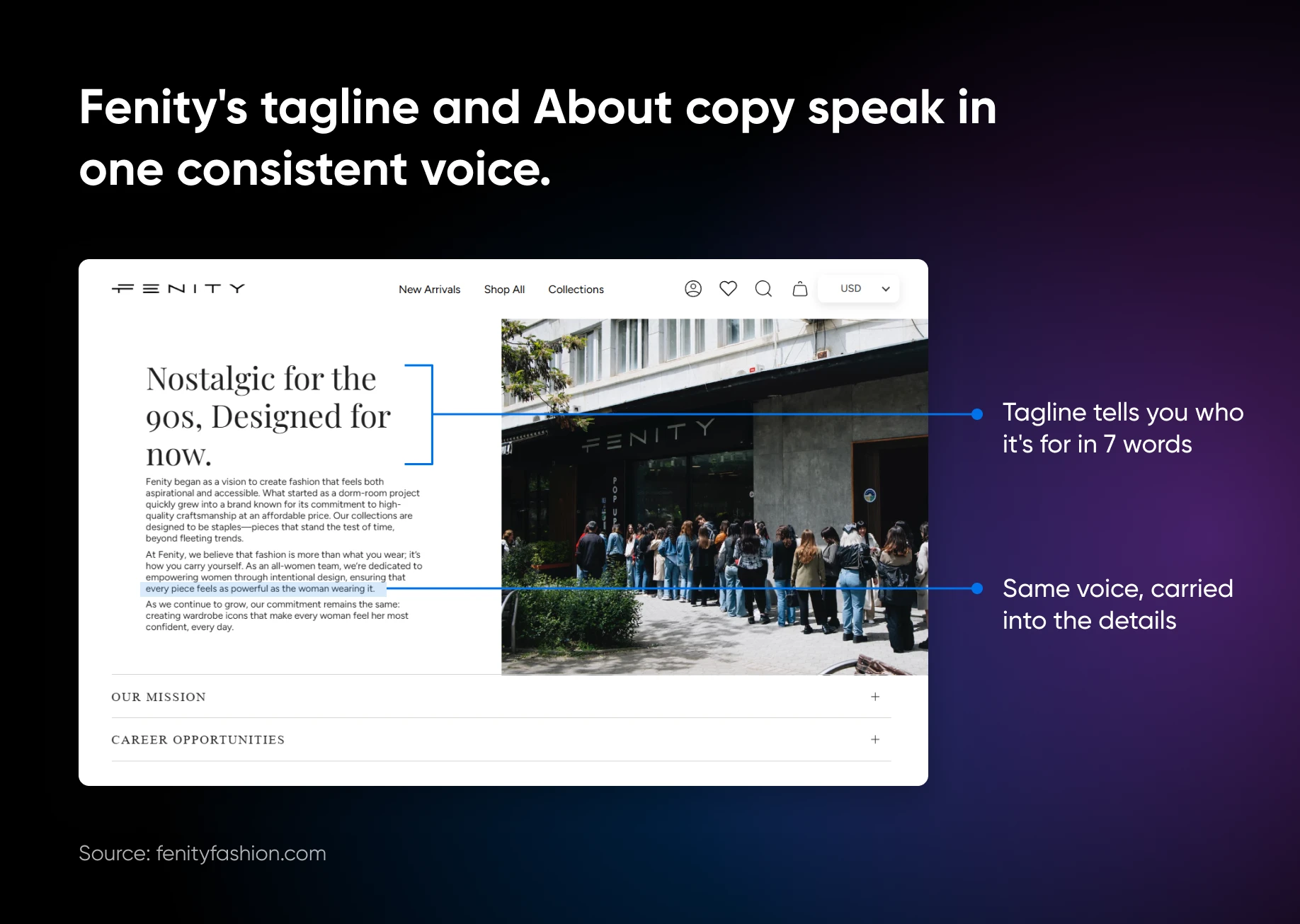
Their About page deepens it: “We believe in the beauty of duality, that everyone in this world has a place, a voice and a style… imperfections make you perfect.” That’s a specific worldview, expressed with warmth and intention.
Everything — the copy, the product naming, and beyond — speaks in one consistent voice.
Worm Return
Worm Return is a Pittsburgh-based composting service founded in 2018 by self-described lifelong environmentalist Laura Totin Codori. And their brand voice is a masterclass in making an unsexy topic feel genuinely inviting.
Their tagline, “Using food scraps to create landscape not landfills,” is punchy, purposeful, and instantly tells you what they stand for.
Their service copy doesn’t lecture or guilt-trip: “It’s even easier than taking out your garbage…”
Every word choice reinforces the same idea: This is good for the earth, and it can be joyful, not joyless.
Fly By Jing
Fly By Jing is a California-based Sichuan chili crisp brand founded by Jing Gao. Part of the engine behind its success? A highly personal brand voice no competitor could copy.
Gao kept her personal story front and center from day one: “It’s never just been about a hot sauce that you can put on anything,” she says. “It’s really about one person’s story and one person’s recipe that she developed in Sichuan.”
From the jar copy to the website to Gao’s own public presence, the voice never drops character, which is exactly what makes it impossible to imitate.
For a founder-led business, there’s an edge no competitor can copy: the story is the product.
Brand voice FAQs
How do I brief creators or a VA to match my brand voice?
Send your one-page voice guide plus two annotated examples: one on-brand, one off-brand, with a note on why. Then review their first draft against your “we are/but not” traits before it publishes. One round of specific feedback fixes most mismatches.
How do I make my marketing sound like me, not like generic AI?
Give AI the same guide you’d give a human writer: your traits, contrasts, and banned words as standing instructions, plus a 500-word sample of your own writing. Then edit every draft against your “we are/but not” list before anything ships.
What should a brand voice guide include?
Three to four voice traits with “we are/but not” contrasts, a short description of your ideal customer, 5 to 10 words you love, 5 to 10 you avoid, and two or three examples of on-brand writing. One to two pages is plenty.
What’s the difference between brand voice and tone?
Voice is your brand’s personality, and it doesn’t change. Tone is how that personality flexes with context: playful in a product launch, calm and direct in an apology. Same person, different moments.
Will You Find Your Voice?
Building a great voice for your small business doesn’t just strike like lightning, all at once.
There are levels to this art.
First you must get clear on what your business actually believes and understand exactly who you’re talking to.
From there, it’s time to start crafting.
Define your voice in concrete terms: Who are you — and who are you most definitely not?
Use that guidance to pursue perhaps the most important practice: Consistency!
Create a simple brand voice guide and use it to audit what you’ve already published and apply it everywhere moving forward. We’re talking your subject lines, your DMs, even your error messages.
Why?
The brands you recognize without seeing the logo got there by showing up the same way, every time, until you couldn’t mistake them for anyone else.

Your Brand Is Working Before You Say a Word
Half of all consumers have chosen one brand over another based on color alone, and one-third of brands saw substantial revenue growth thanks to consistent branding. This 40-page DIY playbook gives small business owners the strategy, voice, color palette, logo, typography, and style guide blueprint to build a pro-level brand with free tools, no designer required.
Get the eBook