
If every month ends with the same quiet dread…
Do I have enough to cover payroll?
What happened to the money from that big invoice from six weeks ago?
…You’re not struggling because you’re bad at business; you’re struggling because no one ever taught you how to manage and forecast your cash flow.
Cash flow management is tracking and planning the money moving in and out of your business. Cash flow forecasting is projecting that movement over the next 30, 60, or 90 days so you can spot a shortfall while there’s still time to fix it. Neither requires a finance degree, just a system you’ll actually keep up with.
Most of the advice out there is either too basic or written for seasoned finance pros. This guide is for the person actually running the numbers, not a finance textbook.
The basics of cash flow forecasting and management
Cash flow is simply the movement of money into and out of your business.
- Money in: Client payments, sales, deposits.
- Money out: Rent, payroll, software subscriptions, supplies, taxes.
Cash flow management means monitoring, analyzing, and planning around that movement so you’re never caught off guard.
Cash flow forecasting takes it a step further; it’s the practice of projecting what your inflows and outflows will look like over a defined future period, usually the next 30, 60, or 90 days.
Just like forecasting the weather, it may not be 100% right all of the time, but you should get caught out in the rain less.
Here’s what a simple cash flow forecast might look like for a boutique consulting firm:
| Week | Expected Income | Expected Expenses | Net Cash Flow |
| 1 | $4,200 (Client A invoice due) | $2,800 (payroll, software) | +$1,400 |
| 2 | $0 | $1,200 (contractor) | -$1,200 |
| 3 | $6,500 (Client B payment) | $3,100 (rent, utilities) | +$3,400 |
| 4 | $1,000 (retainer) | $900 (supplies) | +$100 |
Even this basic snapshot tells you something critical: Week 2 is lean. You can plan for it — defer a non-urgent purchase, make sure an invoice goes out a week earlier, or keep a buffer ready.
Understanding cash flow vs. profit
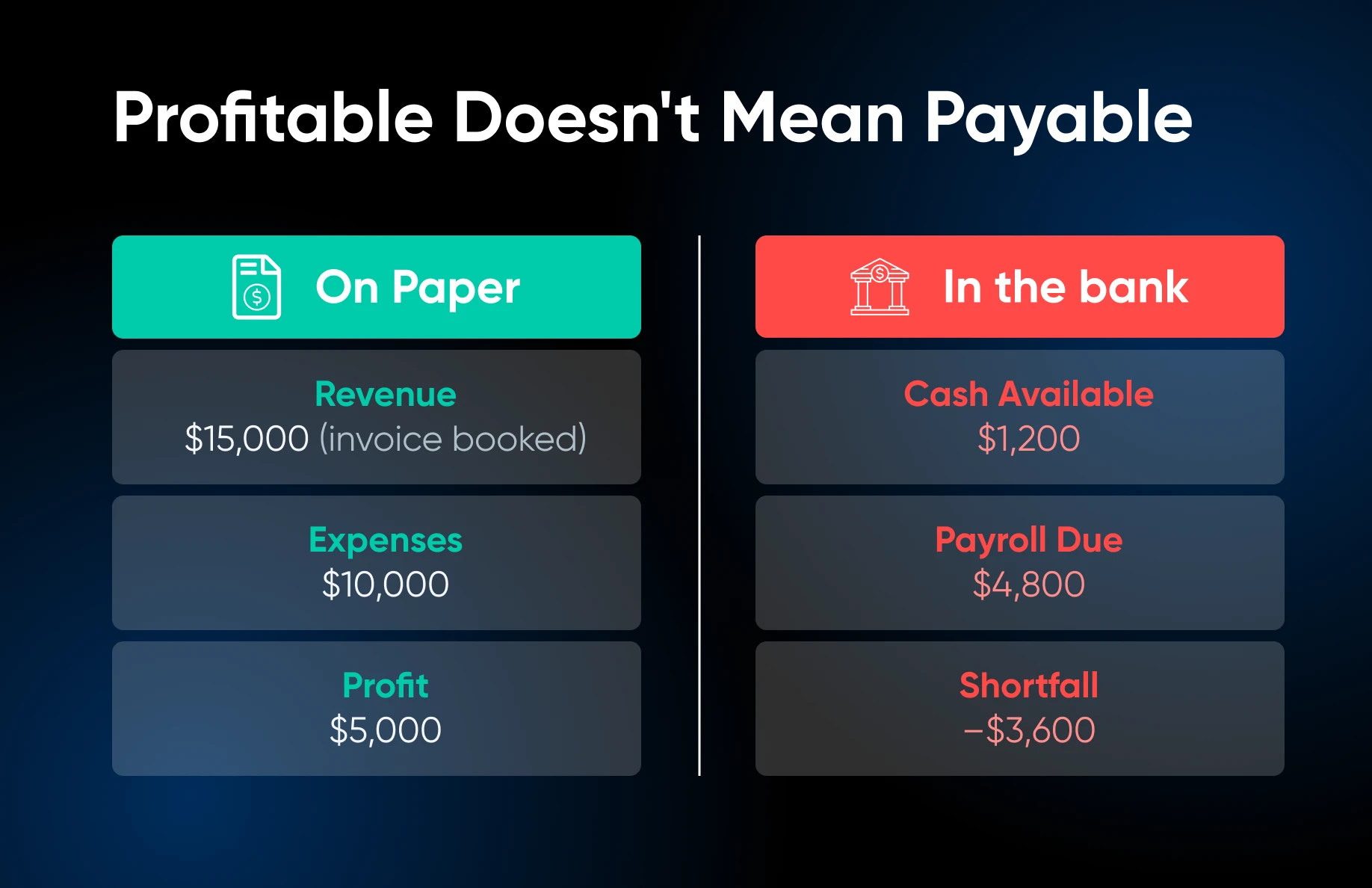
Profit is ultimately an accounting concept. It’s what remains after you subtract expenses from revenue. Your cash balance is what’s actually in your bank account right now. That balance determines whether you can make payroll, not just whether you’re technically profitable.
You can be profitable on paper and still be unable to make payroll due to lack of cash.
Under accrual accounting, a $15,000 invoice may count as revenue before the client pays it. But until that payment clears, it isn’t cash you can use. That’s not so great when payroll is coming up and your bank account is strapped.
This mismatch is exactly why so many otherwise healthy businesses run into trouble. You can see how staying solvent has a lot to do with managing and forecasting the actual flow of cash, not just totals.
6 steps to build a cash flow forecasting and management system (+ tool suggestions)
The best forecasting system is one you’ll stick with. Here’s how to build something practical.
Step 1: Set your baseline
Pull the last three months of bank statements and categorize your expenses:
- Fixed expenses are predictable; they include rent, subscriptions, loan payments, etc.
- Variable expenses are harder to anticipate; they typically refer to supplies, contractors, and advertising.
These become your expense estimates going forward.
Step 2: List expected cash in
Go through your open invoices and active client contracts. Note due dates and, be honest here, how reliably each client pays.
If Client A routinely pays 30 days late, plan for that…even though it’s a bummer.
Step 3: Construct a 90-day forecast
This is really the heart of effectively managing cash flow.
The goal is to get visibility into several months of projected money in, money out, and your running balance. You’re not going to be able to predict everything, but to continue the weather analogy, you should be better prepared for any storms.
Option A: Google Sheets (free, but heavily manual)
Create a row for each of the next three months, or get more granular and list out 12 weeks if your cash flow is more erratic.
Here are the columns you’re filling out for each month/week:
- Opening Balance: Your actual bank balance today goes in row 1. Every row after that pulls from the previous row’s Closing Balance automatically. Here’s the formula: =previous row’s Closing Balance.
- Expected Income: Enter every payment you realistically expect to receive in that period. Include confirmed client invoices, recurring retainer payments, and any other predictable revenue. Don’t include “maybes,” only money you have reasonable confidence in. If a client consistently pays two weeks late, enter it two weeks later than the due date.
- Expected Expenses: List every outgoing payment: rent, payroll, contractor fees, software subscriptions, loan payments, estimated taxes, and any known one-time costs. Fixed expenses are easy, they’re the same every month. For variable expenses, use your average from the last three months as the estimate.
- Closing Balance: This is just [Opening Balance + Expected Income – Expected Expenses.] In Sheets, that formula takes 5 seconds to write and auto-calculates the rest.
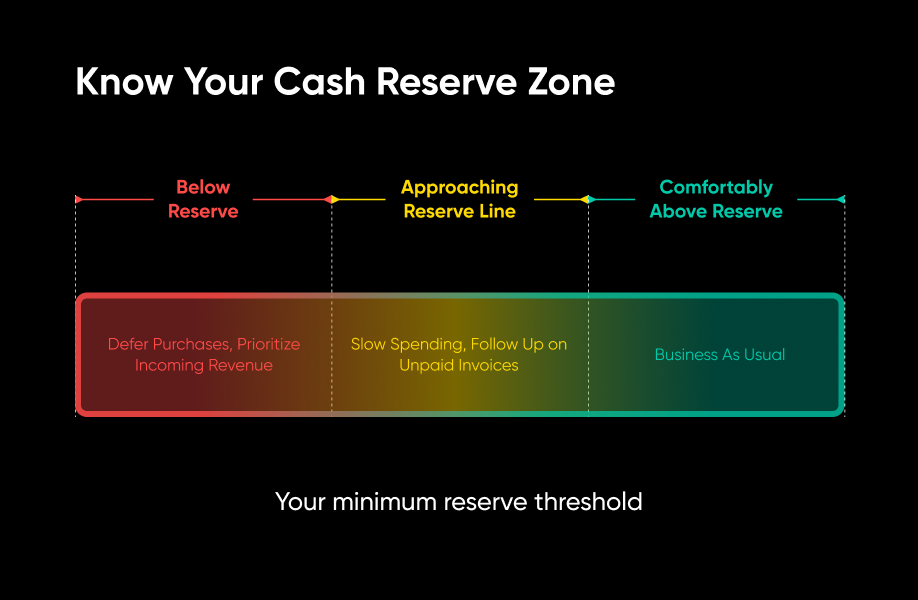
💡Pro tip: Color code your closing balance column; green if it’s comfortably above your reserve threshold, yellow if it’s getting close, red if it dips below. You now have a visual early-warning system.
Option B: Use accounting software (comes with fees, but more features)
If you’re already using QuickBooks Online, FreshBooks, or Wave, you may not need a separate spreadsheet at all.
QuickBooks Online has a built-in cash flow planner (under Reports → Financial planning) that uses your QuickBooks data and connected bank accounts to plan future cash flow. You add expected money-in and money-out items, including repeating ones, without touching your actual books, and you can set a threshold you never want your balance to fall below. Two caveats from Intuit’s own documentation: the planner isn’t available in QuickBooks Online Accountant, and it’s unavailable in any version with Multicurrency turned on.
FreshBooks has a dedicated Cash Flow report under Reports → Accounting Reports, showing your starting balance, gross cash in, gross cash out, and ending balance for the period; note that accounting reports are only available on its Plus, Premium, and Select plans. Wave’s reports compare your numbers month to month or year to year so you can spot cash flow trends, though automatic bank transaction imports require its paid Pro plan.
One honest distinction: QuickBooks Online’s planner projects forward. The FreshBooks and Wave reports described here show what already happened, which is exactly what you need for your baseline in step 1 and for checking your forecast against reality, but you’ll still sketch the projection yourself.
The advantage of these tools is that the numbers come from your actual books and connected accounts, so you’re not retyping figures every week. The tradeoff is less flexibility than a custom spreadsheet. If you’d rather not babysit formulas, that trade is worth it.
Step 4: Update your rolling forecast
“Rolling” means you’re always looking 90 days ahead, not at a fixed window.
Every Friday, or every Monday morning — pick one and stick to it, spend 15 minutes doing the following:
- Move your opening balance to your actual current bank balance.
- Mark any expected payments that came in or didn’t.
- Add the next week or month to the end so you’re always looking 90 days out.
- Note anything that changed, like a new contract signed, an expense that came in higher than expected, or a client who asked for extended terms.
Step 5: Set a minimum cash reserve threshold
Just like you have a safety net for your personal finances (right?!), you need one for your business, too.
Set a minimum cash reserve amount that you never want your business bank account to fall below. There isn’t one reserve target that fits every small business; choose yours based on operating expenses, payment timing, and how predictable your revenue is.
For context: in a 2024 survey by Ocrolus and OnDeck, 70% of small businesses said they had less than four months of cash available to cover operating costs.
Treat this reserve as untouchable except for true emergencies.
Having a clear threshold gives you an early warning system before cash flow problems become serious. If your balance starts getting too close to that number, it’s a sign to slow spending, follow up on unpaid invoices, delay nonessential purchases, or focus on bringing in revenue faster.
Step 6: Automate where you can
Set up recurring invoices for retainer clients, automatic payment reminders, and automated expense categorization.
Every manual step you eliminate is one fewer thing that falls through the cracks. And an invoice can’t get paid before it’s sent, so recurring invoices that go out on schedule put cash in motion without you having to remember a thing.
What makes forecasting and management critical, especially for you
In Ocrolus’s February 2024 analysis of small business lending applications, small businesses’ revenue-to-expenses ratio hovered near 1:1.
Margins?
Damn near invisible.
So it’s no surprise that, in the survey published alongside that data, 71% of small businesses said they were concerned they wouldn’t have enough cash flow to cover expenses.
It’s high time small businesses build up their cash flow confidence.
In our opinion, it’s one of the best ways to reduce stress and make room for growth. When you know exactly what’s coming in and going out, you can make big decisions around hiring, buying equipment, marketing spend, and so on without the anxiety that comes from flying blind.
Despite the doom and gloom the stats may suggest, hopes are still high. In that same survey, 92% of small business owners said they expected moderate or significant growth in the next year.
The optimism is there.
The big gap?
Infrastructure; that is, the systems and habits that turn ambition into real revenue.
A credible website is part of that infrastructure. In DreamHost’s 2026 Local Business Trust Index, a November 2025 survey of 1,201 U.S. consumers, 69% said a website is essential for a local business to be credible, and 60% said an outdated-looking website hurts their perception of a business’s quality or trustworthiness.
Every DreamHost web hosting plan includes a free Handcrafted Starter Website: a 4-page WordPress site set up by a real person, that you fully own, with no builder lock-in.
Cash flow forecasting and management FAQs
What is the formula for a cash flow forecast?
Closing balance = opening balance + expected cash in − expected cash out. Run that calculation for each week or month, carry each period’s closing balance forward as the next period’s opening balance, and you have a rolling forecast. Everything else, from software to color coding, is packaging around that one formula.
What is the difference between cash flow management and cash flow forecasting?
Cash flow management is the ongoing habit: tracking money in and out, chasing invoices, and timing payments. Cash flow forecasting is one tool inside that habit: projecting the next 30 to 90 days so you make decisions before problems arrive instead of during them. You can manage cash without forecasting, but you’ll always be reacting.
How far ahead should a small business forecast cash flow?
A rolling 90-day forecast is a practical starting point for a small business. It’s far enough out to see a lean month coming while you can still act, and near enough that your estimates stay grounded in real invoices and known bills. The further out you project, the more you’re guessing, so keep the detailed forecast short and roll it forward weekly.
How do I forecast cash flow from outstanding invoices?
List every open invoice with its amount and due date, then shift each date to when that client actually pays. If a client reliably pays 30 days late, forecast the cash 30 days after the due date, not on it. Enter those adjusted amounts as expected income in the week you genuinely expect the money to land, and leave out any invoice you’re not confident will be paid.
How much cash should a small business keep in reserve?
Choose a reserve threshold based on your operating expenses, payment timing, and how predictable your revenue is. Set the number, mark it in your forecast, and treat dipping below it as an alarm: slow spending, chase unpaid invoices, and delay nonessential purchases until you’re back above the line.
How’s the forecast looking?
Just like the weather, cash flow gets a whole lot less unpredictable the moment you can see what’s coming.
That’s the whole point of financial forecasting. It’s not a perfect prediction, but it provides enough visibility to spot the lean weeks early and plan around them.
The path is straightforward. First, set your baseline from the last three months, list your expected income honestly, and build a 90-day forecast in whatever tool you’ll actually stick with (a free, flexible spreadsheet or accounting software that pulls from your books are both solid options).
From there, keep the financial management rolling with a 15-minute weekly check-in, set a minimum cash reserve you treat as untouchable, and automate the repetitive pieces so fewer things slip through the cracks.
Most small business owners see growth on the horizon. A financial forecasting and management system helps you turn that hope into an actionable plan.

Stop Chasing Invoices. Automate Your Business Finances.
A free playbook for small businesses: automate expense tracking, payments, cash flow forecasting, and tax prep from one connected system.
Get the Free eBook