
Breaking up is painful. But we’ve all been living in a one-sided relationship for too long.
“Dear Google/Microsoft/Adobe/every other cloud-based service provider,
It’s not you, it’s me. Actually, no…it’s definitely you.
You’ve been reading my emails, tracking my location, and selling my psychological profile to the highest bidder.
That’s not a relationship; that’s a subscription service masquerading as friendship.
We’re done. I’m leaving you for an open-source, self-hosted app that respects my privacy.”
Feels good, right?
If you’re keen to split with your cloud services and protect your privacy, this guide is essential reading. We’ll explain:
- The pros and cons of self-hosted apps
- How to make the switch
- Which open source apps are worth your time
Sound good? Let’s do it!
Cloud Services Are Great (Except for All the Ways They’re Not)
Cloud apps are amazing. By storing data on remote servers, they can deliver content to any device in seconds — movies, songs, emails, passwords, files, and so on.
It’s super convenient. That’s why we all use these apps…but there’s a problem.
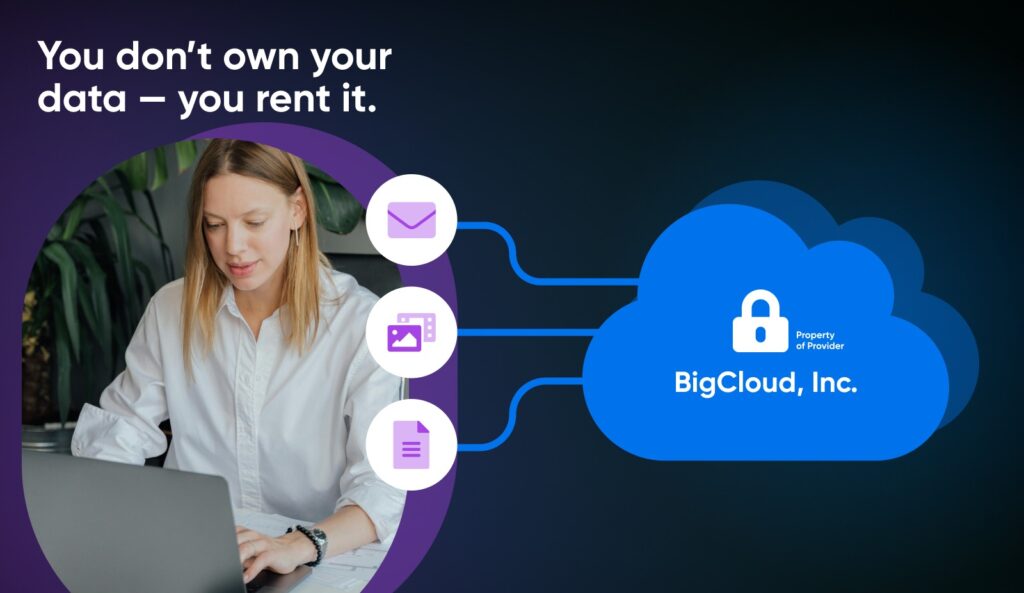
When you live on someone else’s property, you have to live by their rules. That subscription you pay each month is your rent, and the service provider is your landlord.
You don’t own anything; not even data that feels like it should be private.
We know what you’re thinking: “Well, what’s the alternative then?”
Why You Should Consider Self-Hosting Open-Source Apps
The vast majority of well-known apps have an open-source equivalent. These alternatives are generally free for personal use, and you can host them yourself.
No more renting — You own the whole property. Your house, your rules.
In real world terms, that means you regain full control of your data and you’re no longer relying on a corporation to “do the right thing.”
The benefits don’t stop there, either.
What Are the Pros and Cons of Self-Hosted Services?
There are actually many reasons to choose the open source, self-hosted route; and a few reasons why you might prefer sticking with the cloud.
Here’s a quick summary.
Pros:
- True data ownership: You don’t have to sign away your human rights just to check your emails.
- Better portability: Most open source apps allow you to export your data and move to another platform.
- Privacy first: You’re not handing over personal information to a corporation and hoping they won’t sell your data to the highest bidder (they will).
- Stronger customization: Because many open-source apps start as passion projects, they often come with more customization options.
- Cost control: The price of hosting rarely changes much, and you only have to buy hardware once. Compare that with Microsoft 365 subscriptions, which rocketed 30% in 2025.
Cons:
- You’re the janitor: You’re responsible for all maintenance, updates, and troubleshooting.
- You’re also the security guard: You’ll need to keep the digital doors locked (and know how to) if you want to avoid being hacked.
- The user experience might be less polished: To attract subscribers, services need to provide something pretty and easy to use. Open-source developers don’t.
TL;DR: Self-hosting comes with a whole heap of benefits. You’re just responsible for making it work — and you might need to compromise on aesthetics.
The Best Self-Hosted Alternatives to Popular Apps
This all sounds great…but is there really a good open source alternative to your favorite apps and subscriptions? Almost certainly.
Here’s a look at the best alternatives to popular cloud services, sorted into helpful categories for you.
The Best Self-Hosted Communication Apps
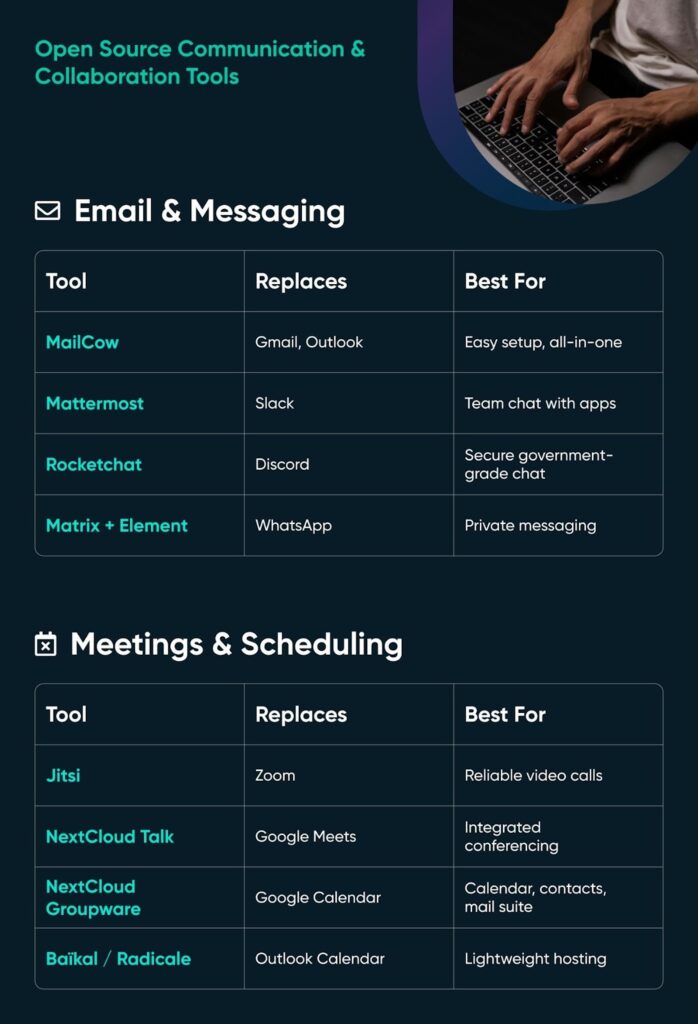
Need to stay in touch with your coworkers or gossip with your bestie? Here are the best open-source tools for the job:
Open-Source Email
Popular cloud services: Outlook, Gmail, Yahoo Mail
Top open source alternatives:
1. MailCow: This powerful email server platform offers mail, contacts, and calendars. It’s pretty easy to set up, and the SOGo webmail interface is slick.
2. iRedMail/Poste.io: Both of these email server solutions offer the same kind of features as MailCow. They just require a bit more setup, and they’re not as pretty.
💡My tip: Managing your own email server is quite technical. As an alternative, you could try switching to your webhost’s email service. This won’t be open source, but you’ll have more control and avoid the big tech data snatchers.
Open Source Team Chat
Popular cloud services: Microsoft Teams, Slack, Discord, WhatsApp.
Top open source alternatives:
3. Mattermost: This is basically a clone of Slack, except it runs on your own server. Mattermost runs in browsers, and there are even native desktop and mobile apps.
4. RocketChat: As used by U.S. government departments, this open-source chat platform feels more like Discord, and is known for being really secure.
5. Matrix + Element: Matrix is an open-source framework for online chats. If you set it up on your own hosting, you can use a compatible client like Element (which is very user-friendly) to chat with your crew. And it ends up feeling just like WhatsApp.
Open-Source Video Conferencing
Popular cloud services: Zoom, Google Meets, Microsoft Teams.
Top open source alternatives:
6. Jitsi: Probably the leading standalone platform for open-source video and audio. Nothing flashy, but it’s pretty reliable and has all the standard features you would expect.
7. Nextcloud Talk: Part of a larger open source productivity suite, Nextcloud Talk is an impressive video and audio conferencing platform. The user experience feels like Google Meets.
Open-Source Calendar and Contacts
Popular cloud services: Google Calendar, Outlook Calendar.
Top open source alternatives:
8. Nextcloud Groupware: Another part of the open source productivity suite. Along with contacts and calendars, this platform can handle mail.
9. Baïkal/Radicale: At the other end of the scale, these lightweight tools allow you to host your own calendars and contacts. They use open-source protocols, so you can access your data using a variety of mobile and desktop clients.
The Best Self-Hosted Collaboration Tools
Besides staying in touch, you probably use other apps to collaborate with your coworkers and manage your projects. Here are some open source gems you can try:
Open Source Docs and Collaboration
Popular cloud services: Google Docs, Microsoft Office, Zoho Office.
Top open source alternatives:
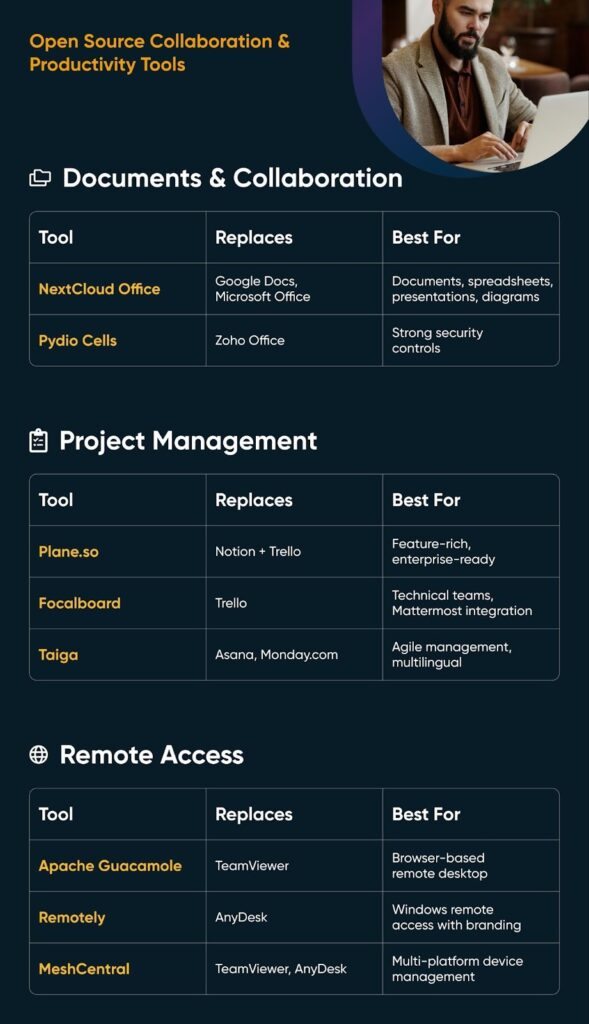
10. Nextcloud Office: Yep, another entry. Powered by LibreOffice, this part of the suite lets you collaborate on documents, spreadsheets, presentations, and even diagrams.
11. Pydio Cells: It’s not the most visually alluring app on this list, but Pydio Cells offers strong collaboration features and impressive security controls.
Open Source Project Management
Popular cloud services: Asana, Trello, Monday.com.
Top open source alternatives:
12. Plane.so: If you smashed together Notion and Trello, you’d get something like Plane. Used by giants such as Sony and Accenture, this project management app is clean, capable, and packed with features.
13. Focalboard: Although this Trello lookalike is aimed at technical teams, it can work for any department. We often see it integrated with Mattermost for a slick open-source workflow.
14. Taiga: If you’re fully invested in agile management, this might be your best option. Taiga looks good, offers plenty of customization options, and it works perfectly in 20 languages.
💡My tip: The smoothest experience I’ve had is with Plane.so — it really feels like a premium product.
Open Source Remote Access
Popular cloud services: TeamViewer, AnyDesk.
Top open source alternatives:
15. Apache Guacamole: Not a tasty dip, but a clientless remote desktop gateway that supports all the standard protocols. You can access it through any web browser.
16. Remotely: For remote access and scripting from Windows machines. You can even add your own branding to the admin area.
17. MeshCentral: It looks like something out of Windows 97, but this remote device management tool is solid as a rock, and it works with pretty much any platform.
The Best Self-Hosted Storage Apps
Moving your files to self-hosting is one of the easiest ways to break away from subscription services. Here are the best open-source tools for organizing your data:
Open Source Cloud Storage
Popular cloud services: Google Drive, Box, OneDrive.
Top open source alternatives:
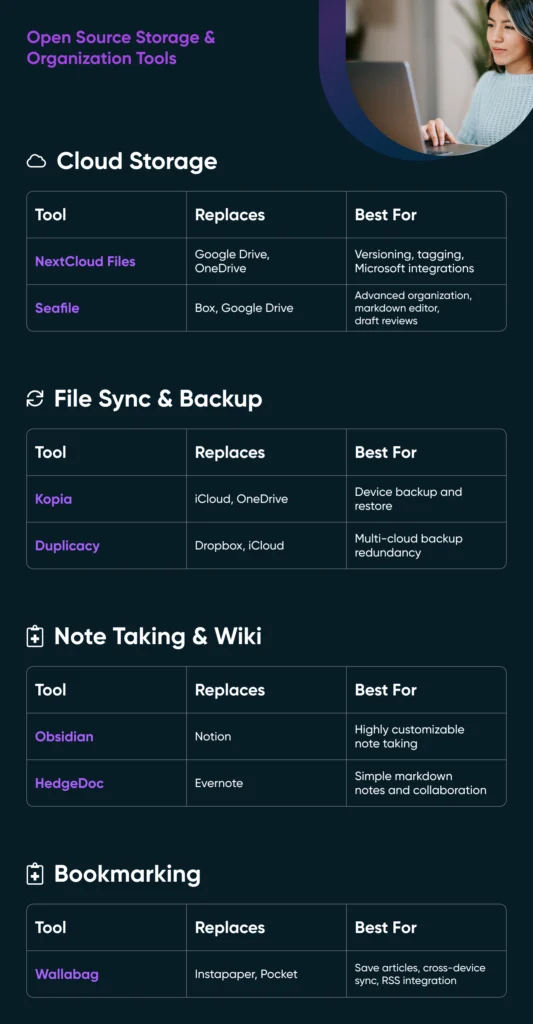
18. Nextcloud Files: NextCloud Files feels like any other subscription file service, with versioning, tagging, and strong Microsoft integrations.
19. Seafile: This open-source file system gives you many ways to organize your data. It also comes with some sweet extras, like a built-in markdown editor and a draft review workflow.
💡My tip: If you’re mainly using cloud storage for documents, you could use Pydio Cells here as well.
Open Source File Sync & Backup
Popular cloud services: iCloud, OneDrive, Dropbox.
Top open source alternatives:
20. Kopia: Made for backing up and restoring key files on your devices. It has both a regular user interface, and a command line version.
21. Duplicacy: This app backs up files from your device to multiple cloud storage locations. If one provider ever fails, you should still have another.
Open Source Note Taking & Wiki
Popular cloud services: Notion, Evernote.
Top open source alternatives:
22. Standard Notes: This app was made to be a one-source-solution to all notetaking needs. Plus, it’s available for every platform you can think of.
23. HedgeDoc: If you’re happy to keep things simple, HedgeDoc offers a slick markdown notetaking experience. You can even build slides and collaborate with friends and family.
Honorable Mention: Obsidian – Think Notion, but a version you can customize however you want. A tinkerer’s paradise for notetaking. While Obsidian itself is closed-source, it uses plain text files, and all plug-ins are required to be open source.
💡My tip: There are so many great apps in this category, so make sure to explore your options. Highlights include Joplin and Obsidian.
Open Source Bookmarking
Popular cloud services: Instapaper, Raindrop.io. (Pocket, long the category leader, was shut down by Mozilla in 2025 — one more reason to own your bookmarks.)
Top open source alternative:
24. Wallabag: Mainly made for saving articles, this app works on pretty much every device, and plays nicely with RSS readers, too.
The Best Self-Hosted Dev Tools
Whether you’re building the next unicorn SaaS or just trying to automate a few basic tasks, there’s no need to give up your data. Here are the best open source dev tools:
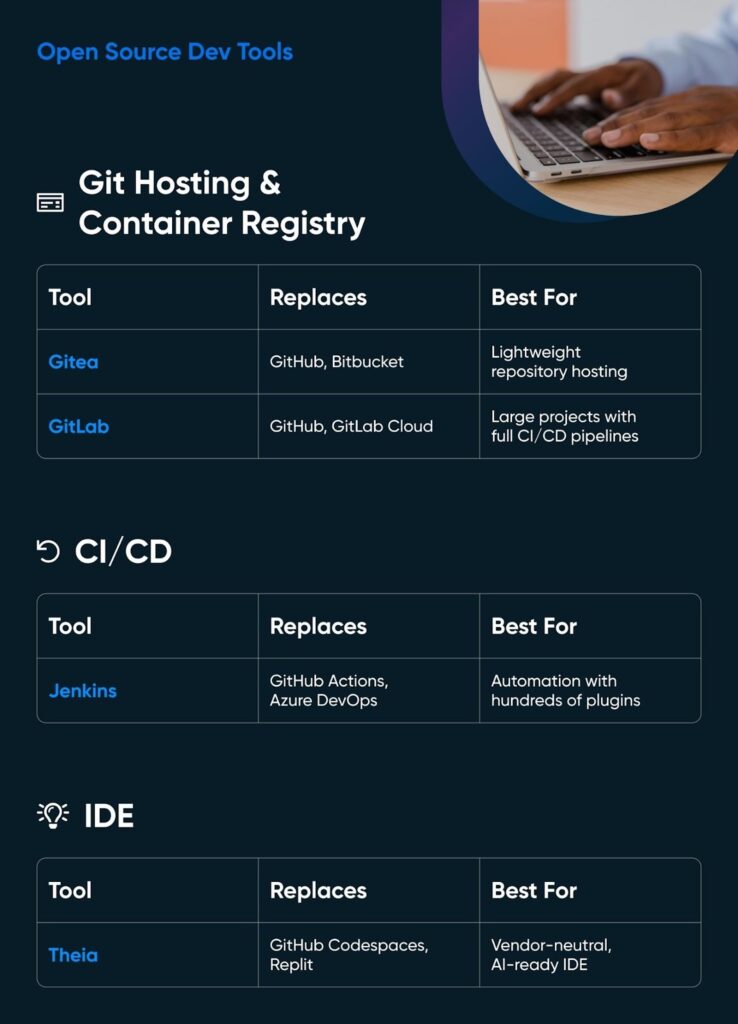
Open Source Git Hosting and Container Registry
Popular cloud services: GitHub, GitLab (Cloud), Bitbucket.
Top open source alternatives:
25. Gitea: If you just need a simple way to host repositories with Git, this lightweight solution should do the trick.
26. GitLab: The better solution for bigger, more ambitious projects. Debian and DreamHost are actually self-hosted on GitLab.
Open Source CI/CD
Popular cloud services: GitHub Actions, Azure DevOps.
Top open source alternative:
27. Jenkins: An automation classic. This impressive tool is fairly easy to install, and there are hundreds of plugins for everything from UI tweaks to build management.
💡My tip: Gitea and GitLab also have full CI/CD pipelines, so you could do everything through these tools.
Open Source IDE
Popular cloud services: GitHub Codespaces, Replit
Top open source alternative:
28. Theia: Available in both desktop and self-hosted flavors, this impressive IDE is vendor-neutral and equipped for every major programming language. It’s also made for AI — a bonus if you’re hoping to do some vibe coding!
The Best Self-Hosted Marketing Tools
Marketing is generally about meeting your customers wherever they hang out. Wouldn’t it be difficult to avoid the big platforms? Yes and no.
Using the well-known tools is probably more convenient, but there are some solid self-hosted alternatives:
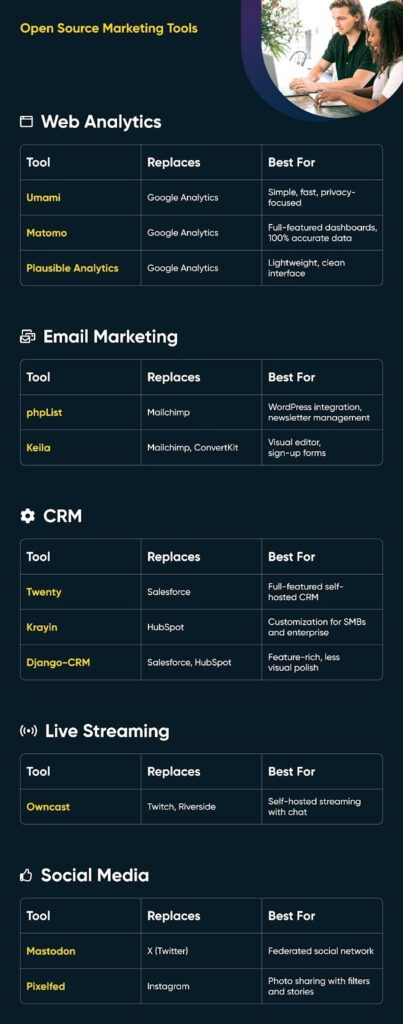
Open Source Web Analytics
Popular cloud service: Google Analytics 4 (GA4).
Top open source alternatives:
29. Umami: The official tagline of this app says it all. “A simple, fast, privacy-focused alternative to Google Analytics.”
30. Matomo: This GA alternative feels more like the real thing, with handsome dashboards and a commitment to 100% accurate data (no sampling).
31. Plausible Analytics: Lightweight GA alternative like Umami, but a little more stripped back and easy on the eye.
Open Source Email Marketing
Popular cloud services: Mailchimp, ConvertKit.
Top open source alternatives:
32. phpList: Okay, this is hella ugly, but this open-source email newsletter tool gets the job done. It also integrates well with WordPress and other CMS platforms.
33. Keila: This one feels more like Mailchimp. You can create emails in a visual editor or with Markdown, and there’s a tool for building pretty sign-up forms.
Open Source CRM
Popular cloud services: HubSpot, Salesforce.
Top open source alternatives:
34. Twenty: Billed as “The #1 Open Source CRM,” this is the closest thing you’ll find to self-hosted Salesforce. Expect tasks, notes, multiple views, email sync, and automated workflows.
35. Krayin: This bold, colorful CRM delivers impressive customization and solid CRM features. It’s aimed at both SMBs and enterprise users.
36. Django-CRM: If you’re willing to trade visual polish for features, this open source CRM has a lot to offer.
Open Source Live Streaming
Popular cloud services: Twitch, Riverside.
Top open source alternative:
37. Owncast: Essentially the self-hosted cousin of Twitch, complete with live chat and your own profile page of historic streams. A genuinely impressive alternative.
Open Source Social
Popular cloud services: Facebook, Instagram, LinkedIn, X
Top open source alternatives:
38. Mastodon: This social platform is “federated,” meaning it’s not owned by any single entity. It feels like X, but you host your own network and invite people to join.
39. Pixelfed: Your very own Instagram lookalike. It has most of the same features, and the interface is strikingly similar. It even has filters and stories.
💡My tip: While many federated social networks exist, none has the same reach as mainstream social media platforms. But if you have a niche community, projects like Mastodon and Diaspora are worth exploring.
The Best Self-Hosted Apps for Security
There’s no data more precious than your online logins, so you might as well go open source with your cybersecurity. Here are your best options:
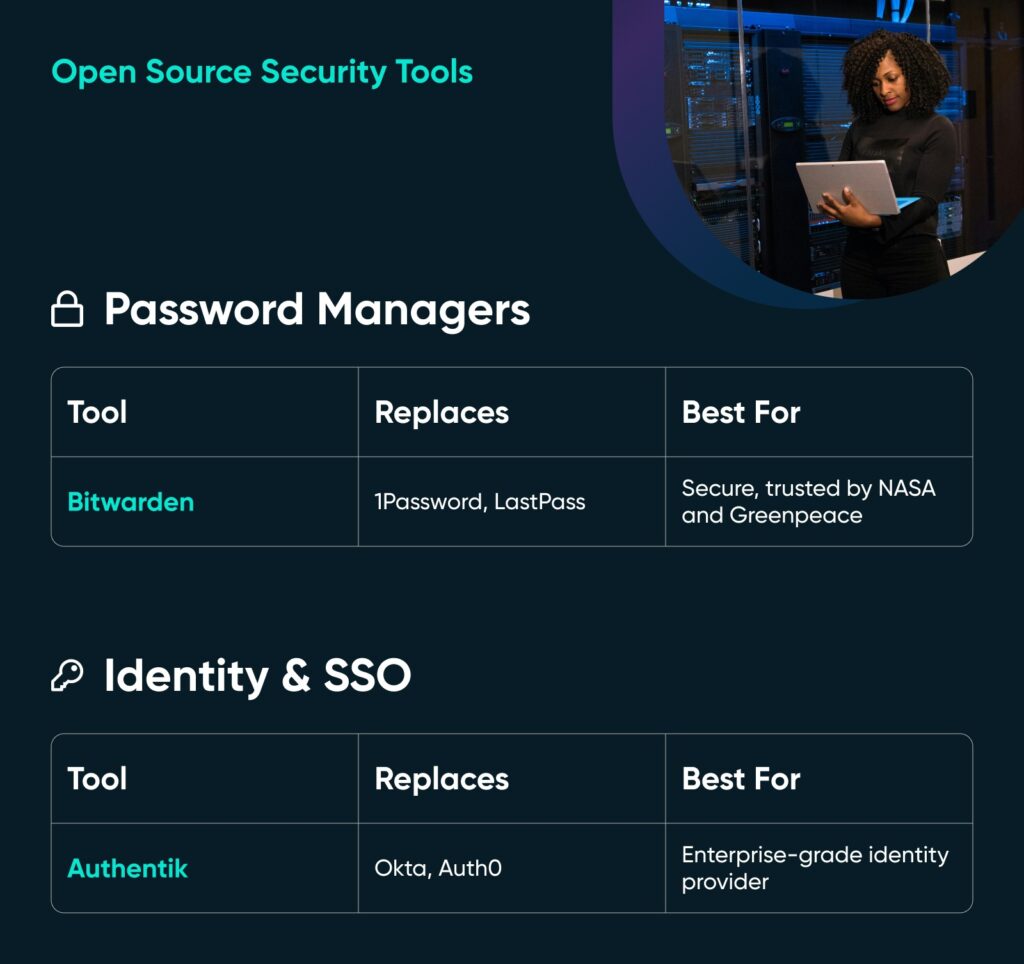
Open Source Password Managers
Popular cloud services: 1Password, LastPass.
Top open source alternative:
40. Bitwarden: The standout choice. Very secure, easy to use, and trusted by tons of big organizations like NASA and Greenpeace.
Open Source Identity & SSO
Popular cloud services: Okta, Auth0
Top open source alternative:
41. Authentik: This identity provider has features to match any commercial service. It’s used by the folks at Cloudflare, no less! I run it at home in front of all my services.
The Best Self-Hosted Website Builders
You really don’t need a cloud subscription to build your own website. There are too many open-source CMS platforms to list here, but we’ll quickly mention the standouts:
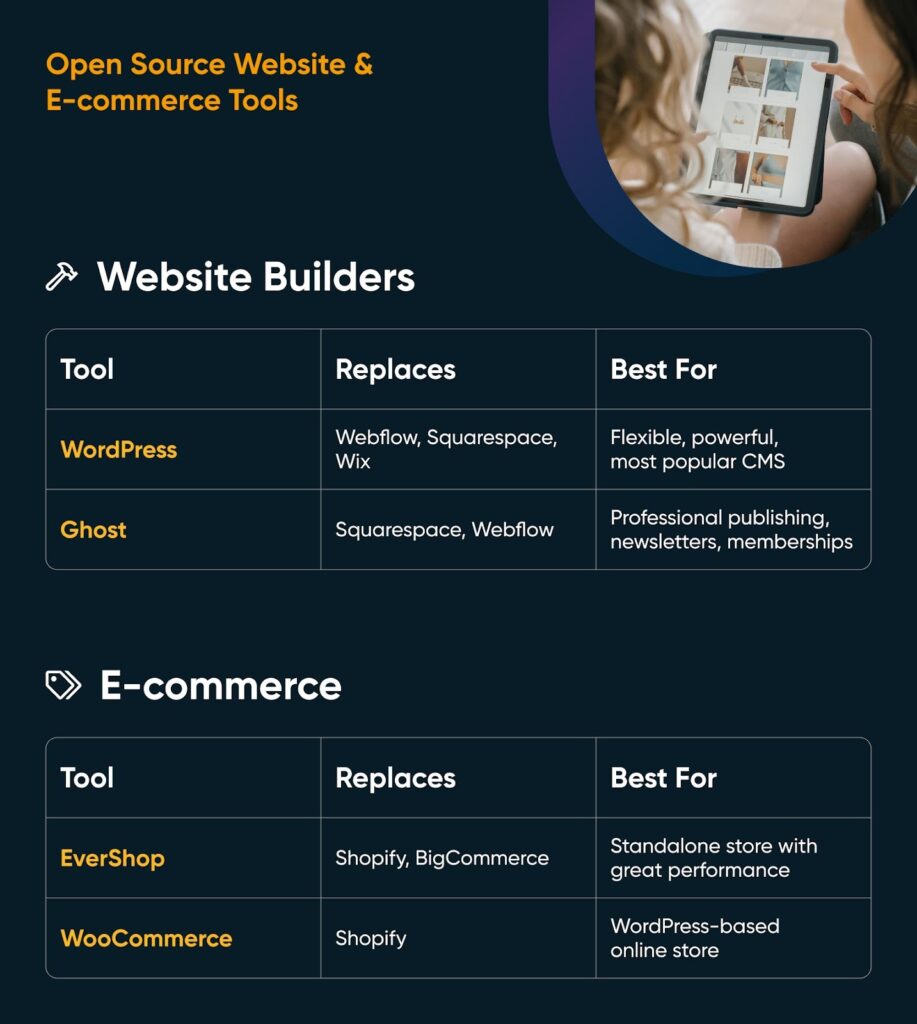
Open Source Website Builders
Popular cloud services: Webflow, Squarespace, Wix.
Top open source alternatives:
42. WordPress: I mean, duh. The world’s most popular CMS is open source, easy to use, powerful, and incredibly flexible. If you self-host with DreamHost, we’ll even configure the platform and maintain it for you.
43. Ghost: Made for professional publishers, Ghost offers a modern, content-focused experience. It also has great audience-building features, like a newsletter tool and memberships. You can even run Ghost on DreamHost VPS plans.
Open Source E-commerce
Popular cloud services: Shopify, BigCommerce.
Top open source alternative:
44. EverShop: This standalone e-commerce system has a great interface, loads of customization options, and integrations galore. Built on NodeJS, it also delivers great performance.
💡My tip: Don’t forget you can use WooCommerce to set up a shop on WordPress. Both are open source!
The Best Self-Hosted AI and Productivity Tools
Here are our top productivity picks:
Open Source AI/LLMs
Popular cloud services: ChatGPT, Claude, Gemini.
Top open source alternatives:
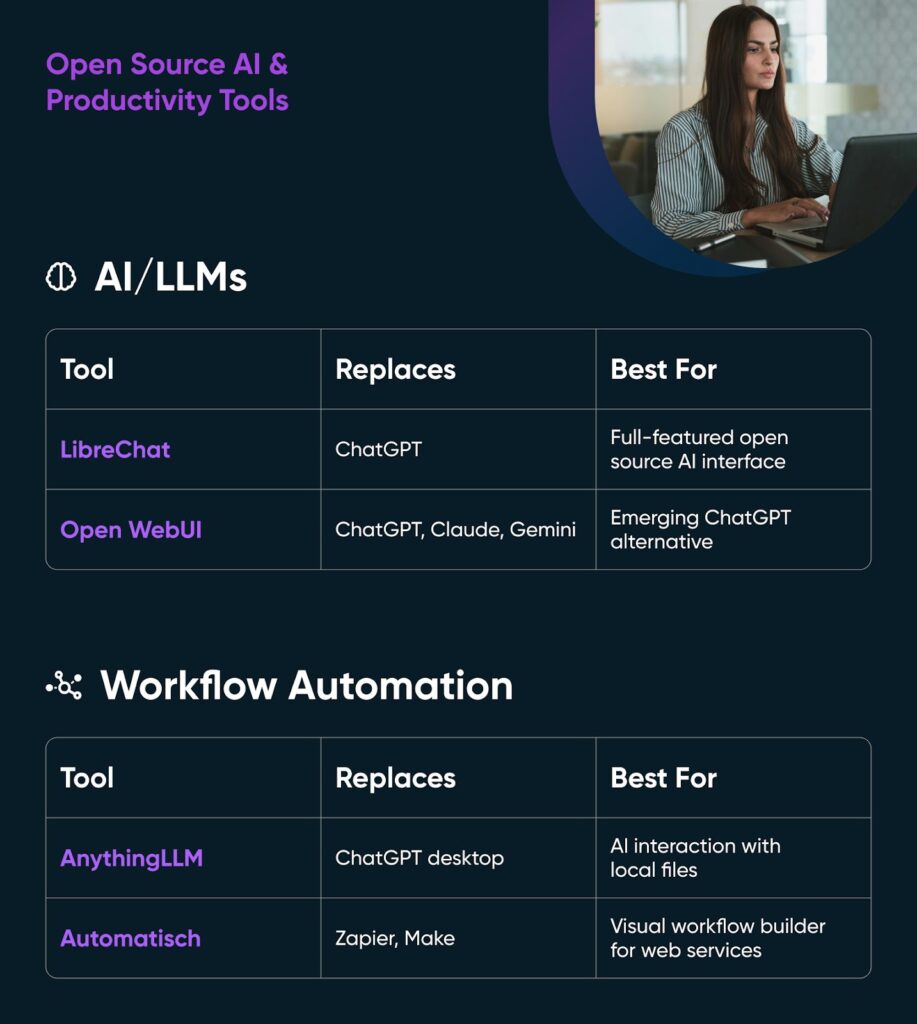
45. LibreChat: Think ChatGPT, but totally open source. The interface feels very familiar, and you get the same array of tools; from agents and code interpreters to artifacts and conversation search.
46. Open WebUI: More of the same, but not quite as polished or well-established as LibreChat. One to watch, though.
47. AnythingLLM: This desktop tool lets you chat with AI about the files on your own computer. It’s not even difficult to use; there’s a one-click installer.
💡My tip: You’ll notice we haven’t mentioned specific open-source AI models here. That’s because the apps above give you access to these models in a user-friendly interface.
Open Source Workflow Automation
Popular cloud services: Zapier, Make.
Top open source alternatives:
48. Automatisch: A like-for-like replacement for Zapier. Lets you connect your web services, and build workflows through a visual interface.
💡My tip: Feeling extra nerdy? You can automate loads of cool stuff around your house using Home Assistant and Node-RED.
The Best Self-Hosted Entertainment Apps
Enough with the serious business. It’s time for the fun stuff. Here are the self-hosted apps that will keep you and your family entertained:
Open Source Video Streaming
Popular cloud services: Netflix, Hulu.
Top open source alternatives:
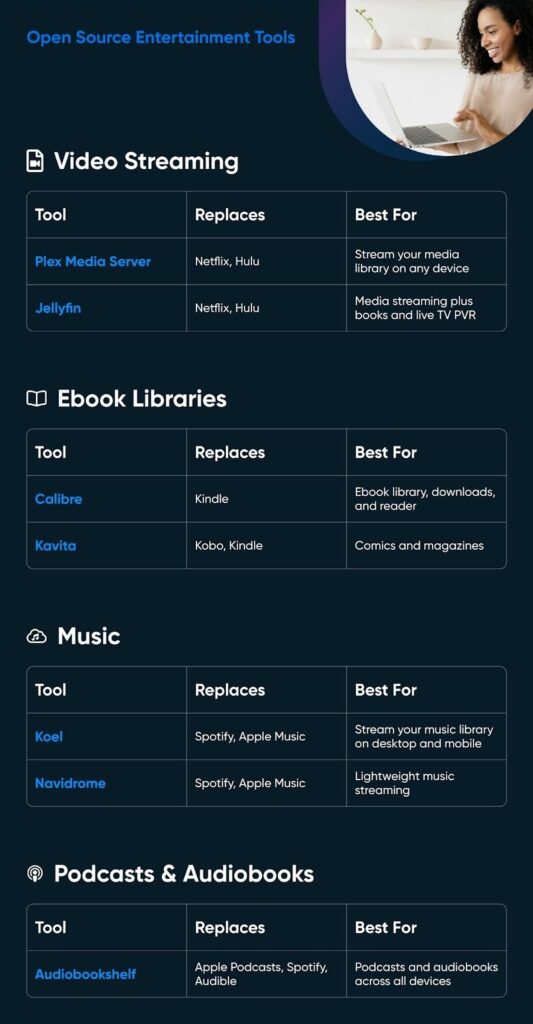
49. Jellyfin: Not the prettiest open source option, but certainly the most true to the mission. The upside is that Jellyfin can also handle books, and work as a PVR for live TV.
Honorable mention: Plex Media Server: Already have a library of TV shows and movies? Plex allows you to stream them on demand, on pretty much any device. We love Plex here at DreamHost.
Open Source Ebook Libraries
Popular cloud services: Kindle, Kobo.
Top open source alternatives:
50. Calibre: An ebook library, download manager, and reader in one. This app has been around for yonks, but it’s still solid.
51. Kavita: Built for comics and magazines, this server-based reading app is fast and beautiful.
Open Source Music Apps
Popular cloud services: Spotify, Apple Music.
Top open source alternatives:
52. Koel: This is basically Spotify for the music you own. Once you set up your library, you can stream (and organize) your songs on desktop and mobile.
53. Navidrome: Performs the same role, but a little more DIY. That said, it doesn’t use many resources, which should keep your hosting bills low.
💡My tip: These are both cool, but Plex is still the king of media management.
Open Source Podcasts and Audiobooks
Popular cloud services: Apple Podcasts, Spotify, Audible.
Top open source alternative:
54. Audiobookshelf: Works like any other podcast app you’ve ever used. It can handle both podcast feeds and audiobook downloads, delivering the goods to all devices through a nice PWA.
💡My tip: Didn’t find what you need in this list? Awesome-Selfhosted provides a comprehensive list of all the apps you can run yourself.
The Great Escape: How To Migrate to Open Source
With so many great tools to choose from, it’s easy to get excited about self-hosting. The question is, how do you actually make the move? Here’s a step-by-step walkthrough:
Step 1: Plan Your Digital Exodus
Before taking action, it’s worth looking at your current setup and the task that lies ahead.
Which cloud services do you currently rely on? These are the apps you might want to replace. Some will be easier to substitute than others.
Next, consider your skill level. How much do you know about hosting? While it’s possible to learn everything you need to know, it will add time to the project.
You should also think about the cost. Here are some realistic numbers:
- Home server: About $300–$3,000 to buy the hardware, and $20–$40 per month in electricity.
- VPS server: Ongoing subscription at $10–$100 per month.
- Managed hosting: Varies based on usage, but could be $5–$100 per month.
Finally, consider whether you’re really willing to put in the time and effort to escape the cloud. Self-hosting is not the easiest route.
Step 2: Choose Your Targets
If you’re all in, the next step is to choose which apps to replace first. Here’s a matrix to make the choice a little easier:
| Quadrant | Priority | Urgency | Examples |
|---|---|---|---|
| High Impact, Low Pain | START HERE FIRST | Immediate | Calendar, Contacts, Bookmarks, RSS Reader |
| High Impact, Medium Pain | PHASE 1 | Weeks 1–4 | Email, File Storage |
| High Impact, High Pain | PHASE 2 | Weeks 5–12 | Video Conferencing, Project Management, Live Streaming |
| Medium Impact, Low Pain | PHASE 2 | Weeks 5–8 | Note-Taking, Password Manager, Team Chat |
| Medium Impact, Medium Pain | PHASE 3 | Weeks 9–16 | CRM, Web Analytics, Document Collaboration |
| Medium Impact, High Pain | PHASE 4+ | Months 4–6+ | E-Commerce, Advanced Automation, Custom Integrations |
| Low Impact, Low Pain | ANYTIME | Flexible | Entertainment (Jellyfin, Music, Podcasts), Bookmarking |
| Low Impact, Medium Pain | WHENEVER | Flexible | Specialized dev tools, custom workflows |
| Low Impact, High Pain | AVOID OR DEFER | Last | Nada |
Step 3: Build Your Perfect Loadout
The final step is to choose where your self-hosted apps are going to live. Your options are:
- Home server: Running apps from a dedicated, always-on computer in your home. Gives you total control, but you’ll probably need expensive hardware and your apps will only work while the computer is running and connected.
- VPS: Renting a virtual machine on a server owned by a host. Obviously, this means giving up some control over infrastructure. But the setup price is much lower, and you can easily upgrade as you add more apps. Also requires way less technical input.
- Managed hosting: Platforms like AWS, Google Cloud, and Heroku. Calls for very little input once you’re set up, but you’re sacrificing control. Also quite costly in the long term.
Once you’ve chosen your hosting solution, we would recommend setting up one app at a time and making sure it’s working smoothly before moving on to the next.
Make sure to document the process. Future you will be thankful when something breaks.
Bonus Tip: When running more than one application, it’s useful to have the One Application To Rule Them All. This is where Docker Compose comes into play. If you find yourself concerned with just the amount of applications you’re trying to navigate, check out Docker and get those apps contained!
And once you’re up and running, don’t skip maintenance:
- Set up regular automated backups.
- Install updates when they become available.
- Use monitoring features to keep an eye on your apps.
Don’t worry if it doesn’t go perfectly to start with. It’s all part of the self-hosting experience! Just take your time, read the documentation, and ask your web host for help if you really get stuck.
Frequently Asked Questions About Self-Hosted Apps
Do I need to be technical to self-host?
No, but expect a learning curve. Start with one service (email or files). YouTube tutorials and communities are your friends. If you can follow instructions, you can do this. Learning basic Docker commands will get you a long way.
Won’t self-hosting be more expensive than SaaS?
Initially, yes. But SaaS costs compound over time. In contrast, your self-hosting setup will stay pretty stable. It might even go down.
What if my server breaks? Will I lose all my data?
Only if you skip backups (which you won’t, right?), automated backups are non-negotiable. Test restores monthly. Have a 24-hour recovery plan. While more costly. you can grow your resilience factor by using distributed storage or RAID to tolerate hardware failures.
Can I run open-source apps on a Raspberry Pi?
Yes, for many services. Email, files, calendar, notes work okay on Pi. Demanding services (video streaming, AI models) need more horsepower. Start small; upgrade if needed.
Do I need a dedicated IP address?
For email, absolutely (reputation matters). For other services, no. Dynamic DNS can work for non-critical services.
How much bandwidth do I need for a home server?
Home ISP upload speeds are the constraint. 5Mbps upload is fine for email, files, and calendar. Video streaming and streaming live require 25Mbps+.
Is self-hosting secure?
More secure than Big Tech if configured properly. Less secure if you ignore updates, skip backups, or expose services unnecessarily. Security is a discipline, not a feature.
What If I want to stop self-hosting?
Your data is yours. Export it (email as IMAP backups, files as SFTP downloads, calendars as ICS files). Migration back to SaaS is possible, but it might be slow.
Can I start small and scale later?
Absolutely. That’s actually what we recommend. Start with one service, learn how to look after it, add the next service — continue until satisfaction.
Do I need to understand Linux?
It’s helpful but not essential. Many services have GUI installers. You’ll touch the command line eventually, but not necessarily on day one.