
You’ve almost certainly heard of generative AI. This subset of machine learning has become one of the most-used buzzwords in tech circles – and beyond.
Generative AI is everywhere right now. But what exactly is it? How does it work? How can we use it to make our lives (and jobs) easier?
As we enter a new era of artificial intelligence, generative AI is only going to become more and more common. If you need an explainer to cover all the basics, you’re in the right place. Read on to learn all about generative AI, from its humble beginnings in the 1960s to today – and its future, including all the questions about what may come next.
What is Generative AI?
Generative AI is a branch of machine learning (itself a subset of artificial intelligence) that creates new content — text, images, audio, video, and code — by learning patterns from large training datasets. It learns from huge amounts of data to build flexible, general-purpose models that can be adapted to many tasks, from answering questions to writing software.
Why is Everyone Talking About Generative AI Right Now?
Generative AI has seen significant advancements in recent times. You’ve probably already used ChatGPT, which reached 100 million users within about two months of its late-2022 launch — a record at the time. And it’s no longer alone: Google’s Gemini, Anthropic’s Claude, and a wave of open-weights models like Meta’s Llama family have turned generative AI into a crowded, fast-moving field.
Major tech companies are in a race against startups to harness the power of AI applications, whether it’s rewriting the rules of search, reaching significant market caps, or innovating in other areas. The competition is fierce, and the pace of new releases keeps accelerating.
The History of Generative AI
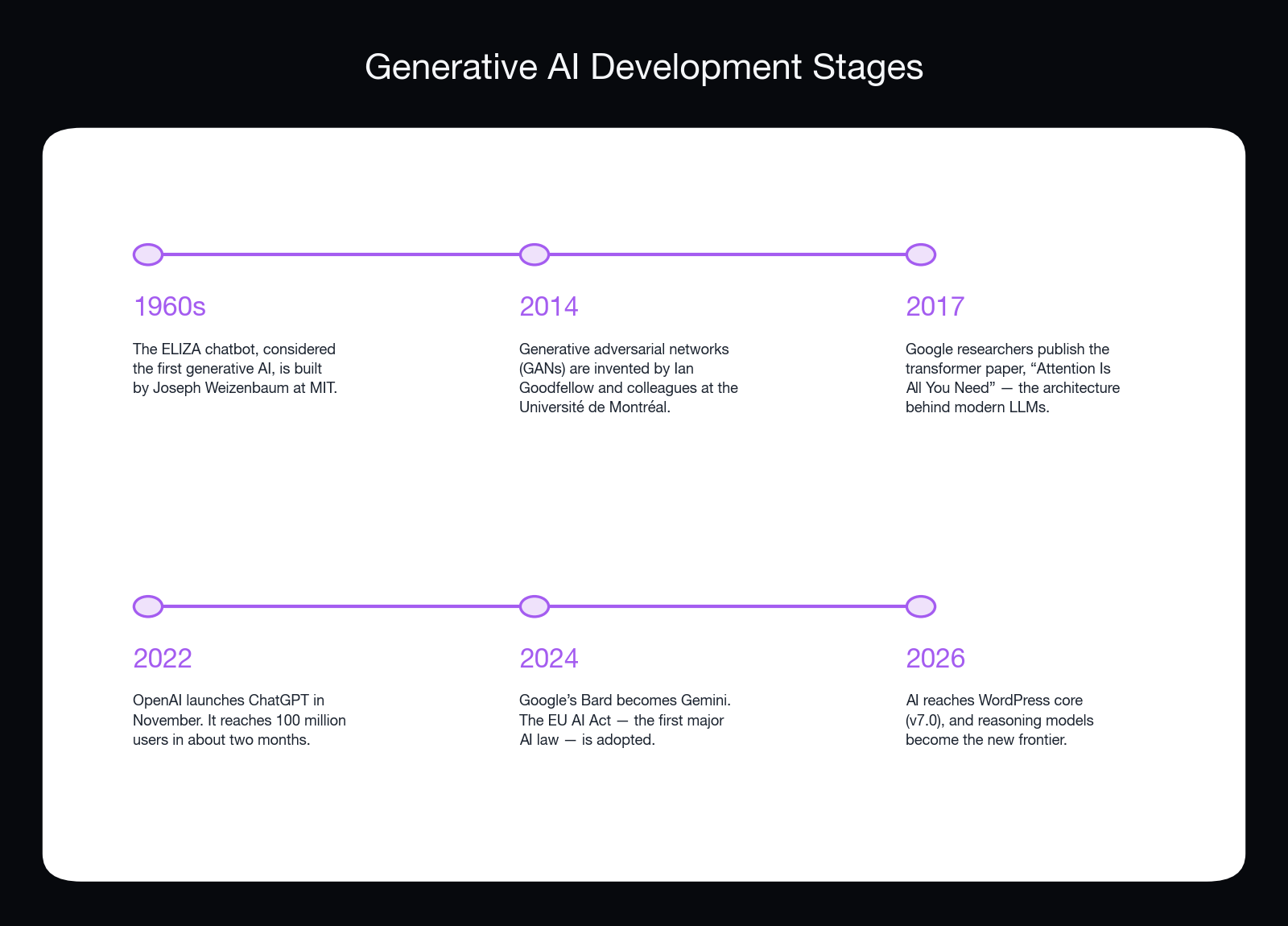
Generative AI’s history goes back to the 1960s when we saw early models like the ELIZA chatbot. ELIZA simulated conversation with users, creating seemingly original responses. However, these responses were actually based on a rules-based lookup table, limiting the chatbot’s capabilities.
A major leap in the development of generative AI came in 2014, with the introduction of Generative Adversarial Networks (GANs) by Ian Goodfellow and his colleagues at the Université de Montréal. GANs are a type of neural network architecture that uses two networks, a generator, and a discriminator.
The generator creates new content, while the discriminator evaluates that content against a dataset of real-world examples. Through this process of generation and evaluation, the generator can learn to create increasingly realistic content.
Network
A network is a group of computers that share resources and communication protocols. These networks can be configured as wired, optical, or wireless connections. In web hosting, server networks store and share data between the hosting customer, provider, and end-user.
Read MoreIn 2017, another significant breakthrough came when a group at Google released the famous Transformers paper, “Attention Is All You Need.” In this case, “attention” refers to mechanisms that provide context based on the position of words in a text, which can vary from language to language. The researchers proposed focusing on these attention mechanisms and discarding other means of gleaning patterns from text. Transformers represented a shift from processing a string of text word by word to analyzing an entire string all at once, making much larger models viable.
The implications of the Transformers architecture were significant both in terms of performance and training efficiency.
The Generative Pre-trained Transformers, or GPTs, that were developed based on this architecture now power various AI technologies like ChatGPT and GitHub Copilot. These models were trained on incredibly large collections of human language and are known as Large Language Models (LLMs).
What’s the Difference Between AI, Machine Learning, and Generative AI?
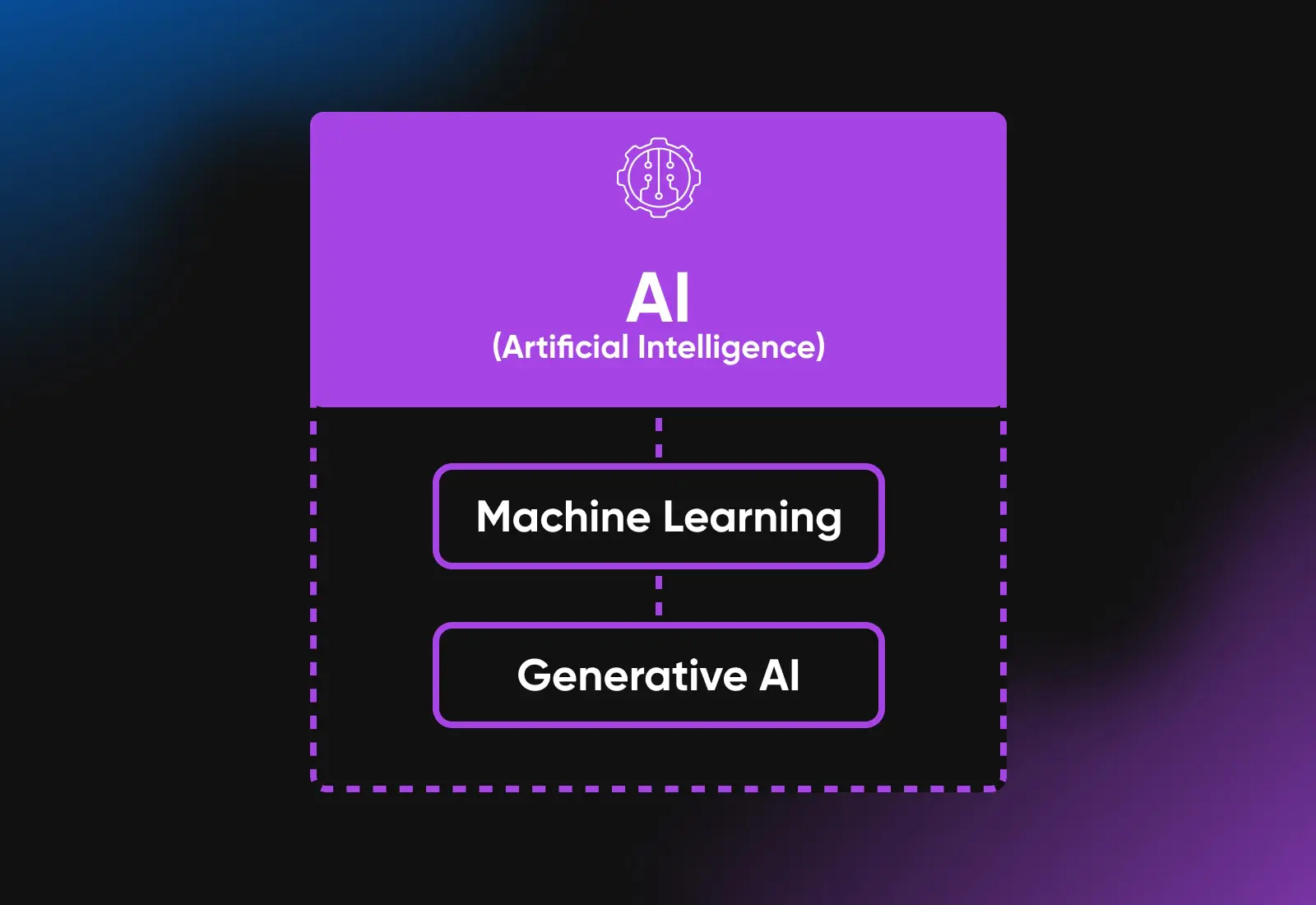
Generative AI, AI (Artificial Intelligence), and Machine Learning all belong to the same broad field of study, but each represents a different concept or level of specificity.
AI is the broadest term among the three. It refers to the concept of creating machines or software that can mimic human intelligence, perform tasks traditionally requiring human intellect, and improve their performance based on experience. AI encompasses a variety of subfields, including natural language processing (NLP), computer vision, robotics, and machine learning.
Machine Learning (ML) is a subset of AI and represents a specific approach to achieving AI. ML involves creating and using algorithms that allow computers to learn from data and make predictions or decisions, rather than being explicitly programmed to carry out a specific task. Machine learning models improve their performance as they are exposed to more data over time.
Generative AI is a subset of machine learning. It refers to models that can generate new content (or data) similar to the data they trained on. In other words, these models don’t just learn from data to make predictions or decisions – they create new, original outputs.
How does Generative AI Work?
Just like a painter might create a new painting or a musician might write a new song, generative AI creates new things based on patterns it has learned.
Think about how you might learn to draw a cat. You might start by looking at a lot of pictures of cats. Over time, you start to understand what makes a cat a cat: the shape of the body, the pointy ears, the whiskers, and so on. Then, when you’re asked to draw a cat from memory, you use these patterns you’ve learned to create a new picture of a cat. It won’t be a perfect copy of any one cat you’ve seen, but a new creation based on the general idea of “cat”.
Generative AI works similarly. It starts by learning from a lot of examples. These could be images, text, music, or other data. The AI analyzes these examples and learns about the patterns and structures that appear in them. Once it has learned enough, it can start to generate new examples that are similar to what it has seen before.
For instance, a generative AI model trained on lots of images of cats could generate a new image that looks like a cat. Or, a model trained on lots of text descriptions could write a new paragraph about a cat that sounds like a human wrote it. The generated content isn’t exact copies of what the AI has seen before but new pieces that fit the patterns it has learned.
The important point to understand is that the AI is not just copying what it has seen before but creating something new based on the patterns it has learned. That’s why it’s called “generative” AI.
How is Generative AI Governed?
Regulation is arriving, but unevenly. The European Union adopted the AI Act in 2024 — the first comprehensive AI law — with its obligations phasing in over several years (some land as late as 2028). In the US, there’s still no single federal AI law; instead, a patchwork of state rules and agency guidance applies. Other countries sit somewhere in between.
The debate hasn’t cooled. Leaders from Google, OpenAI, and Anthropic warned as far back as 2023 that generative AI could be used for wide-scale harm without guardrails, and how much regulation is the right amount remains one of tech’s most contested questions.
Generative AI Models
For the generative AI tools that many people commonly use today, there are two main models: text-based and multimodal.
Text Models
A generative AI text model is a type of AI model that is capable of generating new text based on the data it’s trained on. These models learn patterns and structures from large amounts of text data and then generate new, original text that follows these learned patterns.
The exact way these models generate text can vary. Some models may use statistical methods to predict the likelihood of a particular word following a given sequence of words. Others, particularly those based on deep learning techniques, may use more complex processes that consider the context of a sentence or paragraph, semantic meaning, and even stylistic elements.
Generative AI text models are used in various applications, including chatbots, automatic text completion, text translation, creative writing, and more. Their goal is often to produce text that is indistinguishable from that written by a human.
Multimodal Models
A generative AI multimodal model is a type of AI model that can handle and generate multiple types of data, such as text, images, audio, and more. The term “multimodal” refers to the ability of these models to understand and generate different types of data (or modalities) together.
Multimodal models are designed to capture the correlations between different modes of data. For example, in a dataset that includes images and corresponding descriptions, a multimodal model could learn the relationship between the visual content and its textual description.
One use of multimodal models is in generating text descriptions for images (also known as image captioning). They can also be used to generate images from text descriptions (text-to-image synthesis). Other applications include speech-to-text and text-to-speech transformations, where the model generates audio from text and vice versa.
What Are ChatGPT, Gemini, and Claude?
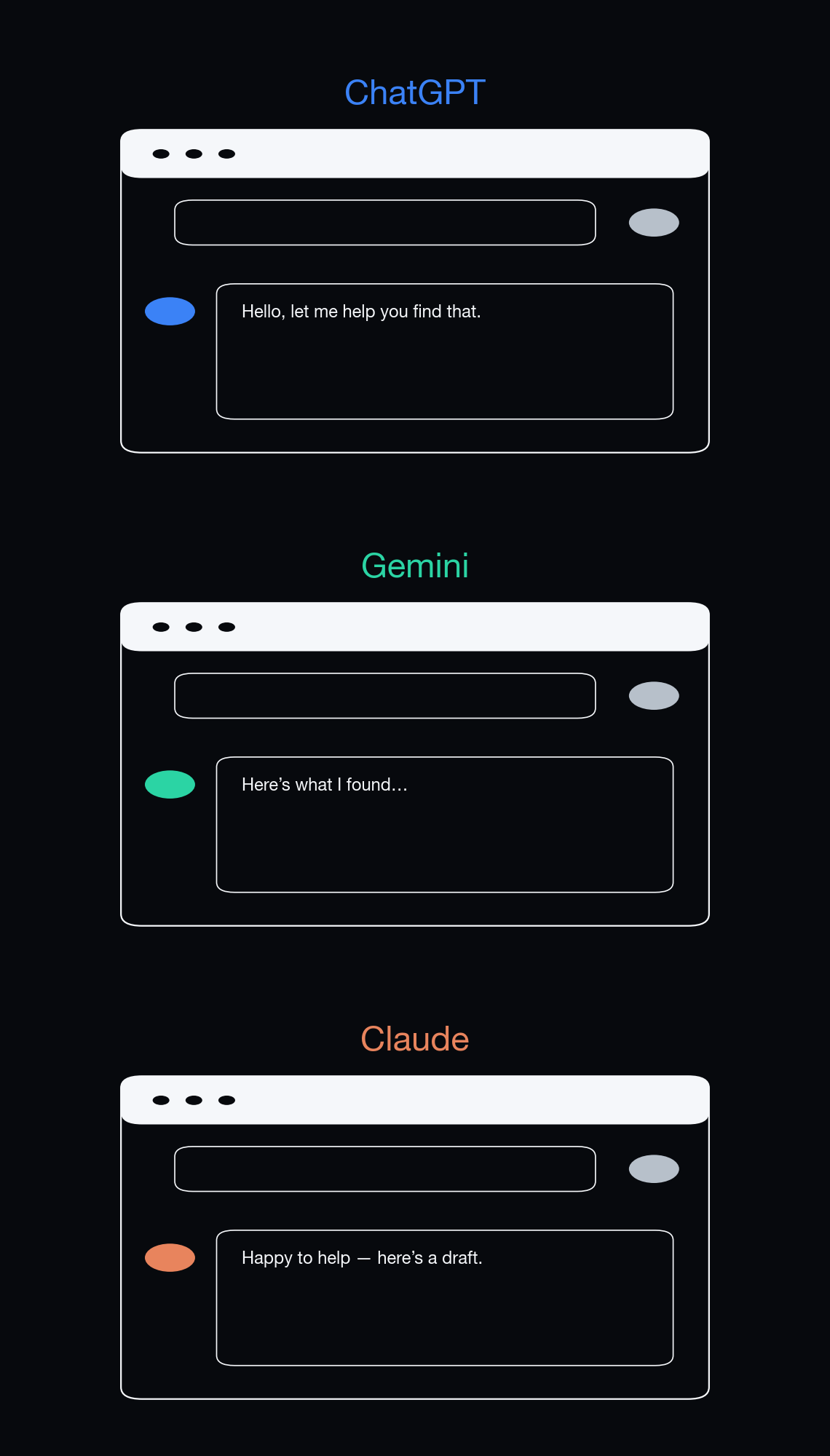
ChatGPT, Gemini, and Claude are the three most widely used general-purpose AI assistants — each backed by one of the major AI labs, and each capable of text, image, and code work.
ChatGPT
ChatGPT is OpenAI’s AI assistant, built on the GPT (Generative Pre-trained Transformer) family of models. It launched in November 2022 and now runs on the current GPT-5-era models, including reasoning models that work through hard problems step by step before answering. ChatGPT handles conversation, writing, image generation, and code, in the browser, in mobile and desktop apps, and through an API for developers.
Gemini
Gemini is Google’s AI assistant — you may remember its original name, Bard, which Google retired in February 2024. It runs on Google’s Gemini family of multimodal models, handles text, images, audio, and video in one system, and is woven throughout Google’s products, from Search’s AI Mode to Workspace.
Claude
Claude is Anthropic’s AI assistant, known for long-document analysis, careful reasoning, and strong writing and coding. Anthropic trains its Claude models with an emphasis on safety and reliability, which has made Claude especially popular for professional and developer work.
15 Generative AI Tools You Can Try Right Now
While ChatGPT, Gemini, and Claude are the biggest players in the field of generative AI, there are many other tools you can try — we keep a longer list in our roundup of AI tools (note that some require paid plans):
- Text generation tools: Jasper, Writer, Lex
- Image generation tools: Midjourney, Stable Diffusion, ChatGPT’s built-in image generation
- Music generation tools: Suno, Udio, Dadabots
- Code generation tools: GitHub Copilot, Claude Code, Tabnine
- Voice generation tools: Descript, Listnr, ElevenLabs
What is Generative AI used for?
Generative AI already has countless use cases across many different industries, with new ones constantly emerging. (For hands-on ways to put it to work, see our guide on how to use AI.)
Here are some of the most common (yet still exciting!) ways generative AI is used:
- In the finance industry to watch transactions and compare them to people’s usual spending habits to detect fraud faster and more reliably.
- In the legal industry to design and interpret contracts and other legal documents or to analyze evidence (but not to cite case law, as one lawyer learned the hard way).
- In the manufacturing industry to run quality control on manufactured items and automate the process of finding defective pieces or parts.
- In the media industry to generate content more economically, help translate it into new languages, dub video and audio content in actors’ synthesized voices, and more.
- In the healthcare industry by creating decision trees for diagnostics and quickly identifying suitable candidates for research and trials.
There are many other creative and unique ways people have found to apply generative AI to their jobs and fields, and more are discovered all the time. What we’re seeing is certainly just the tip of the iceberg of what AI can do in different settings.
What are the Benefits of Generative AI?
Generative AI’s biggest benefits are speed, scale, and reach: it automates tedious work, produces output at volumes humans can’t match, and surfaces ideas people might otherwise miss. Here’s how that plays out in practice.
Better Efficiency and Productivity
Generative AI can automate tasks and workflows that would otherwise be time-consuming or tedious for humans, such as content creation or data generation. This can increase efficiency and productivity in many contexts, optimizing how we work and freeing up human time for more complex, creative, or strategic tasks. (We tested the standouts in our AI productivity tools roundup.)
Increased Scalability
Generative AI models can generate outputs at a scale that would be impossible for humans alone. For example, in customer service, AI chatbots can handle a far greater volume of inquiries than human operators, providing 24/7 support without the need for breaks or sleep.
Enhanced Creativity and Innovation
Generative AI can generate new ideas, designs, and solutions that humans may not think of. This can be especially valuable in fields like product design, data science, scientific research, and art, where fresh perspectives and novel ideas are highly valued.
Improved Decision-Making and Problem-Solving
Generative AI can aid decision-making processes by generating a range of potential solutions or scenarios. This can help decision-makers consider a broader range of options and make more informed choices.
Accessibility
By generating content, generative AI can help make information and experiences more accessible. For example, AI could generate text descriptions of images for visually impaired users or help translate content into different languages to reach a broader audience.
What are the Limitations of Generative AI?
While generative AI has many benefits, it also has limitations. Some are related to the technology itself and the shortcomings it has yet to overcome, and some are more existential and will impact generative AI as it continues to evolve.
Quality of Generated Content
While generative AI has made impressive strides, the quality of the content it generates can still vary. At times, outputs may not make sense — They may lack coherence or be factually incorrect. This is especially the case for more complex or nuanced tasks.
Overdependence on Training Data
Generative AI models can sometimes overfit to their training data, meaning they learn to mimic their training examples very closely but struggle to generalize to new, unseen data. They can also be hindered by the quality and bias of their training data, resulting in similarly biased or poor-quality outputs (more on that below).
Limited Creativity
While generative AI can produce novel combinations of existing ideas, its ability to truly innovate or create something entirely new is limited. It operates based on patterns it has learned, and it lacks the human capacity for spontaneous creativity or intuition.
Computational Resources
Training generative AI models often requires substantial computational resources. Usually, you’ll need to use high-performance GPUs (Graphics Processing Units) capable of performing the parallel processing required by machine learning algorithms. GPUs are expensive to purchase outright and also require significant energy. (Running smaller open models is a different story — see our guide to hosting AI models locally.)
A 2019 paper from the University of Massachusetts, Amherst, estimated that training a large AI model could generate as much carbon dioxide as five cars over their entire lifetimes — and that study predates today’s far larger models. The International Energy Agency estimated that data center electricity use would roughly double between 2022 and 2026, driven in part by AI, and expects steep growth to continue through 2030. The environmental question has only grown more pressing as AI advances.
What’s the Controversy Surrounding Generative AI?
Beyond the limitations, there are also some serious concerns around generative AI — and even with the EU AI Act now phasing in, oversight still trails how fast the technology moves.
Ethical Concerns
Ethically, there are concerns about the misuse of generative AI for creating misinformation or generating content that promotes harmful ideologies. AI models can be used to impersonate individuals or entities, generating text or media that appears to originate from them, potentially leading to misinformation or identity misuse. AI models may also generate harmful or offensive content, either intentionally due to malicious use or unintentionally due to biases in their training data.
Momentum is finally building — the EU’s AI Act (2024) is the first comprehensive law, and other governments are drafting rules — but experts still debate whether regulation is moving anywhere near as fast as the technology.
Bias in Training Data
Bias in generative AI is another significant issue. Since AI models learn from the data they are trained on, they may reproduce and amplify existing biases in that data. This can lead to unfair or discriminatory outputs, perpetuating harmful stereotypes or disadvantaging certain groups.
Questions About Copyright and Intellectual Property
Legally, the use of generative AI introduces complex questions about copyright and intellectual property. For example, if a generative AI creates a piece of music or art that closely resembles an existing work, it’s unclear who owns the rights to the AI-generated piece and whether its creation constitutes copyright infringement. Additionally, if an AI model generates content based on copyrighted material included in its training data, it could potentially infringe on the original creators’ rights.
In the context of multimodal AI creation based on existing art, the copyright implications are still uncertain. If the AI’s output is sufficiently original and transformative, it may be considered a new work. However, if it closely mimics existing art, it could potentially infringe on the original artist’s copyright. Whether the original artist should be compensated for such AI-generated works is a complex question that intersects with legal, ethical, and economic considerations.
Generative AI FAQ
Below are some of the most frequently asked questions about generative AI to help you round out your knowledge of the subject.
Who Invented Generative AI?
Generative AI wasn’t invented by a single person. It has been developed in different stages, with contributions from numerous researchers and coders over time.
The ELIZA chatbot, considered the first generative AI, was built in the 1960s by Joseph Weizenbaum.
Generative adversarial networks (GANs) were invented in 2014 by Ian Goodfellow and his colleagues at the Université de Montréal.
Transformer architecture was invented in 2017 by Ashish Vaswani, Noam Shazeer, Niki Parmar, Jakob Uszkoreit, Llion Jones, Aidan N. Gomez, Lukasz Kaiser, Illia Polosukhin.
Many more scientists, researchers, tech workers, and more are continuing the work to advance generative AI in the years to come.
What Does it Take to Build a Generative AI Model?
Building a generative AI model requires the following:
- Data. Generative models are trained on large amounts of data. For instance, a text-generating model might be trained on millions of books, articles, and websites. The quality and diversity of this training data can greatly affect the performance of the model.
- Computation resources. Training generative models typically require significant computational power. This often involves using high-performance GPUs that can handle the intense computational demands of training large neural networks.
- Model architecture. Designing the architecture of the model is a crucial step. This involves choosing the type of neural network (e.g., recurrent neural networks, convolutional neural networks, transformer networks, etc.) and configuring its structure (e.g., the number of layers, the number of nodes in each layer, etc.).
- A training algorithm. The model needs to be trained using a suitable algorithm. In the case of Generative Adversarial Networks (GANs), for example, this involves a process where two neural networks are trained in tandem: a “generator” network that tries to create realistic data, and a “discriminator” network that tries to distinguish the generated data from real data.
Building a generative AI model can be a complex and resource-intensive process, often requiring a team of skilled data scientists and engineers. Luckily, many tools and resources are available to make this process more accessible, including open-source research on generative AI models that have already been built.
How do you Train a Generative AI Model?
Training a generative AI model involves a lot of steps – and a lot of time.
- Data collection and preparation. The first step is to collect and prepare the data that the model will be trained on. Depending on the application, this could be a large set of text documents, images, or any other type of data. This data needs to be preprocessed into a form that can be fed into the model.
- Model architecture selection. Next, a suitable model architecture needs to be chosen. This will depend on the type of data and the specific task. For example, Generative Adversarial Networks (GANs) are often used for generating images, while Long Short-Term Memory (LSTM) networks or Transformer models may be used for text generation.
- Model training. The model is then trained on the collected data. For a GAN, this involves a two-player game between the generator network (which tries to generate realistic data) and the discriminator network (which tries to distinguish real data from the generated data). The generator learns to produce more realistic data based on feedback from the discriminator.
- Evaluation and fine-tuning. After the initial training, the model’s performance is evaluated. For this, you can use a separate validation dataset. Then you can fine-tune the model based on the evaluation.
- Testing. Finally, the trained model is tested on a new set of data (the test set) that it hasn’t seen before. This gives a measure of how well it’s likely to perform in the real world.
What kinds of Output can Generative AI Create?
Generative AI can create a wide variety of outputs, including text, images, video, motion graphics, audio, 3-D models, data samples, and more.
Is Generative AI Really Taking People’s Jobs?
Sometimes — but it more often changes jobs than eliminates them outright. This is a complex issue with many factors at play: the rate of technological advancement, the adaptability of different industries and workforces, economic policies, and more.
AI has the potential to automate repetitive, routine tasks, and generative AI can already perform some tasks as well as a human can (but not writing articles – a human wrote this).
It’s important to remember that generative AI, like the AI before it, has the potential to create new jobs as well. For example, generative AI might automate some tasks in content creation, design, or programming, potentially reducing the need for human labor in these areas, but it’s also enabling new technologies, services, and industries that didn’t exist before.
And while generative AI can automate certain tasks, it doesn’t replicate human creativity, critical thinking, and decision-making abilities, which are crucial in many jobs. That’s why it’s more likely that generative AI will change the nature of work rather than completely replace humans.
Will AI ever Become Sentient?
No — today’s AI is not sentient, and researchers don’t agree on whether it ever will be. The consensus among AI researchers is that AI, including generative AI, has yet to achieve sentience, and it’s uncertain when or even if it ever will. Sentience refers to the capacity to have subjective experiences or feelings, self-awareness, or a consciousness, and it currently distinguishes humans and other animals from machines.
While AI has made impressive strides and can mimic certain aspects of human intelligence, it does not “understand” in the way humans do. For example, a generative AI model like GPT-5 can generate text that seems remarkably human-like, but it doesn’t actually understand the content it’s generating. It’s essentially finding patterns in data and predicting the next piece of text based on those patterns.
Even if we get to a point where AI can mimic human behavior or intelligence so well that it appears sentient, that wouldn’t necessarily mean it truly is sentient. The question of what constitutes sentience and how we could definitively determine whether an AI is sentient are complex philosophical and scientific questions that are far from being answered.
The Future of Generative AI
Since this guide was first written in 2023, a lot of its “future” has already arrived: models became multimodal by default, reasoning models that think before they answer went mainstream, and AI agents began completing multi-step tasks rather than just responding to prompts. Generative AI even reached WordPress core in 2026, with built-in connections to OpenAI, Google, and Anthropic models.
The next frontier looks like deeper agent autonomy, models that are cheaper to run locally, and regulation catching up with capability — the EU AI Act’s rules continue phasing in through 2028, and other governments are watching closely.
One thing hasn’t changed: the generative AI age is still young, and the tools are getting more capable — and more accessible — every year.
And if you want to put generative AI to work on your own website, WordPress 7.0’s built-in AI features run happily on DreamHost’s WordPress hosting.

Unbeatable WordPress Hosting
Reliable, lightning-fast hosting solutions specifically optimized for WordPress.
See More