
Referrals are great — until they’re not. If you’ve ever operated a business that depended on them, you know they can be just as fickle as summer weather.
Some months, they roll in like a warm front. Former clients send friends, a past coworker refers an associate, and someone’s business partner says, “I know a person.” You’re booked and busy.
Other months? Nothing. Just you and your empty calendar, left out in the cold.
That’s the danger of building an agency on relationships alone. Referrals are high-trust, high-quality, and often your best leads. They’re also unpredictable. You can encourage them, ask for them, and do excellent work that makes them more likely, but you can’t fully control when you get them. And generating your own leads instead is genuinely hard: 30% of marketers still report generating leads as one of their top challenges in 2026, per HubSpot’s marketing statistics roundup.
Freelancers can sometimes survive on that rhythm because the business only has to feed one person, but agencies, with their higher overhead, need more stability. Once you have employees, contractors, project managers, and software costs, you need to get strategic about your pipeline.
That doesn’t mean you have to abandon referrals. You just need a stronger sales system so your agency has multiple ways to find, close, and retain clients. Here’s how to build it.
What is an agency sales pipeline?
An agency sales pipeline is the documented path a potential client follows from first contact to signed contract (lead, qualified prospect, discovery, proposal, closed, and onboarding) with a clear action required to move a deal from one stage to the next. It tells you how much future revenue is in motion and where deals stall.
Here’s what each stage means for an agency, and what qualifies a deal to advance:
- Lead: Someone who fits your ideal client profile and knows you exist — a referral, a form fill, a reply to outreach. Advances when you confirm they’re worth a conversation.
- Qualified prospect: They have a problem you solve, a budget, and the authority to hire you. Advances when they book a discovery call.
- Discovery: You’ve scoped the problem, the timeline, and what success looks like. Advances when you send the proposal.
- Proposal: They’ve received the proposal and walked through it with you. Advances when they sign, or when you record the loss and why.
- Closed: The contract is signed and the first invoice is out.
- Onboarding: The handoff from sales to delivery: kickoff call, access, and expectations for what happens next.
From freelancer sales to an agency sales pipeline
When transitioning from freelancer to agency, referrals will probably remain your best lead source for years. But you will need additional channels so referrals aren’t the only thing keeping the lights on.
That requires you to stop selling yourself and start selling outcomes. As a freelancer, clients buy you. As an agency, they buy the result your team delivers. That means your sales system needs to do more than showcase your talent. It needs to communicate:
- Who you help
- What problem you solve
- What results clients can expect
- How your process works
- Why your team can deliver consistently
- What makes your approach different
- What happens after someone says yes
Your sales materials, case studies, and pitch all need to emphasize what clients get, not who does the work.
Outbound vs. inbound: two ways to fill your pipeline
Early agencies usually need both outbound and inbound sales.
Outbound is the short game: cold email, LinkedIn outreach, partnerships, and conferences. It may achieve faster results, but requires a higher tolerance for rejection. Good outbound is specific, relevant, and brief. AI tools can draft the first pass of a cold email or your proposal boilerplate, but the specificity and relevance still have to come from your own research into the prospect.
Inbound is the long game, and it’s how you build a pipeline that doesn’t depend on referrals: content marketing, SEO, speaking at events. It builds authority and generates warm leads, but budget for the ramp — SEO typically takes three to six months to produce measurable results, and six to 12 in competitive industries, per Search Engine Land (2026).
| Strategy | Time To Results | Best For | Common Mistake |
| Referrals | Ongoing | High-quality, warm leads | No structure — relying on luck instead of asking |
| Cold outreach | Typically 1-3 months | Filling pipeline gaps, targeting ideal clients | Generic messaging that gets ignored |
| Strategic partnerships | Typically 2-4 months | Complementary service cross-referrals | Vague agreements with no follow-through |
| Events and conferences | Typically 3-6 months | Credibility, network building | Choosing visibility over relevance |
| Content marketing and SEO | Typically 3-6 months; 6-12 in competitive industries (SEO) | Steady lead flow, authority building | Inconsistency — publishing fades when you get busy |
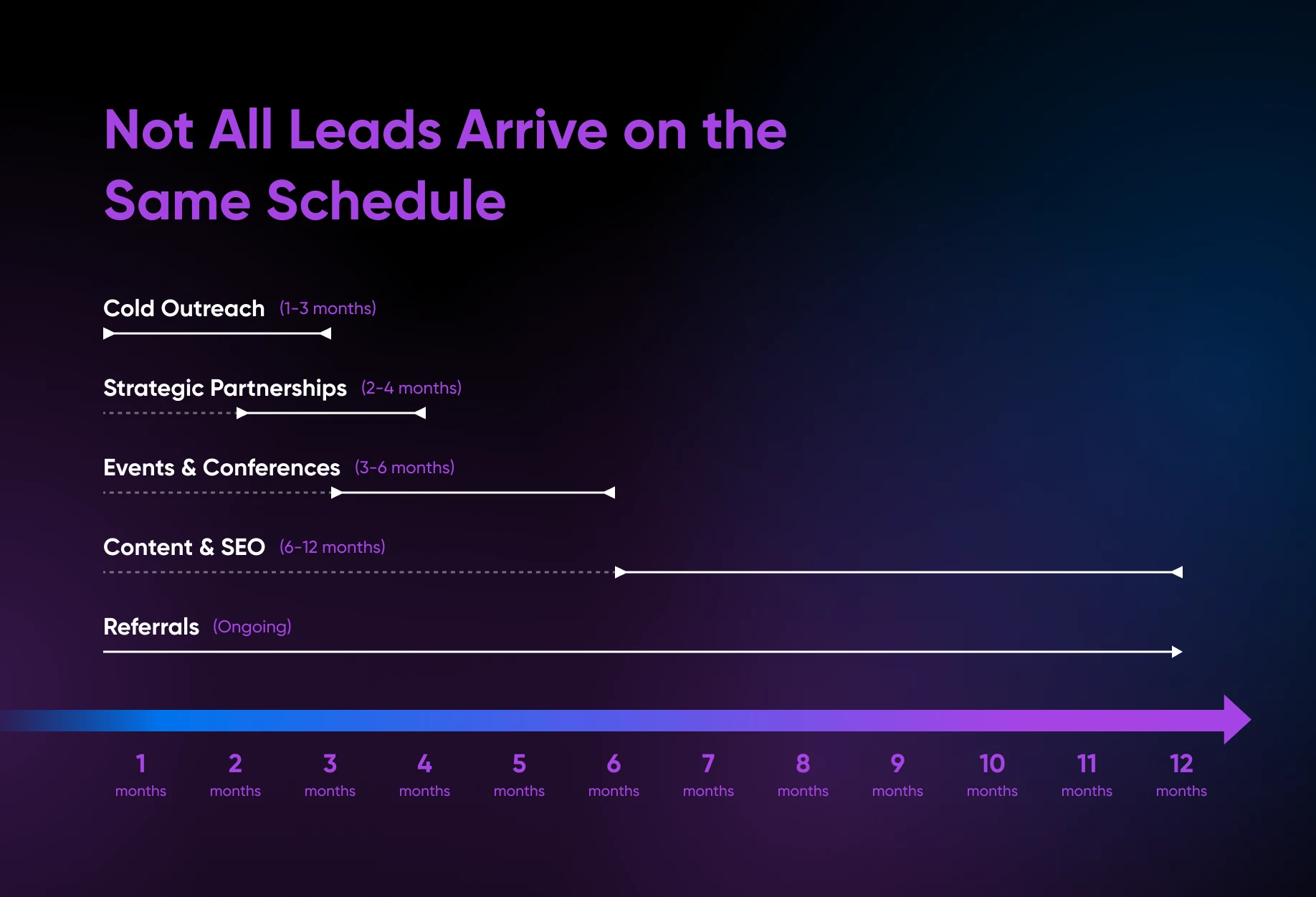
Rather than dabbling in everything, it’s best to pick one or two channels and be consistent. Play to your strengths. If you’re a good writer, lean into content. If you’re a natural connector, build partnerships. And remember you can always build more channels as you grow.
How do you bridge revenue while inbound ramps up?
Sequence short-cycle revenue to fund the ramp. If your sales cycle runs long and referrals still pay the bills, don’t rip anything out. Layer in this order:
- Expand existing clients first. A next-phase project or retainer add-on for a client who already trusts you closes faster than any new lead.
- Systematize referral asks. Ask at project milestones (launch day, a strong result) instead of waiting for referrals to happen on their own.
- Run outbound for short-cycle offers. Pitch small, fixed-scope projects like audits or site teardowns that close in weeks, not quarters.
Inbound compounds in the background while these keep cash coming in, and every short-cycle win feeds your case studies.
Proposal and closing processes
By the time a prospect receives a proposal, they should already understand the problem, the recommended approach, the investment, and what happens next. The proposal confirms the conversation and acts as a decision tool.
A strong agency proposal includes:
- Client context
- Problem summary
- Recommended solution
- Scope of work
- Timeline
- Deliverables
- Investment
- Assumptions and exclusions
- Team roles
- Approval process
- Next steps
Don’t just send the proposal and wait. Build a defined follow-up sequence. Walk through it on a call and follow up in 48 hours or so to address any concerns.
Sales team development
You don’t need a salesperson before you have a repeatable sales process — they can’t fix unclear positioning, a weak offer, inconsistent pricing, or a founder who hasn’t gotten comfortable selling.
Before you’re ready to delegate sales, you need to document:
- Your ideal client profile
- Common pain points
- Qualification questions for your ideal clients
- Discovery call structure
- Pricing logic
- Proposal templates
- Responses to objections
- Follow-up cadence
- Red flags
Build a sales playbook even if you’re the only one using it. That way, it’ll be ready when you need to hire and train a sales team.
Build out and document your sales pipeline
These steps will help you create three practical sales assets you can use now and hand off later if you decide to build a sales team.
Audit your lead sources: List every client project from the past 12 months. For each one:
- Record the client name, how they originally found you, and the total project value.
- Sort by source.
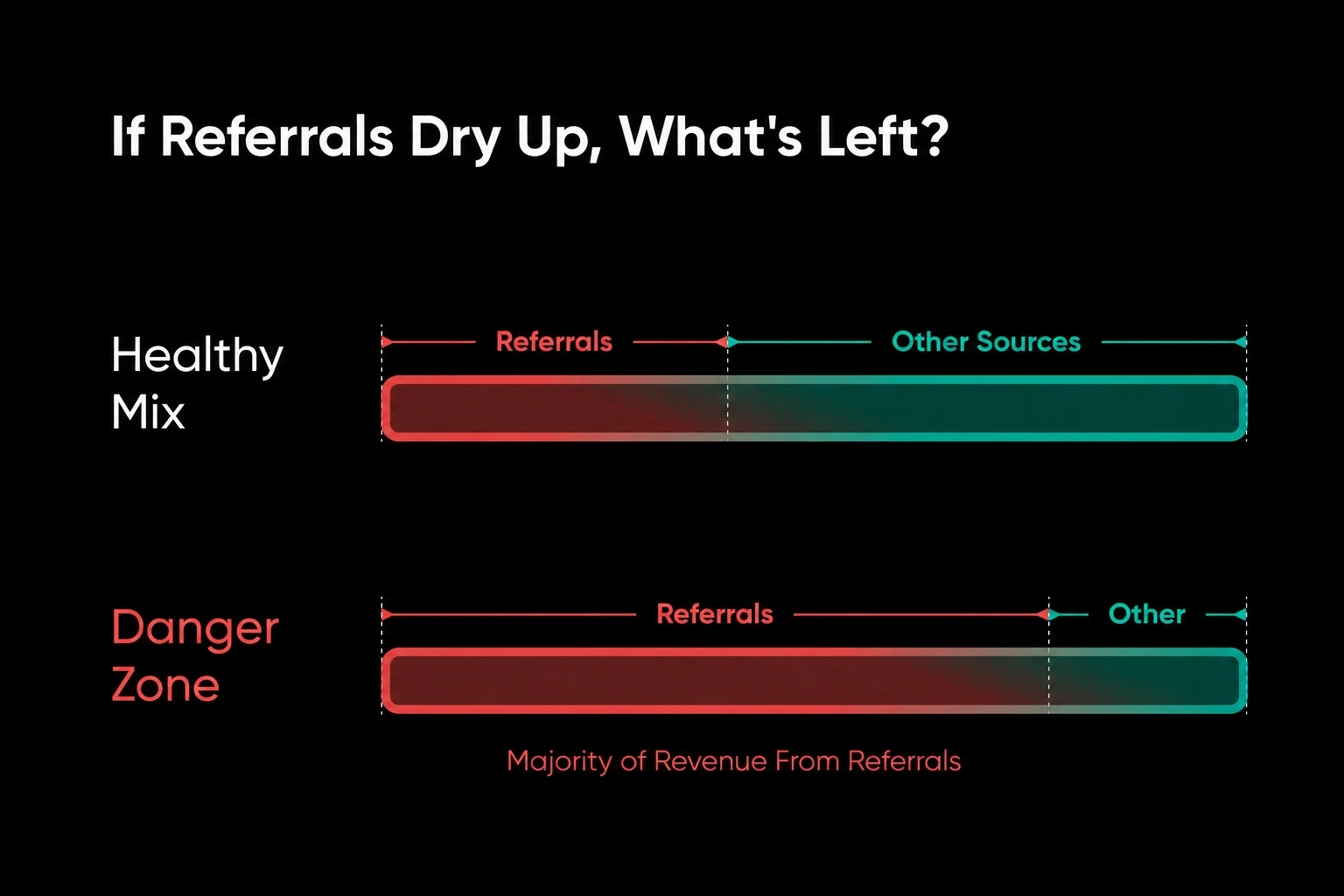
- Add up the revenue that came from referrals and word of mouth, then calculate that as a percentage of your total.
- If referrals account for the majority of your revenue, your entire business depends on a channel you can’t control or predict. Let’s work on that.
Build a one-channel, 90-day plan
Choose a single non-referral channel to test. For the channel you chose, write out four specific weekly tasks and one leading metric you can start tracking in the first month. Set a minimum threshold for that metric. If you haven’t hit it by day 90, you’ll stop and try a different channel. Add a second channel only after the first produces a repeatable baseline.
Create a reusable proposal template
In a blank document, build the skeleton:
- Client context
- Problem summary
- Recommended solution
- Scope of work, timeline
- Deliverables
- Next steps
Now fill in everything that stays the same across clients: your standard terms, processes, etc. For the parts that change per prospect, leave bracketed placeholders like [client’s core challenge] and [proposed timeline].
How much pipeline does your agency need?
A common rule of thumb is 3x to 4x pipeline coverage: keep three to four times your revenue goal in open, qualified opportunities. As sales enablement platform Bigtincan (2024) explains, those numbers work “because most companies have win rates in the ballpark of 25% to 33%” — the underlying math is 1 divided by your win rate.
Here’s how to calculate your own number, using the lead-source audit you just ran:
- Set a revenue goal. Say you want $30,000 in new business next quarter.
- Find your average deal size. Total project revenue from your audit divided by the number of projects. Say it’s $10,000 — you need 3 new deals.
- Estimate your win rate. Proposals won divided by proposals sent. Say you close 1 in 3, about 33%.
- Do the math. 3 deals needed ÷ 0.33 win rate = roughly 9 qualified opportunities in play, or about $90,000 of pipeline. That’s 3x your goal.
- Work back through your sales cycle. If deals take three months from first call to signature, the pipeline that pays next quarter has to be built this quarter.
No historical data yet? If you’ve grown on untracked referrals, you won’t have a real win rate or cycle length. Start with conservative placeholders (assume cold channels will close less often, and more slowly, than referrals taught you to expect) and log every opportunity from today: source, date, deal size, stage, outcome. After 10 to 15 closed-or-lost deals, your own numbers beat any rule of thumb. Recalculate quarterly.
Build the sales pipeline before you need it
You don’t need a complicated CRM or a 40-page sales manual. A spreadsheet with one row per deal (source, stage, value, next action, follow-up date) is enough at first. Once follow-ups start slipping or you’re juggling more than 10-15 open deals, a lightweight CRM earns its keep for deal tracking and follow-up reminders; proposal software and client portals can wait until your volume justifies them. Whatever the tool, you just need a clear, repeatable path for how someone moves through the stages above — from stranger to lead, from lead to prospect, and from prospect to client.
Start by looking at where your current clients actually came from, and then look at which sources produced the best work.
From there, choose one or two channels to improve deliberately. If referrals are your strongest source, create a real referral process. If content is your long-term play, publish consistently around the problems your best clients already ask about. If partnerships make sense, define who the right partners are, what they can refer, and how you’ll handle follow-ups.
A sales pipeline doesn’t have to be complicated. It just has to exist and be something you actually use. Start with the audit, calculate how much pipeline your revenue goal requires, and pick one channel to test for 90 days. Agencies that do this consistently tend to stop waiting for the phone to ring.
Agency sales pipeline FAQs
How much pipeline does an agency need?
A common rule of thumb is 3x to 4x coverage: three to four times your revenue goal in open, qualified opportunities, per Bigtincan (2024). The precise version is 1 divided by your win rate — if you win 25% of your proposals, you need 4x coverage.
What are the stages of an agency sales pipeline?
Six stages cover most agencies: lead, qualified prospect, discovery, proposal, closed, and onboarding. A deal advances only when a defined action happens, like a discovery call booked, a proposal sent, or a contract signed. Record lost deals too, along with why they were lost.
How do you build a sales pipeline for a marketing agency?
Audit where every client from the past 12 months came from, pick one non-referral channel, test it for 90 days against one leading metric, and document the process in a sales playbook. Add a second channel once the first produces a repeatable baseline.
How long does it take to build an inbound pipeline?
There’s no single timeline for every inbound channel. For SEO, measurable results typically take 3-6 months and may take 6-12 months in competitive industries, per Search Engine Land (2026). Bridge the gap with existing-client expansion, structured referral asks, and short-cycle outbound offers.
Do you need a CRM to manage an agency pipeline?
Not at first. A spreadsheet with one row per deal works while your open-deal count stays small. Adopt a lightweight CRM when follow-ups start slipping through the cracks — deal tracking and automated reminders are the features that matter early on.

Ready to Scale From Freelancer to Agency?
A free playbook for freelancers deciding whether to build a team: positioning, hiring, sales, finances, and the math to decide if scaling is right for you.
Get the Free eBook