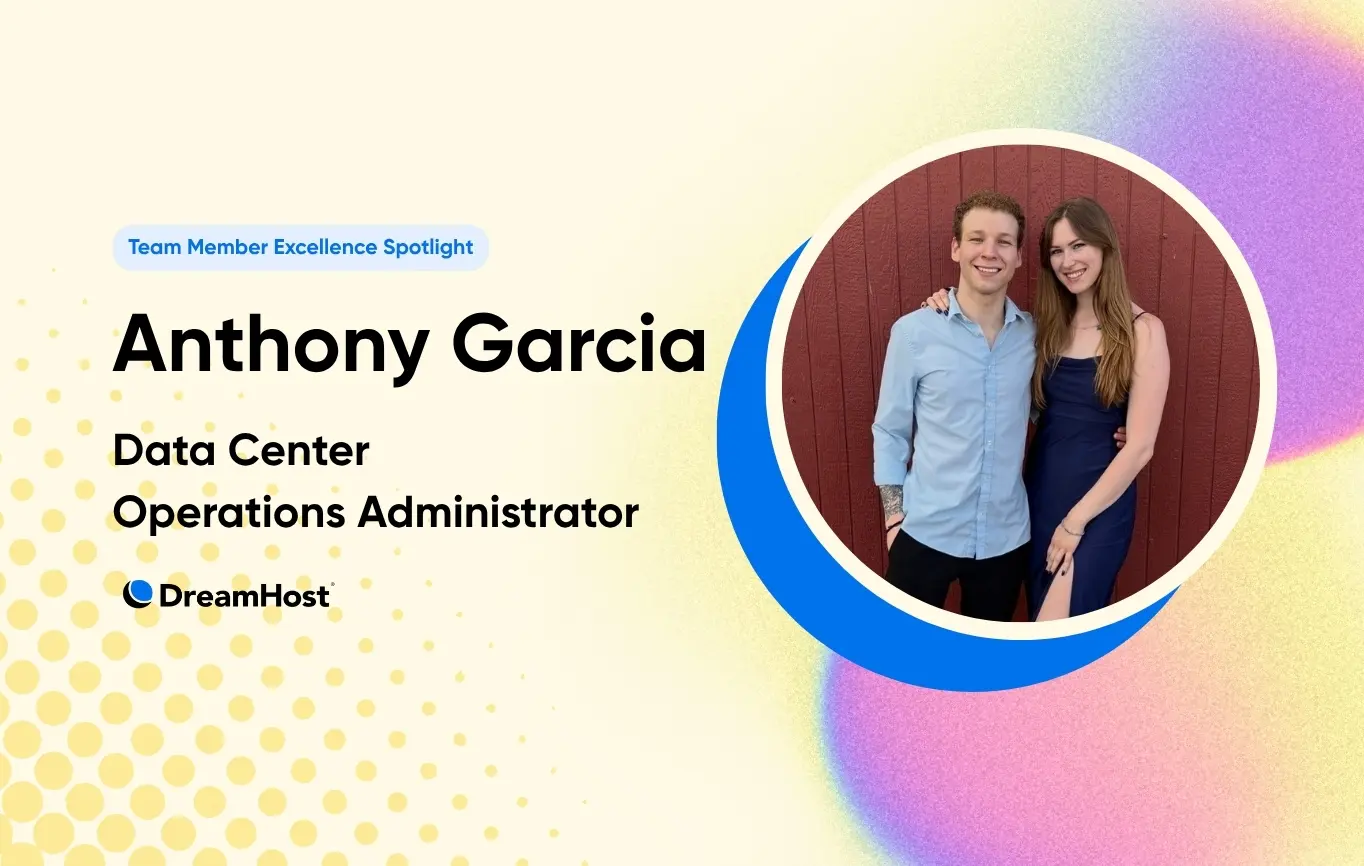





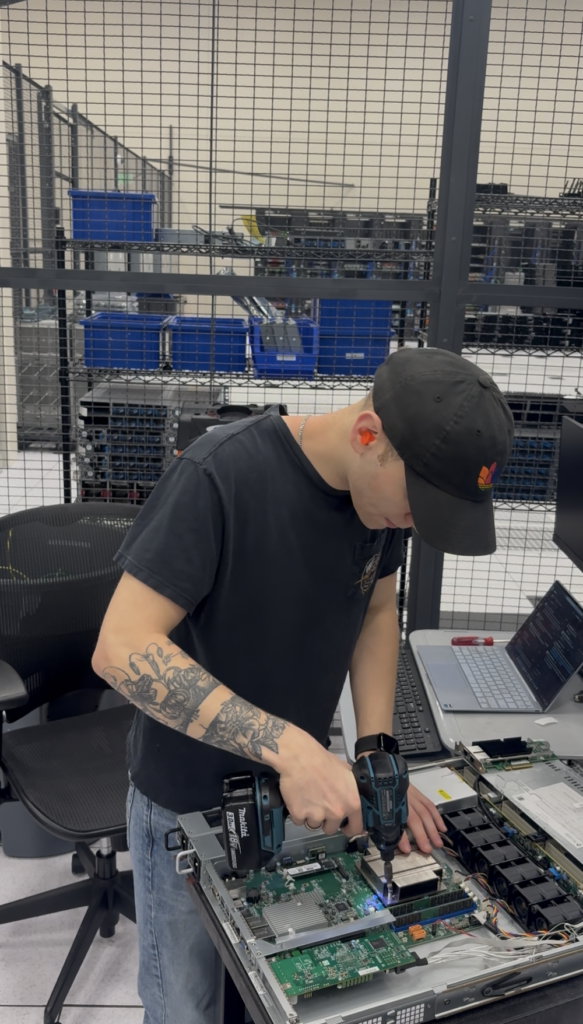
For all the work that happens online at DreamHost, there are still plenty of things that require someone to physically walk up to a server, whether it’s replacing a bad drive, adding RAM, running a cable, or rebooting a machine.
“We’re the physical hands for the company,” says Garcia, a Data Center Operations Administrator (DC Ops) at DreamHost’s Portland data center.
It’s a role that suits Garcia, who likes figuring out how things work, prefers to have a plan (Google Sheets is his “best friend”), and readily admits there’s something satisfying about getting things organized.
Working with data center servers wasn’t always his day job, though. Before DreamHost, Garcia worked in sales and knew it wasn’t where he wanted to stay long term.
A Job That Sounded Too Good to Be True
Garcia wanted to get into technology since graduating high school. He eventually saved enough money to leave his sales job and take a year off to make this happen.
He completed a boot camp, but also spent a good chunk of that year learning on his own and building his skills. Once he felt ready, he started applying for jobs and came across DreamHost on LinkedIn. The job sounded promising to Garcia, but maybe a little too promising.
“There were the little benefits of, ‘Oh, and there’s a snack budget,’ and lunch is free Tuesdays and Thursdays, and there’s a wellness benefit credit, too!” he remembers. “I’m like, this is too many things. I’m not going to get this job, but I’ll apply anyway.”
Spoiler alert: he got the job, of course.
It didn’t take long for Garcia to notice that some of what had caught his attention in the job listing carried over once he was actually inside DreamHost. After joining the company Slack space, he noticed people from completely different parts of the company chatting in channels about gaming, random topics, and things that had nothing to do with their regular jobs.
“There’s just a sense of community,” he says. “That’s really cool. I like that about it.”
Garcia also got his first real look at a data center during the interview process. His future manager, Chris Lewis, brought him onto the floor and asked him to diagnose what might be wrong with a server sled. Garcia was understandably a little preoccupied with passing the test, but once that was over, he had a chance to actually take in his surroundings.
“Being there and seeing this is where it happens was just a really cool feeling,” he says. “It felt like something had been unlocked.”
More than two years into his DreamHost tenure, that fascination hasn’t worn off.
Garcia still likes watching the tiny blue lights across the front of DreamHost’s drives blink as customers read and write data. His manager pointed them out when he first started and explained what each flash represented.
“You multiply that times thousands,” Garcia says. “It’s just really cool to see it happen.”
Blue Lights, Bad Drives, and Google Sheets
A typical day for Garcia starts with checking the alert board for bad drives or other problems and filling customer pre-orders. Other than that, “typical” gets a bit harder to define.
Other DreamHost teams might need someone to check a machine, replace a component, add memory, or troubleshoot something that is misbehaving. Something that worked perfectly a month ago may not work the same way today.
“Things are always changing,” Garcia says. “We’re always trying to figure out why something that worked a month ago no longer works.”
Garcia believes that unpredictability has helped him become a better troubleshooter as he’s learned to break a problem down, consider the most likely causes first, and work through them rather than getting lost chasing every possibility.
It probably doesn’t hurt that Garcia has some practice thinking a few moves ahead.
At eight years old, he took first place in Oregon’s state chess tournament for his age group. He doesn’t play competitively anymore, but he still remembers his chess teacher telling him to think three moves ahead.
“That’s something that I think is really relevant in life in general,” he says.
And then there are his other best friends: Google spreadsheets.
“I have one for everything,” Garcia says. “It doesn’t matter what. I will somehow turn whatever I’m doing into a Google Sheet.” (He even admitted he made one for this interview.)
His love of order has found a practical outlet at DreamHost. When Garcia started, the Portland data center had a storage room so packed with equipment that it was difficult to walk through, so he immediately decided he wanted to tackle that project.
“I thought, I’m going to organize this. I’m going to find out what we have. It’s going to be neat.”
After DreamHost’s recent tech refresh, Garcia and the team finally emptied the room. Now he’s looking forward to getting the remaining inventory organized and easier to track.
“I know it’s kind of silly,” he says, “but I’m looking forward to cleaning up and making everything look neat and pretty.”
That’s not a small thing to Garcia. To him, better organization means knowing what equipment is actually there, making audits easier, and avoiding buying things his team doesn’t need.
Mount Hood, Video Games, and Katniss the Cat
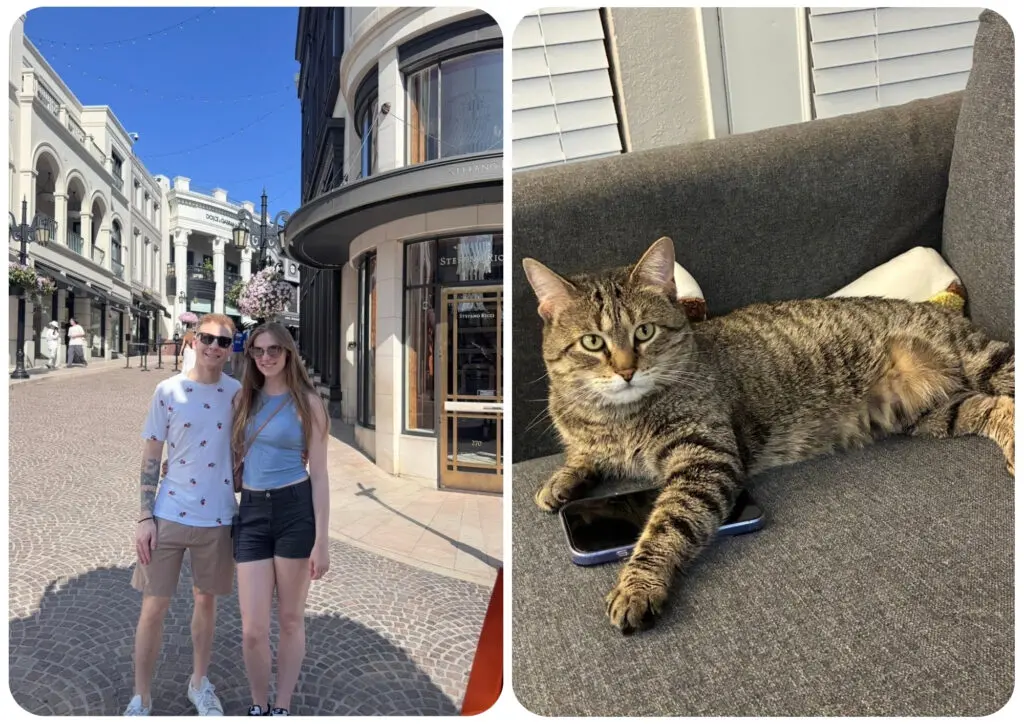
Garcia spends his free time with his girlfriend, Hannah, and their cat, Katniss, hanging out with friends, playing video games, or snowboarding.
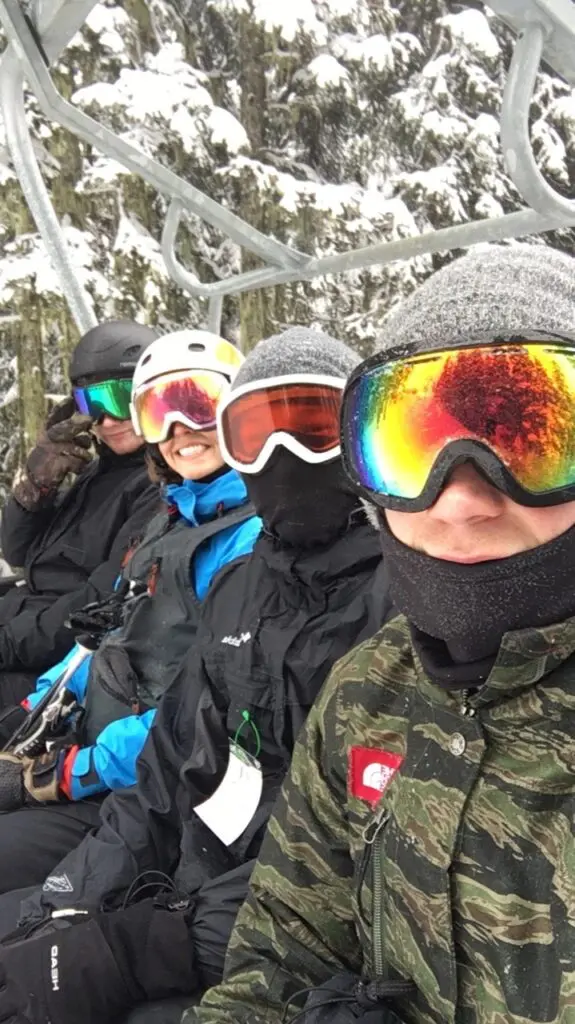
He started snowboarding in high school and still heads to Mount Hood when he gets the chance. “Something about going fast down a mountain just really does it for me,” Garcia says.
There’s also a practical benefit over skateboarding, another sport he used to play.
“As I get older, my bones appreciate falling into snow a lot more.”
At home, Garcia gravitates toward story-driven games like Elden Ring and Expedition 33. He also has two tattoos, both with some meaning behind them.
One is a collection of flowers native to Oregon, where Garcia was also born and reared. The other comes from Expedition 33: the words “For those who come after.” It’s a reminder that making a difference doesn’t have to mean doing something enormous.
“I personally may not make this huge change in the world that affects the entire world,” he says. “But I can do little bits here and there. I can do things that help contribute to a better world or a better future.”
That’s an idea that shows up in smaller ways, too. Garcia’s advice for anyone starting out at DreamHost is to ask questions, have a willingness to learn, and never worry about looking like you don’t know something.
“I enjoy coming to work everyday,” Garcia says. “This is actually a job I want to do. I like learning.”
Want to work with people like Anthony Garcia? Check out our careers page to see what makes DreamHost’s culture special. Next month, we’ll feature a DC Ops systems administrator who balances a passion for high-tech infrastructure with a love for family and good coffee.