
Every freelancer knows the struggle of saying yes to every inquiry that comes their way.
Website? Sure. Logo? Probably. SEO? Let me open a few tabs. Email funnel? How hard can it be? Before long, your service list starts looking like the Cheesecake Factory menu: tons of choices, but no niche.
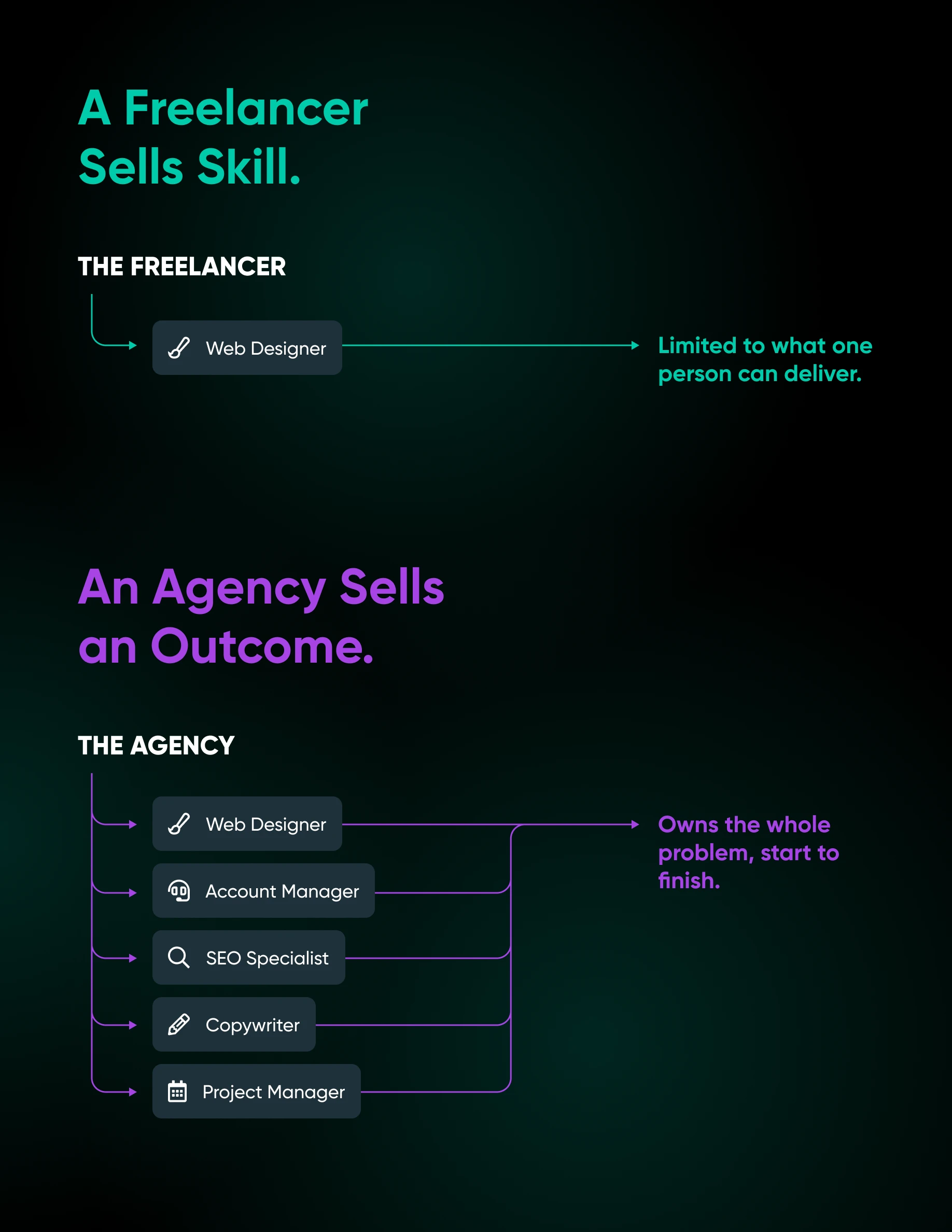
And that can work when you’re a solo operator. At that stage, clients are often buying you: your taste, your speed, your brain, your ability to learn new skills and workflows on the fly.
But agencies have to sell something bigger than one person’s talents: They need to sell a clear outcome, a reliable process, and a reason to be picked over every other studio, expert, internal hire, and freelancer.
That’s the whole point of positioning.
What is agency positioning?
Agency positioning is the strategic choice of exactly who your agency helps, what problem you solve for them, and why your team is uniquely equipped to solve it. Instead of cramming every service you’ve ever provided into a single tagline, focus on making your agency easier to find, understand, trust, and hire.
Niche specialization strategies
A freelancer can get away with being a “web designer.”
An agency usually cannot.
As you scale, clients need a good reason to choose your business. You need to differentiate, and one of the best ways to do that is by choosing a specialty or niche.
Niching down often feels terrifying because it looks like you’re shrinking your market. But when you specialize, you gain expertise that allows you to match with your ideal clients more easily and charge more for your experience.
For example, a design agency that specializes in ecommerce for DTC food and beverage brands can charge more than a generalist because they understand the regulatory, packaging, and conversion challenges in the industry.
You can specialize by:
- Industry: Work for restaurants, coaches, accountants, clinics, nonprofits, trades, etc.
- Business stage: Target businesses at launch, growth, turnaround, post-funding, or pre-sale.
- Platform: Become an expert in WordPress, Shopify, HubSpot, QuickBooks, or Google Business Profile.
- Outcome: Build your niche in generating leads, boosting conversions, cleaning up operations, or strengthening retention.
- Service model: Offer audits, retainers, implementation sprints, or care plans.
- Audience: Work with local businesses, founder-led companies, or creative entrepreneurs.
The best niche is one with healthy demand and work you can deliver profitably, even if it isn’t the narrowest option. It’s also one where you can position your business well to stand out from others who already exist within the niche.
If you’re weighing several candidate niches, score each one (1–5) on four criteria:
- Demand evidence: Are businesses in this niche actively paying for this work? Look at job posts, RFPs, and search demand.
- Existing proof: Do you already have clients, case studies, or results in this niche?
- Profitability: When you’ve done this work before, did it make money, or did scope creep eat the margin?
- Access to buyers: Can you reach decision-makers in this niche through communities, referrals, or channels you already have?
The niche that scores highest across all four beats the one that merely excites you. And if you choose wrong? You’ll know within a couple of quarters, and you can adjust. A menu can always be reprinted.
Choosing a niche raises the question every agency owner asks next: What about the off-niche clients currently paying the bills? You don’t have to fire anyone. Here’s a workable transition:
- Grandfather your best off-niche clients. Keep serving profitable, low-drama accounts on their current terms. They fund the transition; they just don’t appear in your new marketing.
- Phase out the rest. As projects wrap or contracts come up for renewal, refer poor-fit clients to a trusted partner instead of re-signing them.
- Bridge the revenue. Plan on a runway of roughly 6–12 months where legacy work covers overhead while you build niche case studies and pipeline.
- Decline off-niche inbound only after the niche pipeline can replace it. A practical trigger: Niche work has covered your baseline costs for 2 or 3 consecutive months.
Strong positioning should answer three questions for prospective clients:
- Who do we serve?
- What problem do we solve for them?
- Why are we the obvious choice?
Take a look at this example:
| Who Does It Serve? | What Problem Does It Solve? | Why Is It the Obvious Choice? | ||
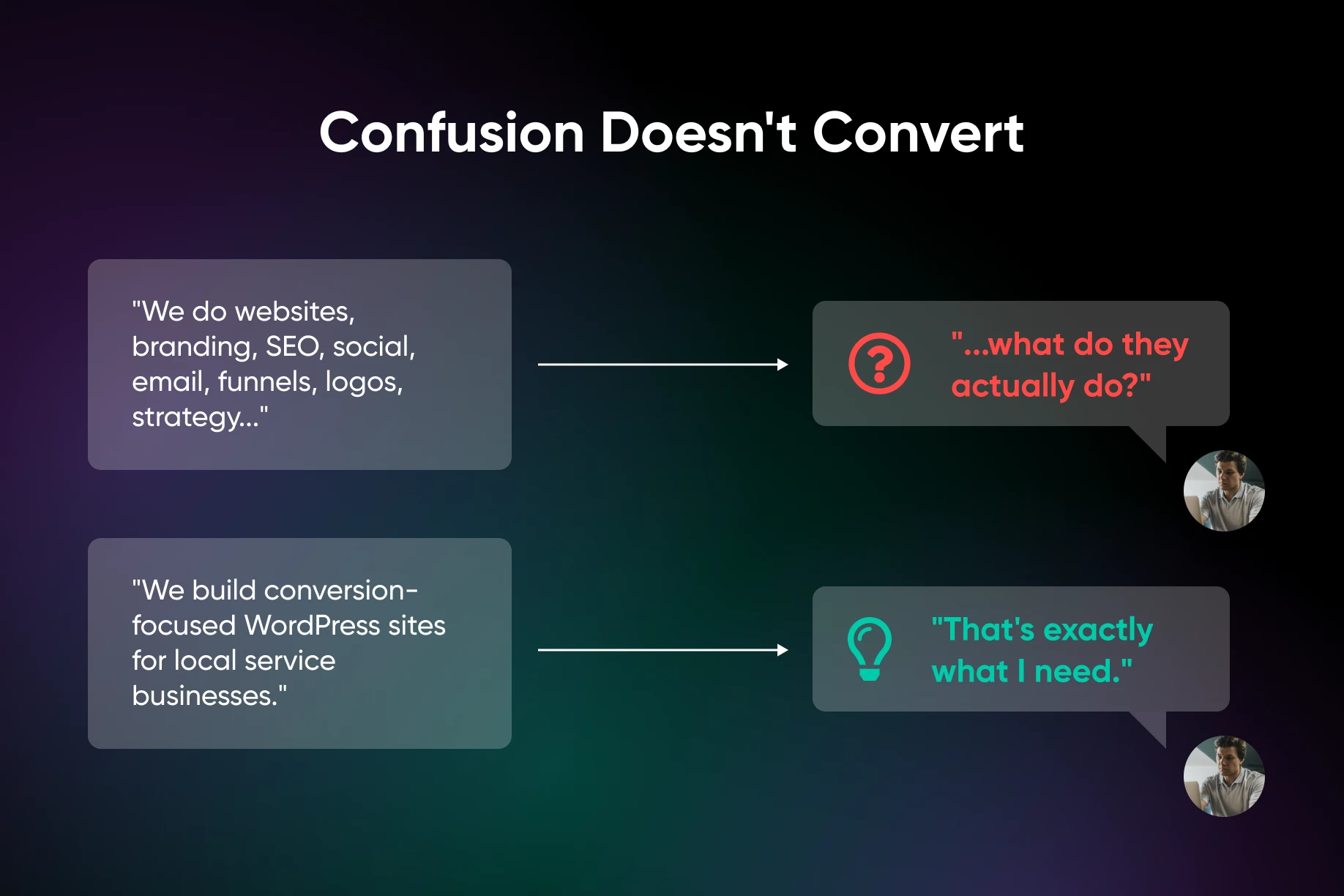
| Bad Positioning | “We offer websites, branding, SEO, social, email, funnels, logos, strategy, maintenance, and vibes.” | No idea | General web design? | It’s not |
| Good Positioning | “We build conversion-focused WordPress websites for local service businesses, using insights from 50+ completed projects to generate more qualified leads.” | Local service businesses | Getting more qualified leads and conversions | It names its proof: 50+ completed projects back the claim |
What do you believe that weaker competitors don’t? What do clients misunderstand before working with you? What broken norm in your industry do you refuse to repeat?
Your answers to those questions will help you find your positioning and create strong differentiation from your competitors.
Write your positioning statement
Need help finding your positioning? Finish these sentences to help you get started (tip: they also work well as an AI prompt; paste them into your favorite assistant with a few details about your agency, then refine the drafts it returns):
- We help…
- Who struggles with…
- By providing…
- So they can…
- Unlike…
- We believe…
- Proof we can deliver this…
A finished version might look like:
“We help DTC food and beverage brands who struggle with inconsistent online sales by providing branded ecommerce design that converts, so they can grow direct revenue without relying on third-party apps. Unlike generalist design studios, we’ve built stores for 30+ CPG brands. Proof: Three clients hit six figures in year one.”
Service offering evolution
Many freelancers try to scale by adding services. Counterintuitively, agencies often scale better by subtracting: trimming that Cheesecake Factory menu down to the dishes the kitchen is actually known for.
More services create more complexity. Every new offer needs sales language, pricing, process, staffing, QA, and timelines. If you add too much too soon, you risk diluting the quality you offer your clients. So first, determine your core service offering and make it profitable and repeatable.
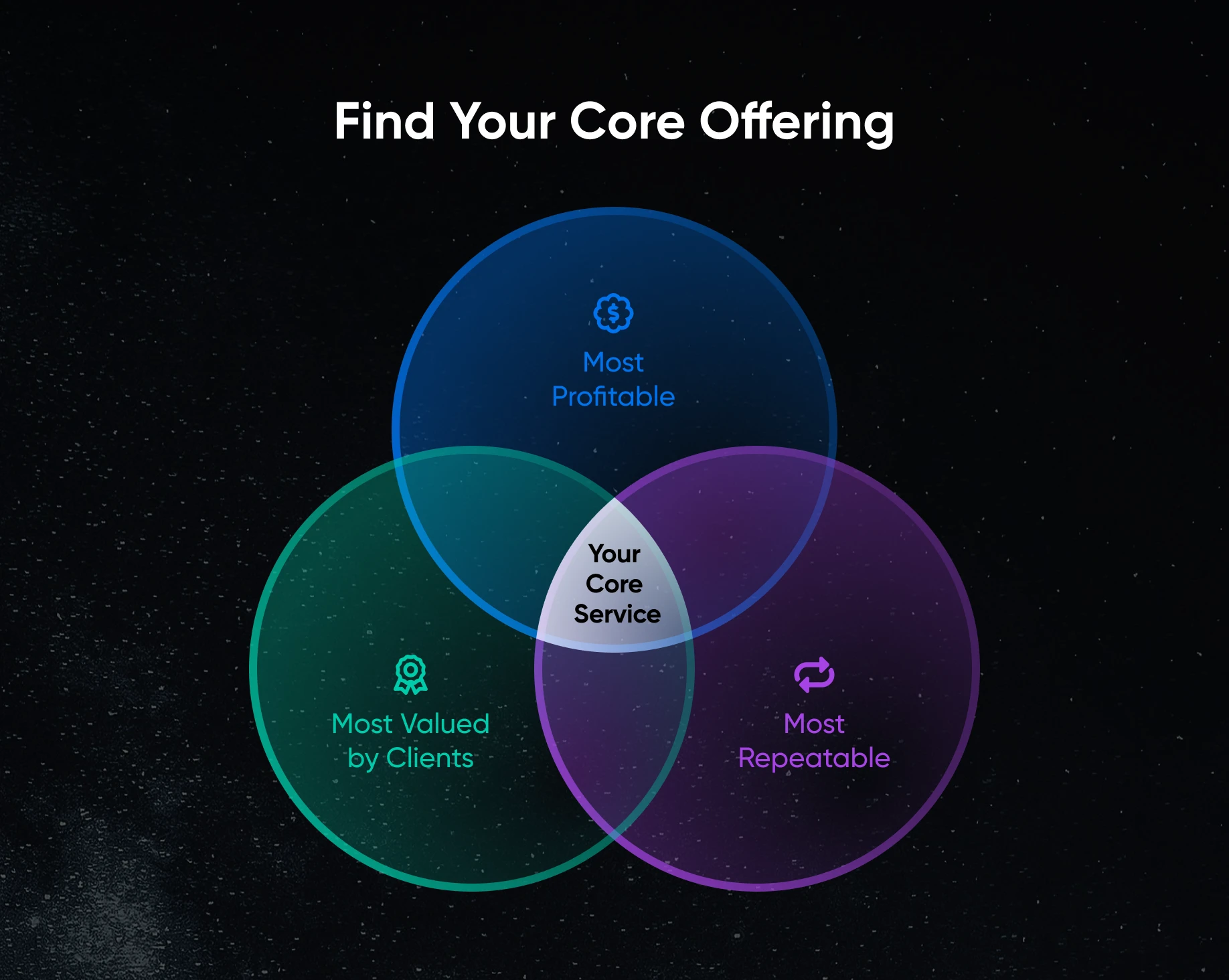
Start by auditing your last 12 months of projects. Ask:
- Which were most profitable?
- What did clients value most?
- Which services are most repeatable?
You’ll find your core service offerings where those three circles overlap.
More About Reseller Hosting
Reseller hosting is a service where an individual or company buys server resources like storage and bandwidth from a web host at wholesale rates, then resells them to clients under its own brand. The reseller sets prices and handles billing and first-line support, while the parent host maintains the servers and network.
You can expand later as you stabilize and add capacity to train employees on new services. Here’s how agencies typically structure their service offerings:
| Tier | Description | Purpose |
| Core offerings | Your primary service — highly systematized | Reliable revenue, delivered by your team |
| Premium service | Core + a strategic layer (consulting, custom work, etc.) | Higher margins, but requires senior involvement |
| Retainer | Ongoing support, updates, optimization | Recurring revenue, predictable cash flow |
Premium positioning
Price is a signal — and clients read it both ways. Set a low rate, and they wonder why. A premium rate can signal expertise, but it also narrows your buyer pool. It works only when your proof and delivery support it. The proof looks like this:
- Clear before-and-after examples
- Specific client outcomes
- Case studies
- Testimonials
- A strong discovery process
- A defined methodology
- Better client education
- Reliable project management
- A polished website with clear service pages
- Visible trust signals, such as credentials, reviews, media mentions, or client logos
Notice what the strongest versions of that proof share: numbers and terms a buyer can verify. A case study that says “organic leads up 62% in six months for a regional HVAC company” beats “we do SEO.” The same goes for how you work: publishing your engagement models (retainer, fixed-price, or hourly), who owns the finished work, and how quickly you respond removes friction before the first call. Clarity about how you do business is itself a trust signal.
If prospects can’t immediately understand what you do, who you help, and why they should trust you, they probably won’t buy from you. And that’s why you need a great website. It’s where referrals go to validate you, where inbound leads decide whether to inquire, and where prospects look for proof that your business can meet their needs.
The positioning work makes the selling easier
Strong positioning is more of an operational decision than just a tagline. The tagline is the menu cover; the real work is deciding what the kitchen stops cooking. In practice, committing to a position means:
- Retiring services outside your core offer, even ones you can technically deliver
- Declining (or referring out) leads that don’t fit, once your niche pipeline can absorb the hit
- Rebuilding your case studies and portfolio around the niche you’re claiming
- Repricing to reflect expertise, because specialist pricing is part of the signal
Skip those commitments and you’ve reprinted the menu without changing the kitchen. The same scattered orders keep coming in, delivery doesn’t improve, and within a couple of quarters it’s tempting to conclude that positioning “didn’t work.” The messaging was never the problem; the decisions behind it never happened.
When your agency knows who it serves and what it solves, it makes almost every other business decision easier and cleaner. Your website gets sharper. Your sales calls get smoother. Your team understands what great delivery looks like because the target no longer moves every time a new lead appears.
When a prospect lands on your website, reads your service page, or hears your pitch, they should be able to think quickly and confidently: “This is for me. They understand the problem. I know what to do next.” That’s the power of positioning: a shorter menu, where every dish is one your kitchen is known for.
Agency positioning FAQs
How do you position an agency?
Answer three questions: who do you serve, what problem do you solve, and why are you the obvious choice? Write it as one sentence (“We help X who struggle with Y by providing Z”), then enforce it operationally: narrow your services, rebuild your case studies, and reprice.
What makes agency positioning good?
Good positioning is specific, believable, and provable. A prospect should read one sentence and know whether your agency is for them, what outcome to expect, and why you can deliver it. If your statement could describe a thousand other agencies, it isn’t positioning yet.
Should you hire an agency for positioning or do it yourself?
Most agencies can do this work themselves, because the raw material is your own project history and client feedback. Bring in outside help when you’re too close to see the patterns or your team can’t agree. A facilitator speeds up the decision; they can’t make it for you.
What are the best agency positioning strategies?
Specialize by industry, business stage, platform, outcome, service model, or audience. Pick the axis where you have demand evidence, existing client proof, and profitable past work, then commit operationally: narrow your services, rebuild case studies around the niche, and price like the specialist you’ve become.

Ready to Scale From Freelancer to Agency?
A free playbook for freelancers deciding whether to build a team: positioning, hiring, sales, finances, and the math to decide if scaling is right for you.
Get the Free eBook