
Take a look at your phone for a second. No, really. Pick it up and look at it. And notice how you’re holding it.
Odds are it’s upright in one hand, with a thumb in scrolling position. And you have no intention of rotating in sideways unless something really earns that effort. No, we’re not watching you. Or psychic. That’s just how everyone holds phones.
That small, unconscious behavior explains why vertical video is suddenly everywhere — not because social platforms woke up one day and decided to reinvent video, but because the web quietly reorganized itself around how people actually use their devices.
For businesses, it’s understandable if the shift is creating a little bit of whiplash. For a long time, you were told not to film vertically, and now it’s non-negotiable. And not only are you expected to keep up with the change, but you have to create content without a video team or a massive budget. That’s a tall order.
In this article, we’re breaking down vertical video: what it is, why it works from a behavioral and economic standpoint, and how small businesses can respond strategically, even with limited marketing budgets.
What Is Vertical Video?
Vertical video is video created in a portrait orientation (typically a 9:16 aspect ratio), designed to fill the entire screen on a mobile device without requiring the viewer to rotate their phone.
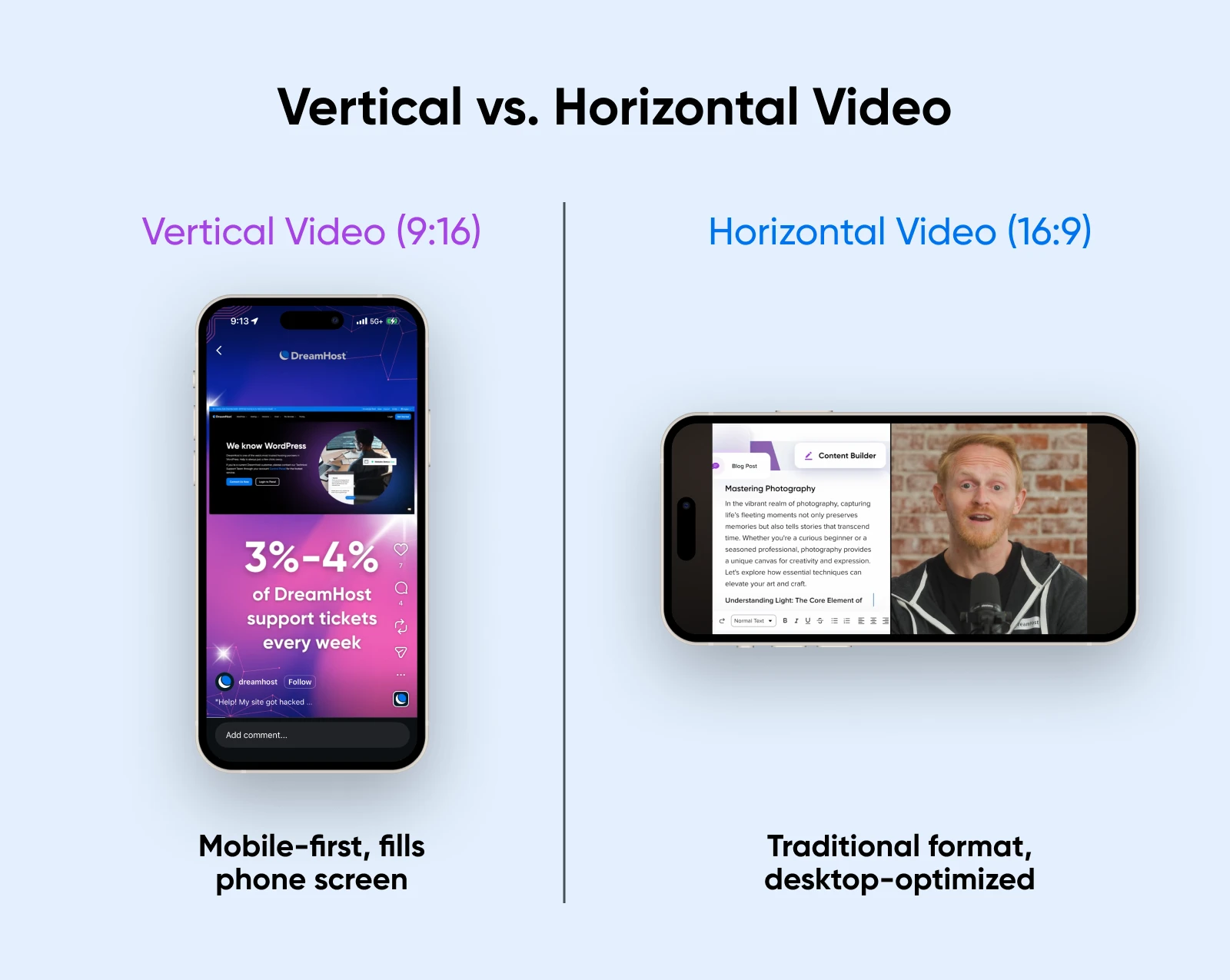
You’ll see vertical video across nearly every major platform today, from short-form feeds to Stories and ads. While it’s often associated with social media, vertical video is a format, not a platform feature.
Here’s how vertical video compares to other common formats:
| Format | Aspect Ratio | Typical Use Case |
| Vertical | 9:16 | Reels, Shorts, TikTok, Stories, mobile ads |
| Square | 1:1 | Legacy feeds, some ads |
| Horizontal | 16:9 | Long-form YouTube, webinars, site embeds |
Also, it’s important to note that vertical does not automatically mean low production quality, and it doesn’t mean content must be disposable or unserious.
Why Is Vertical Video Everywhere Right Now?
Vertical video is everywhere because mobile-first consumption is no longer an alternative behavior — it’s the default.
Smartphones now dominate online video viewing. In the United States, 79% of consumers watch online video on their smartphones every week, reinforcing that mobile screens — not desktops — are the primary viewing environment for most people. Globally, multiple industry reports show mobile accounting for the majority of digital video consumption, with that share continuing to grow year over year.
A few other forces are working simultaneously to reinforce the shift toward vertical video:
- Efficiency: Vertical video fills the screen, captures attention faster, and reduces visual competition.
- Platform economics: Social platforms optimize for formats that keep users engaged longer, which drives ad revenue.
Also important is the order of causality. Platforms didn’t create the demand for vertical video — they responded to it. Algorithms, ad formats, and creator tools followed audience behavior, not the other way around.
In other words, vertical video isn’t winning because it’s new. It’s winning because it’s easier for users. It’s as simple as that.
Is Vertical Video a Trend — or a Permanent Shift?
While vertical video may not be permanent (is anything on the web?), it’s also not a passing trend, because it’s rooted in human behavior and reinforced by platform economics. Trends come and go when platforms change priorities. Behavioral shifts stick around when they align with how people naturally use technology.
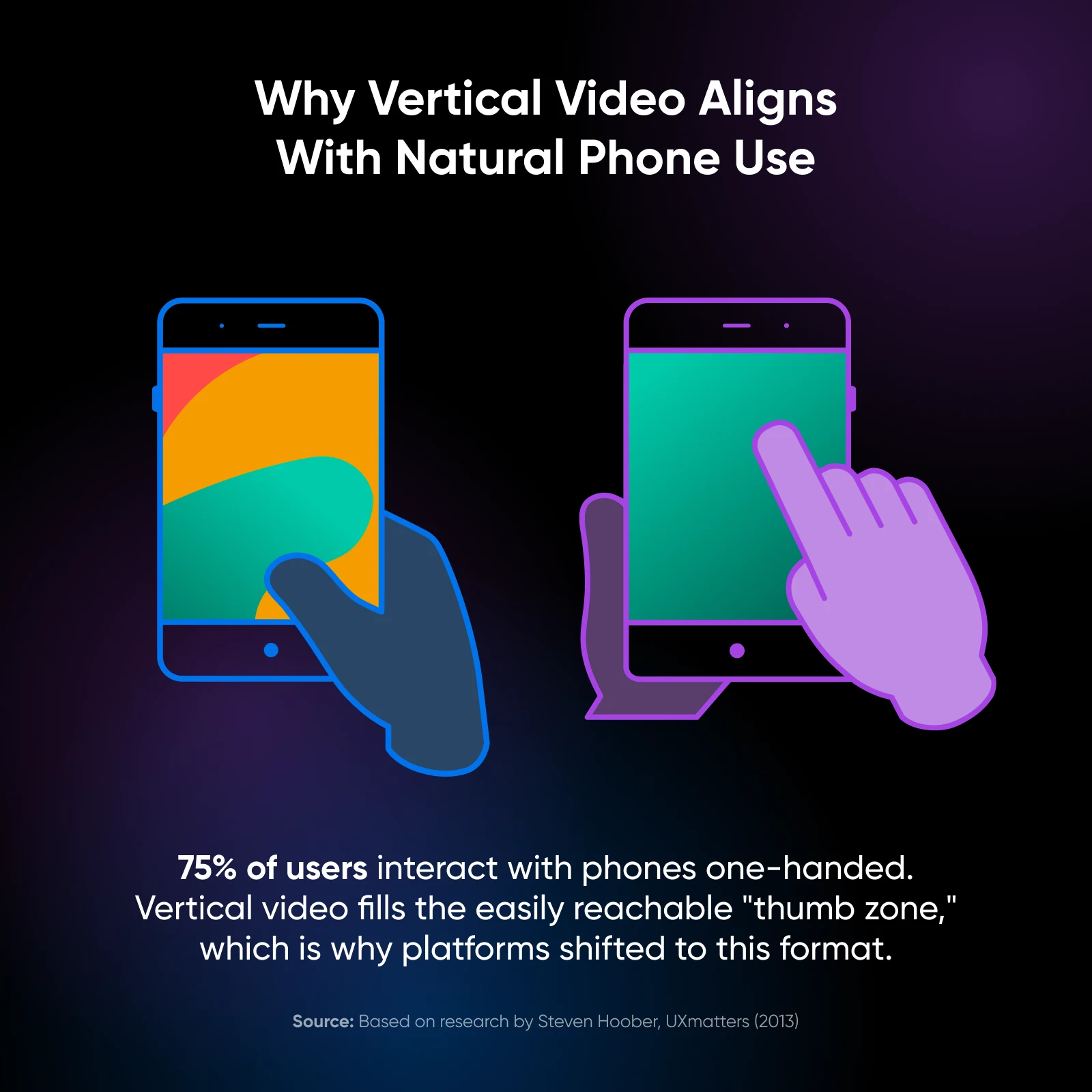
The core behavior has been ramping up for years: more and more people use smartphones as their primary screen, and they hold them upright. What has changed is that platforms finally reorganized around that reality. Vertical video didn’t replace horizontal video everywhere, but it became the default for discovery, scrolling, and casual viewing.
That’s why every major platform, from TikTok to YouTube to Instagram to LinkedIn, independently moved toward vertical video over time. They weren’t copying each other; they were responding to the same audience signals.
Horizontal video still exists for intentional, lean-back viewing, while vertical video dominates casual, in-feed, discovery-driven experiences. Both formats have a place, and as a business, it’s necessary to understand the distinction.
What Are the Real Business Benefits of Vertical Video?
The real business benefit of vertical video is attention efficiency — it helps you earn more attention with less friction in the environments where people already spend their time.
That doesn’t mean vertical video magically guarantees conversions or sales, but it does mean the format improves your odds at the very top of the funnel by meeting audiences where they are, in the way they prefer to consume content.
The main benefits are:
- Faster attention capture: Vertical video fills the entire screen, eliminating competing visual noise and helping your message register more quickly.
- Stronger alignment with discovery: Most discovery on social platforms happens in vertical feeds, making the format well-suited for introducing your brand, product, or expertise.
- Better return on production effort: Vertical videos are often shorter and simpler to produce, which makes consistent publishing more achievable for small and budget-constrained teams.
- Improved performance for paid distribution: Advertisers increasingly favor short-form, mobile video because it performs better in feed-based environments, which is why mobile and short-form video dominate ad spend growth.
That said, vertical video shouldn’t replace your existing marketing efforts. Any marketing channel should fit within an overarching strategy, where different platforms and efforts work together to support your business goals.
Vertical video helps your ideas, offers, and expertise travel further in a mobile-first world, often without requiring an enterprise budget or full-scale marketing team, and for that, it should be treated as a powerful tool.
Which Vertical Platforms Matter Most for Businesses?
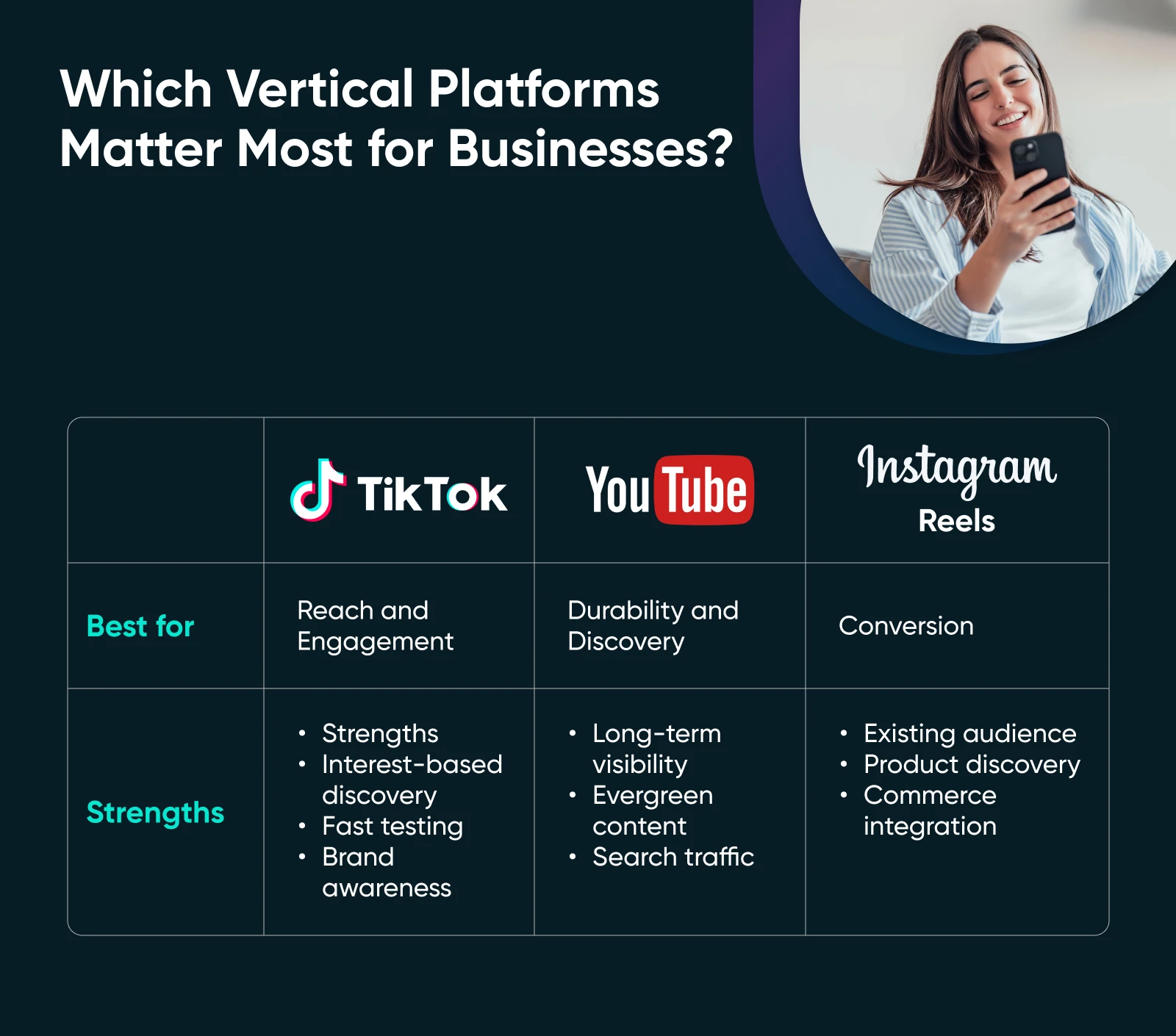
No single platform universally “wins.” TikTok, YouTube Shorts, and Instagram Reels each deliver value in different ways, depending on your business goals. The real difference between platforms comes down to how attention is generated, how long it lasts, and what that attention is most likely to do next.
TikTok, YouTube Shorts, and Instagram Reels all prioritize vertical video, but they serve different strategic purposes. Treating them as interchangeable is most likely to lead to frustration, because success on each platform is driven by slightly different mechanics.
Rather than asking “Which platform should I pick?” a better question is “What outcome am I optimizing for?”
- If you want reach and engagement, go with TikTok.
- If you want durability and discoverability, go with YouTube Shorts.
- If you want conversion within a known audience, go with Instagram Reels.
Understanding the differences and playing to each platform’s strengths allows you to allocate effort intentionally rather than a “spray and pray” approach where you try to win everywhere all at once.
TikTok: Why Does It Drive Outsized Engagement?
TikTok drives outsized engagement because it’s optimized for interest-based discovery. Content is distributed primarily based on predicted relevance, not who you already follow.
Why does that matter? On TikTok, a video from a small or unknown business can reach a large audience if it aligns with viewers’ interests. The algorithm tests content quickly, expands reach when engagement signals are strong, and deprioritizes content that fails to hold attention.
Independent platform analyses consistently show TikTok outperforming other short-form platforms on engagement metrics, delivering higher average engagement rates than Instagram Reels and YouTube Shorts across most content categories.
This engagement advantage is one reason TikTok has become such a powerful discovery engine. Market analyses estimate TikTok holds roughly 40% of the short-form video market, significantly more than individual competitors.
For businesses, this makes TikTok especially effective for:
- Brand awareness and early-stage discovery.
- Trend-driven or educational content.
- Testing messaging quickly with minimal production overhead.
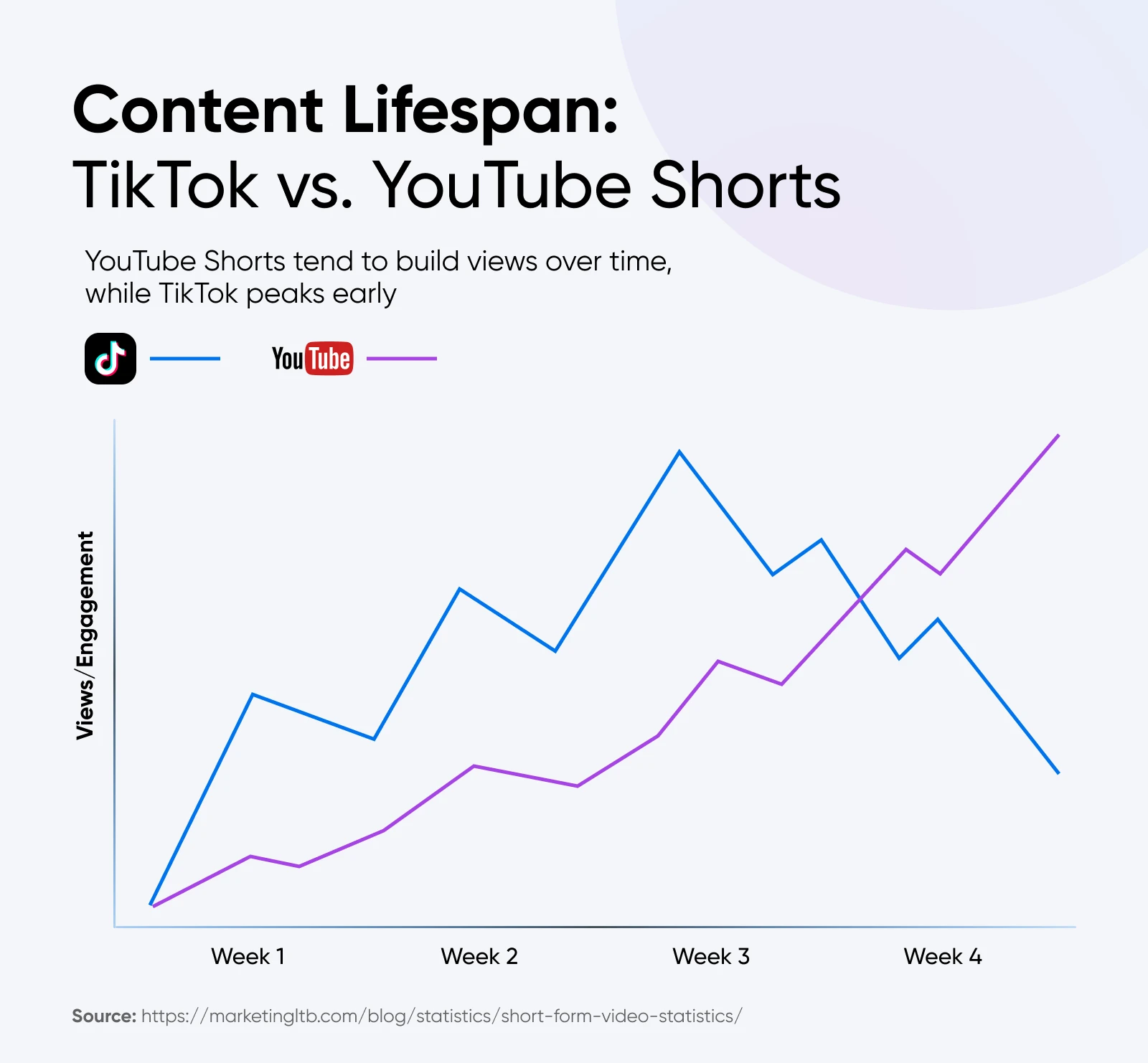
However, the tradeoff is durability. TikTok content often peaks fast and fades fast. Engagement can be intense, but it’s usually short-lived unless you reinforce it with consistent publishing.
YouTube Shorts: Why Does It Last Longer?
YouTube Shorts lasts longer because it’s connected to the broader YouTube ecosystem, which is built around search, recommendations, and long-term discovery. Unlike purely feed-driven platforms, YouTube continues resurfacing content well after it’s published.
Shorts benefit from YouTube’s recommendation engine, which blends short-form videos into homepages, subscriptions, and suggested content alongside long-form videos. That means a Short can continue accumulating views weeks or even months after posting.
Scale also plays a role. YouTube Shorts generates hundreds of billions of views daily, supported by YouTube’s massive global user base. That scale increases the odds of content being rediscovered over time.
For businesses, YouTube Shorts works well when:
- Content is educational or evergreen.
- Videos can support or complement long-form content.
- Search visibility and long-term traffic matter.
The key advantage is longevity. A single Short can act as a long-running entry point into your broader content library, rather than a one-day engagement spike.
Instagram Reels: Why Does It Convert?
Instagram Reels converts well because it operates inside an ecosystem built around identity, relationships, and commerce. Users often encounter Reels from accounts they already recognize or brands they already follow.
Unlike TikTok’s primarily interest-driven discovery model, Instagram places more weight on existing social graphs. That makes Reels particularly effective when a business already has an audience or visual brand presence on Instagram.
Meta’s financial disclosures underscore how commercially important this format has become. The Wall Street Journal reported that Meta’s Reels products have reached an estimated $50 billion annual revenue run rate, driven largely by advertising and commerce integrations.
For businesses, Reels tends to perform best when:
- The goal is product discovery or conversion.
- Visual storytelling supports brand trust.
- Content connects naturally to shopping, profiles, or links.
Reels may not always deliver the same raw engagement spikes as TikTok, but it often produces stronger downstream actions, like profile visits, saves, and purchases, especially for e-commerce and service-based brands.
How Should Small Businesses Approach Vertical Video To Maximize Resources?
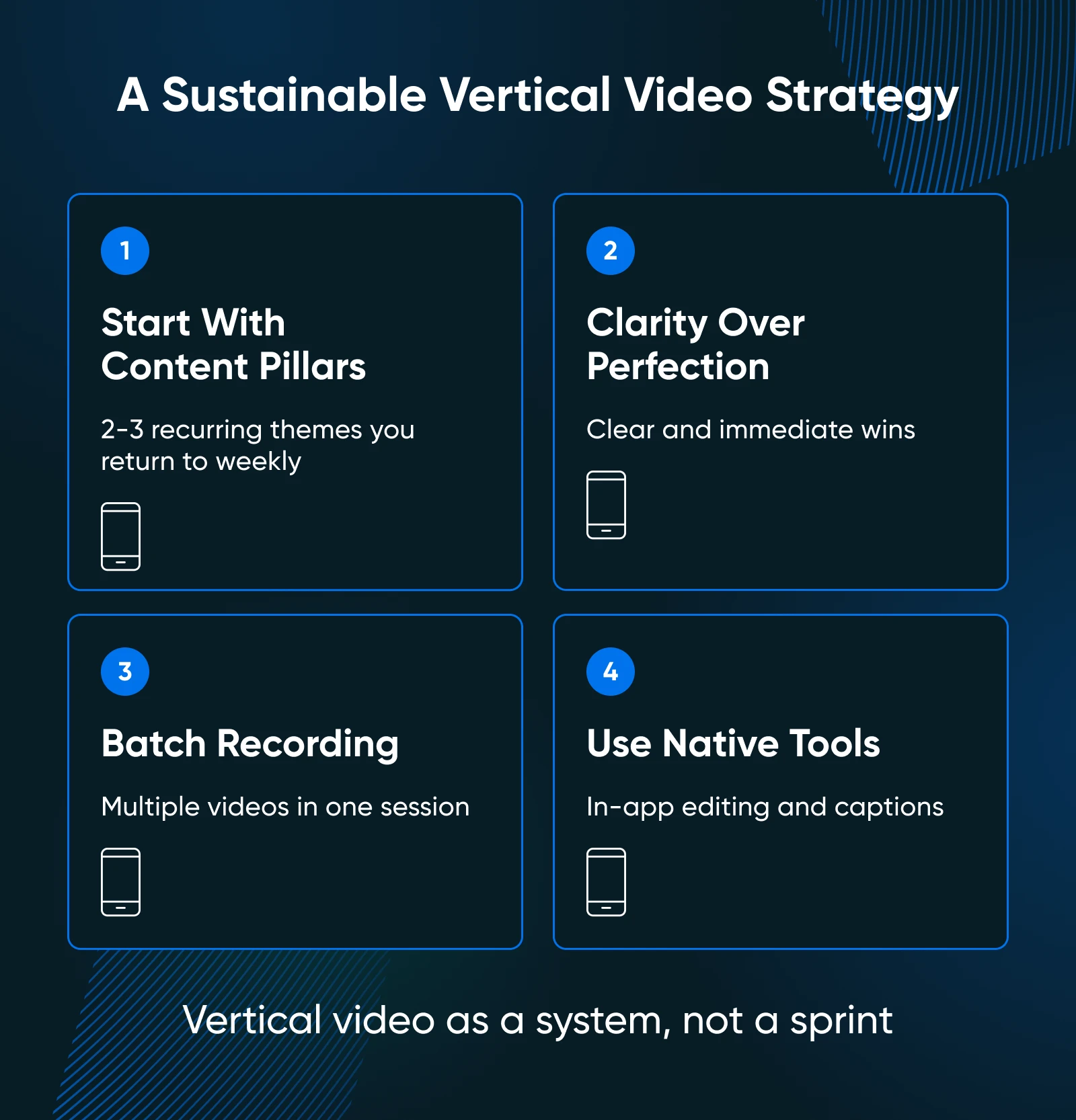
Small businesses should approach vertical video as a system, not a content sprint. Rather than post everywhere or chase trends, your goal should be to create a repeatable process that fits alongside everything else you already manage.
The most effective approach starts with constraint, not ambition. Limited time, limited budget, and limited headcount are normal. Vertical video works best when it’s designed around those realities instead of fighting them.
A resource-efficient strategy usually includes a few core principles:
- Start with content pillars, not ideas: Choose 2-3 recurring themes you can return to every week, such as FAQs, quick tips, behind-the-scenes moments, or product explanations.
- Design for short attention, not perfection: Vertical video performs because it’s clear and immediate, not because it’s polished.
- Batch whenever possible: Recording several videos in one sitting reduces setup time and decision fatigue.
- Use the platforms’ native tools: In-app editing, captions, and templates are optimized for speed and distribution, which is why many creators and small teams rely on them instead of external software.
Don’t think of vertical video as an extra channel — think of it as a more efficient way to distribute ideas you already have. When treated that way, it becomes sustainable instead of overwhelming.
What Technical Basics Matter With Vertical Video?
Only a small set of technical fundamentals actually matter for vertical video. Once those are covered, adding more complexity actually delivers diminishing returns.
Most platforms have the same baseline requirements:
| Requirement | Best Practice | Why It Matters |
| Aspect ratio | 9:16 | Matches how phones are held |
| Resolution | 1080×1920 | Prevents compression artifacts and maintains clarity across devices |
| Safe zones for text placement | Keep text centered | Keeps important text away from edges and avoids UI overlays |
| Captions | Always include | Supports accessibility and silent viewing |
Following these best practices reduces friction for viewers, so don’t think of them as arbitrary platform rules. Beyond that, technical perfection rarely determines success. Clear messaging, strong hooks, and relevance consistently matter more than camera specs or editing effects.
What Mistakes Should Small Businesses Avoid With Vertical Video?
Most vertical video failures come from strategic mistakes, not creative ones. These issues are common, avoidable, and far more costly than minor production flaws.
Here are some common pitfalls to avoid:
- Treating every video like an ad: Viewers respond better to clarity and usefulness than sales language.
- Starting too slow: The first second matters because feeds reward immediate engagement.
- Ignoring captions: Many users watch without sound, especially in public or at work.
- Posting without a destination: Attention without a next step rarely delivers business value.
These mistakes often stem from a misunderstanding that vertical video is a discovery and distribution format, not a closing mechanism. Expecting it to do everything leads to disappointment.
Businesses that avoid these pitfalls tend to treat vertical video as one part of a broader system, where attention flows from social feeds to owned assets like websites, landing pages, and email lists.
What Does the Web Going Vertical Actually Mean for You?
Vertical video isn’t a trend you can wait out. It’s the visible result of a deeper shift in how people use the web: on phones, in motion, one scroll at a time.
For small businesses, that doesn’t mean becoming a full-time content creator or rebuilding your marketing from scratch. It means recognizing that format matters, attention is mobile-first, and distribution now favors content that fits naturally into everyday behavior.
The businesses that succeed with vertical video aren’t the loudest or the most prolific. They’re the ones that approach it deliberately to earn attention efficiently, connect it back to systems they control, and move on.
Once you understand that, vertical video stops feeling like pressure and becomes what it actually is: a practical format for a mobile-first web.

Get More Visitors, Grow Your Business
The best-designed site is worthless if no one can find it. Leverage proven online marketing strategies and techniques to help more of your target audience find you.
See MoreFAQ
1. Is vertical 16:9 or 9:16?
Vertical video is 9:16, not 16:9. A 9:16 aspect ratio means the video is taller than it is wide, which matches how smartphones are naturally held. 16:9 is horizontal (landscape), which is designed for TVs, desktops, and lean-back viewing. If you’re creating video for mobile-first feeds like Reels, Shorts, or TikTok, 9:16 is the correct and expected format.
2. How to do a vertical video?
You make a vertical video by filming or exporting your video in a 9:16 aspect ratio and designing it for full-screen mobile viewing. That usually means:
- Filming with your phone held upright
- Keeping the subject centered and readable
- Adding captions or on-screen text for silent viewing
- Exporting at 1080×1920 resolution
3. Can I convert horizontal video to vertical?
You can convert horizontal video to vertical, but it requires intentional editing. For example, you can’t just crop a 16:9 video into 9:16—that would cut out important visual information or make the video feel awkward. Instead, you may need to:
- Reframe the subject to keep it centered
- Crop strategically rather than automatically
- Break long horizontal videos into shorter vertical clips
- Add text or captions to replace lost visual context
4. What are common mistakes in vertical video editing?
Most mistakes in vertical video editing are about usability, not creativity. These include:
- Using the wrong aspect ratio, resulting in letterboxing or awkward crops
- Placing text too close to the edges, where platform UI covers it
- Skipping captions, even though many viewers watch without sound
- Over-editing, which slows down production without improving results
- Starting too slow, instead of delivering a clear hook immediately
Anything that adds friction, like confusing framing, unreadable text, or unnecessary effects, works against the format.