
Dangerously close to half of the web today is dependent on what is largely one person’s work: Danack.
Danack, a portmanteau of Dan Ackroyd, is the singular maintainer of Imagick — a PHP extension that enables WordPress’ most popular image processing tool, ImageMagick, to work.
via GIPHY
Pretty much every time you or a client uploads an image to WordPress, or you see a thumbnail on a website, there’s a pretty good chance Danack’s open source contributions made it possible.
While it may seem outlandish that just one person is fully responsible for maintaining what’s become a critical piece of tech upon which WordPress websites rest, unsung heroes like him are actually more common than those outside of the web development community realize.
In an age of burgeoning, powerful, but faceless, AI tools, join us in exploring and celebrating the individual people who still make the web possible.
Danack and the Imagick Story
Because of the (ironically) offline and privacy-minded way that many people who work online are, we don’t know that much about Danack’s backstory.
The self-proclaimed “recovering video game developer” began as a web programmer at Sun Microsystems in the late 90s. He became the lone maintainer of Imagick in 2014, which he still does now over a decade later, supported only by GitHub Sponsors. This, in addition to his commitment to improving PHP as a whole via RFCs, makes it clear he is just as much a champion of open-source technology as we are.
Open Source
In software development, open source projects are free for anyone to download, use, modify, and distribute. WordPress is one great example of open source software, although it’s far from the only one.
Read MoreWhat is it that makes this choice to preserve Imagick so important?
Understanding that all starts with getting to know the tool it was built to serve: ImageMagick.
ImageMagick is an open-source program for creating and editing images, especially in bulk. Unlike consumer-facing apps like Photoshop, it doesn’t have an easy-to-use interface to do this. That’s why it’s most often integrated into other tools via API.
Sounds pretty useful, right?
Right.
Except…it doesn’t work directly with WordPress.
Enter Imagick.
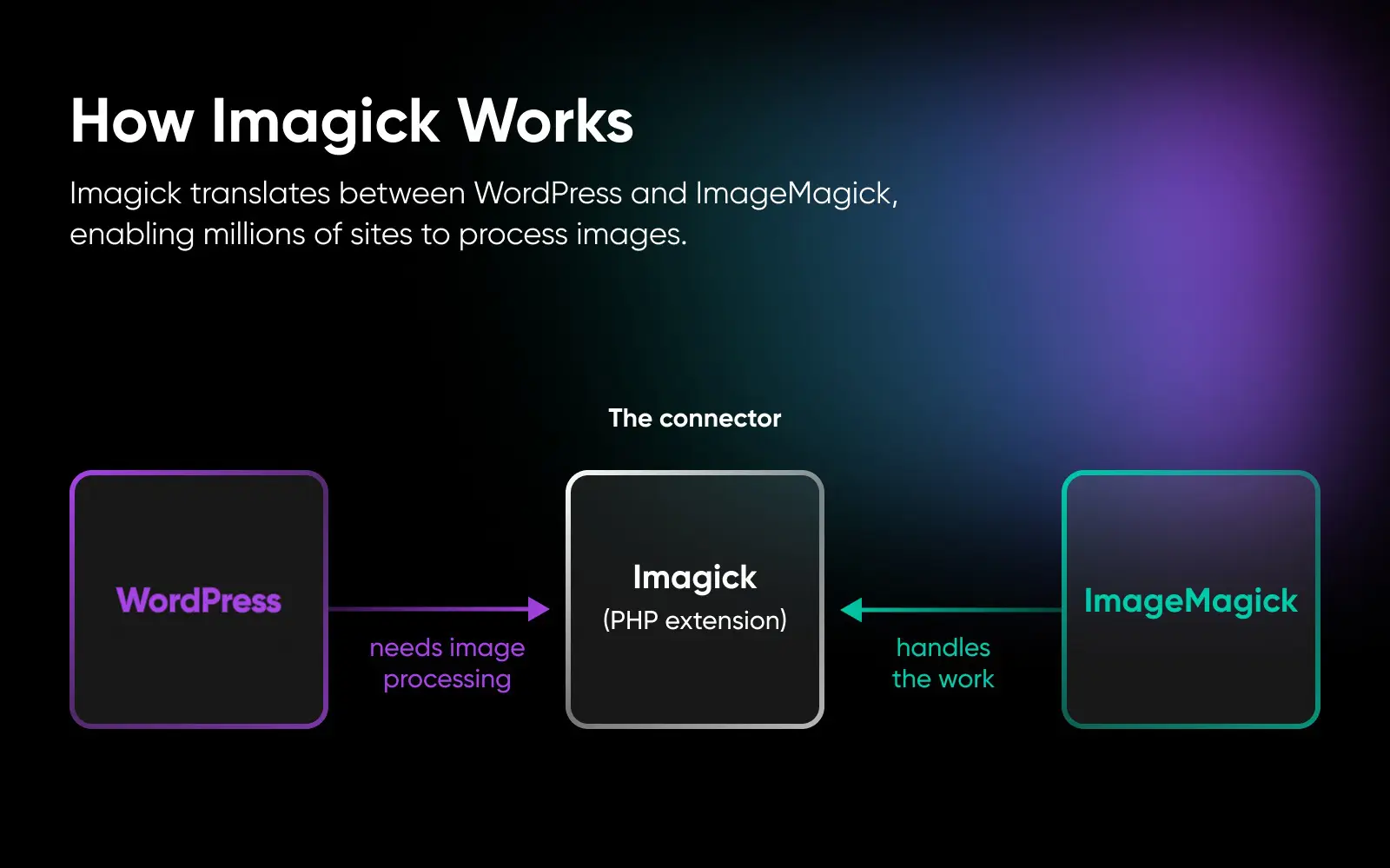
Imagick is an extension written in PHP (like much of WordPress) that acts sort of like “connective tissue,” allowing WordPress and ImageMagick to work together seamlessly.
What Makes Imagick a Pillar of the Modern Web?
If ImageMagick is made available on a server by a web host, WordPress will automatically use it as its default image processor. It’s easy to use and it’s become one of the most well-known tools of its type thanks to its functionality — even compared to the PHP-native GD library.
Comment
byu/cangaroo_hamam from discussion
inPHP
Yeah, we’re talking about the same WordPress that powers more than 43% of all the websites on the internet.
That means millions of sites (precariously close to half, even) depend on Imagick to enable WordPress to use ImageMagick for image processing.
To put it plainly: if Imagick were to stop working, a large portion of the web could experience serious image-related problems. And it would spell certain death for image-reliant sites, like those in the retail space.
Imagick, a relatively small piece of individually-maintained software, quietly helps keep the modern internet running smoothly.
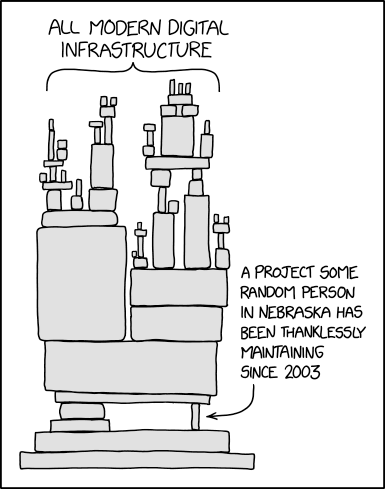
It’s a great example of where we are today with technology dependency — where many larger systems rely on small, often-overlooked, and critically under-maintained tools to function properly.
Other Examples of Tech Dependency — and the People Behind Them
The situation with Imagick is not all that unusual.
In fact, several aspects of the web are built on a complex network of dependencies just like it. Let’s take a gander.
Contact Form 7 for WordPress

With more than ten million active downloads, Contact Form 7 is a massively popular plugin that powers simple contact forms for WordPress.
More than a decade on, it’s still maintained by its author, Takayuki Miyoshi, and their company, Rock Lobster; which we suspect is made up of just a handful of people, if not only Miyoshi alone.
Contact Form 7 is old (in the scheme of plugins), has a huge install base, and is maintained by a very small number of people. This, too, is a classic case of tech dependency and a recipe for potential disaster if maintenance stumbles.
The XZ Utils Hack
XZ Utils is a free set of tools that help with lossless data compression.
In 2024, its founder and head maintainer gave co-maintainer status to a user who had cozied up to them and gained their trust. This new maintainer, going by the name Jia Tan, signed off on version 5.6.0, which introduced a dangerous backdoor that would allow malicious actors to access the entire operating system once installed.
This backdoor was ranked among the most severe security vulnerabilities, but was thankfully caught before the version was widely adopted.
So, it’s easy to wonder if, had a larger team been involved in the management and testing of the newest version of XZ Utils, it would have ever been released at all.
Left-pad and NPM
In 2016, indie developer Azer Koçulu removed the small-but-mighty package they had built — left-pad — from NPM, which is the default package manager for Node.js. This action was in response to NPM taking over one of Koçulu’s other projects, which they did to comply with a legal dispute with a large instant-messaging app.
In the developer’s words: “This situation made me realize that NPM is someone’s private land where corporate is more powerful than the people, and I do open source because Power To The People.”
As it turns out, thousands of projects depended on this handful of code!
When major tools like Babel and React stopped working, huge companies like Facebook, PayPal, Netflix, and Spotify had to scramble to fix the fallout.
The Reality of Maintaining Critical Open-Source Infrastructure
We believe open-source technology is incredibly important to the modern internet, and yet it also exists in an incredibly delicate limbo.
First, it’s a fragile setup. The digital world we rely on every day often depends largely on a handful of largely unpaid people (shoutout to the XZ hack for bringing this to light). That means many crucial open-source tools are just maintained in someone’s spare time.
If these behind-the-scenes heroes get sick, burned out, or simply move on, things can unravel shockingly fast.
It’s also often thankless for these volunteers. Maintainers rarely get recognition when everything runs smoothly, yet they have to deal with all the backlash when something breaks.
In Danack’s case, there have been times when updates didn’t roll out as quickly as users wanted, and people got upset.
His response? If this software is so important to you, then support it!
“ … if having OpenSource projects be maintained is of value to you, please look at sponsoring the work I do: https://github.com/sponsors/Danack Or you can contact me via email if for any reasons going through github sponsors is not desirable.”
How To Recognize and Support Technology’s Unsung Heroes
The next time you upload an image to your WordPress retail site, close a deal that started with one of your website’s online forms, or rely on really any piece of software quietly working behind the scenes; take a moment to appreciate the individuals who make it possible.
But don’t stop there. If you’re able, supporting these maintainers is essential to keeping the modern internet stable and resilient.
As an independently-owned hosting company, we pride ourselves in supporting the open-source ecosystem at DreamHost not only with our developer-friendly tooling but also in our monetary sponsorship of indie devs on GitHub.
We hope you’ll join us in celebrating their commitment and generosity, and dedicate whatever real, ongoing support you can to keep the community thriving.

Unbeatable WordPress Hosting
Reliable, lightning-fast hosting solutions specifically optimized for WordPress.
See MoreFAQs About Imagick
What is Imagick?
Imagick is a PHP extension that connects WordPress to ImageMagick, enabling image processing like resizing, cropping, and thumbnails.
Who maintains Imagick?
A developer known as Danack has maintained it for over a decade, supported primarily through GitHub Sponsors.
Why is Imagick so important?
It powers WordPress’ image handling for millions of websites, making it a critical but overlooked piece of web infrastructure.
How can I support Imagick or similar projects?
You can sponsor maintainers like Danack on GitHub (https://github.com/sponsors/Danack) or contact them directly if needed. Supporting open-source helps keep the web stable.
