Picture this: a frazzled parent types “Plan my kid’s birthday party under $300” into ChatGPT. Within seconds, they’ve got a theme, a supply list, and links to buy everything — cake topper, streamers, party favors, and bags — without ever typing a URL or landing on a homepage.
Meanwhile, a 20-something scrolling TikTok at 11 p.m. watches a creator demo a skincare routine, taps “buy,” and has three products headed to their door before the video ends.
These are hardly hypotheticals anymore.

TikTok Shop hit $33.2 billion in global gross merchandise value (GMV) in 2024, with $9 billion from the U.S. alone: a 650% year-over-year explosion just 16 months after launch. The broader U.S. social commerce market has already reached $114.7 billion in 2025. And Morgan Stanley predicts that nearly half of U.S. online shoppers will be using AI shopping agents by 2030, potentially adding $115 billion to e-commerce.
If you’re a merchant reading those numbers, you might feel the ground shifting beneath your carefully optimized product pages. Should you abandon your website and go all-in on social? Is your homepage about to become as relevant as a phone book?
Well, here’s where things get interesting. DreamHost’s Local Business Trust Index found that shoppers are 7x more comfortable making purchases of $100 or more on a company’s website than through social media platforms. They’re also 14x more likely to spend $500+ on a website.
And their average comfortable spending amount? Just $36 on social platforms, versus $177 on a website.
So no, your website isn’t dead, but it might be changing jobs. Let’s unpack what’s happening and what it means for your online storefront.
The New Shopping Reality: Platforms Mediate, While Websites Reassure
Two forces are reshaping how people buy things online: the explosive growth of social commerce and the emergence of AI shopping agents. Together, they’re creating a world where your next customer might discover, evaluate, and even purchase products without ever intentionally visiting your website.
But there’s a persistent trust gap that keeps your owned digital presence more relevant than ever.
How Social Commerce and AI Agents Are Rewriting the Funnel
The numbers show a fundamental shift in where commerce happens. While social commerce has been growing for years, AI shopping agents represent something newer, and potentially even more disruptive. On Black Friday 2025, AI-driven traffic to U.S. retail sites surged 805% year-over-year, helping drive $11.8 billion in online spending, a new record.
The practical implications are significant. ChatGPT already has a Shopify integration for in-chat purchases. Amazon’s Rufus, Walmart’s Sparky, and Target’s ChatGPT integration are making AI-assisted shopping feel as natural as asking a store associate for help.
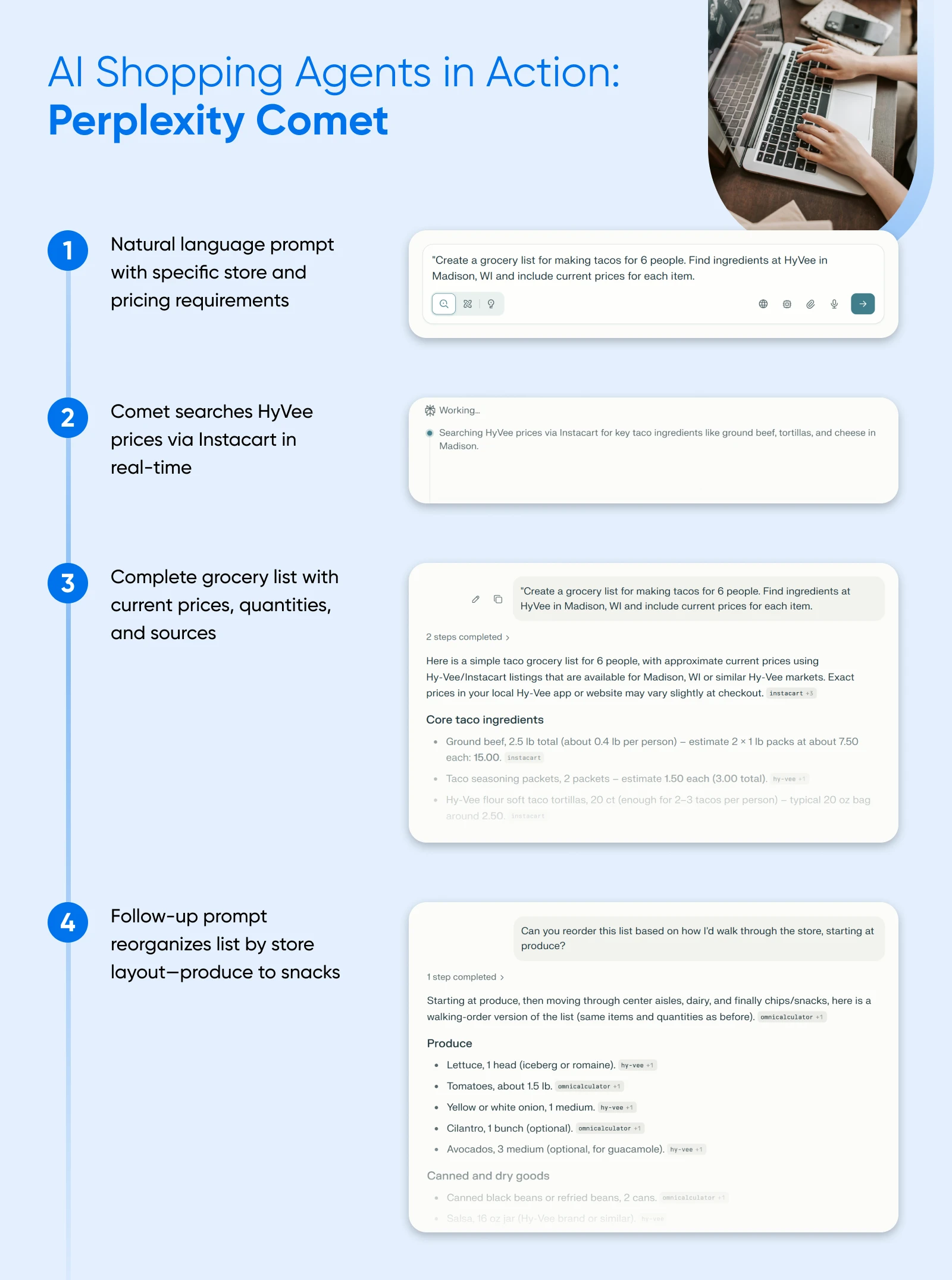
Plus, AI browsers, like Perplexity’s Comet, let users drop in a grocery list and have the AI add everything to their cart automatically.
Discovery, comparison, and increasingly even checkout are happening inside platforms and AI assistants — not on your homepage. But that’s only half the story.
The Trust Gap: Big Purchases Still Happen on Websites
For all the excitement around social commerce and AI agents, there’s a fundamental asymmetry in where people are willing to spend serious money.
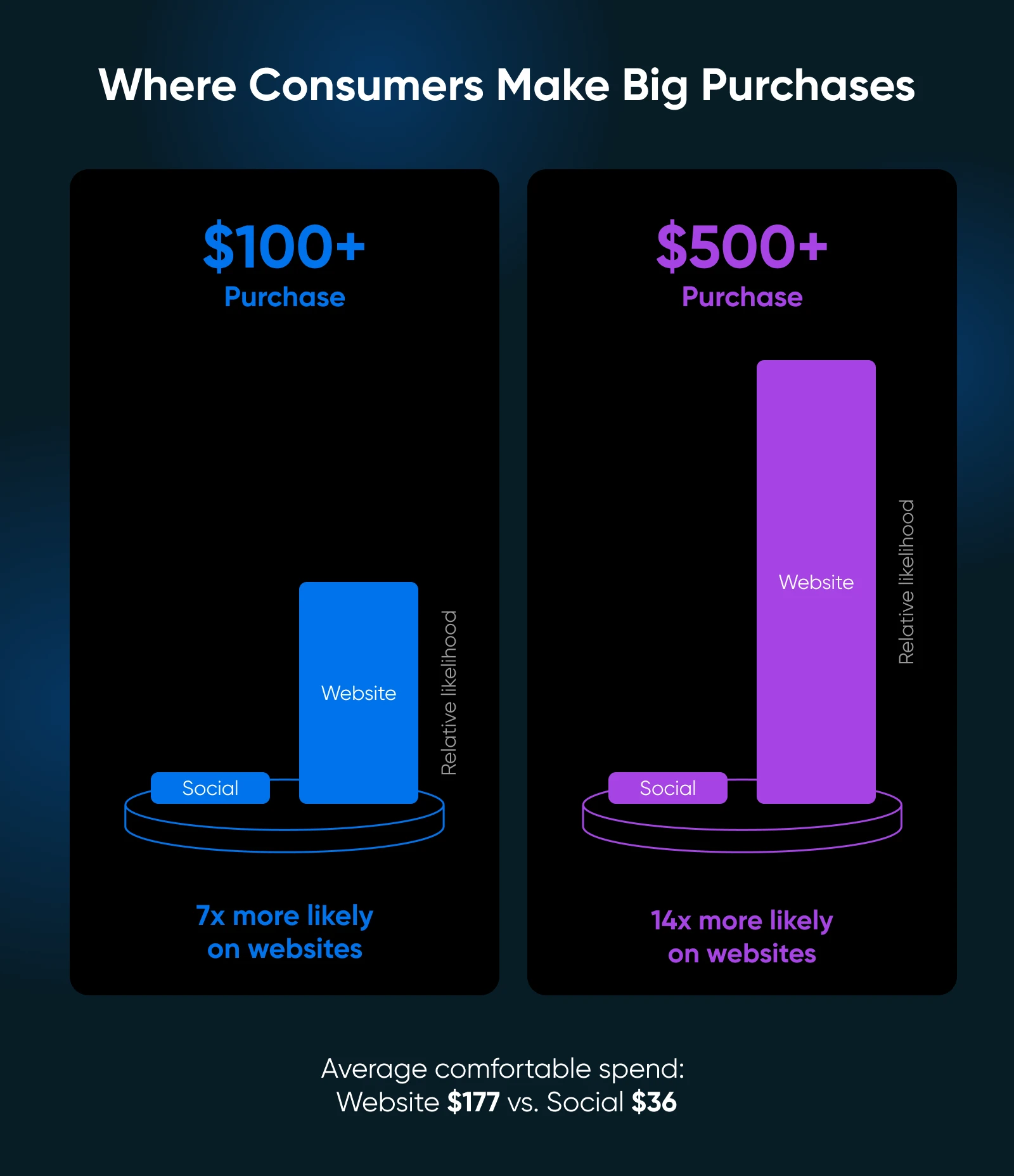
When we conducted our Trust Index survey in November, our findings were striking:
- Consumers are 7x more comfortable making high-value purchases ($100+) on a company’s website than through social media platforms.
- They’re 14x more likely to spend $500+ on a website versus social.
- Average spend comfort is just $36 via social media versus $177 via a business website.
- 33% of respondents said they wouldn’t feel comfortable spending any money through social media.
Social platforms are optimized for entertainment and discovery, not for detailed product information, clear return policies, and brand credibility signals that people need before making significant purchases.
What does this mean for retailers? Platforms excel at getting you seen, but your site is still where serious spending and long-term trust live.
3 Shifts That Actually Matter for Your Store
When you cut through the noise, we see three shifts that will actually shape how you sell online in the next few years.
Shift #1: Social Commerce Becomes the Impulse Layer
Think of social commerce as window shopping on steroids, especially for Gen Z and younger millennials. The format rewards scrolling, discovery, and split-second purchase decisions. You see something interesting in a 30-second video, you tap buy, it shows up in three days —the friction between “that looks cool” and “I own it” has essentially disappeared.
The platform isn’t replacing traditional e-commerce, but it is creating a new category: the ambient, entertainment-driven impulse buy.
👉What it means for e-commerce retailers: Use TikTok and Instagram as discovery engines and low-friction checkout points for products under $50: bundles, limited drops, trending items. This is your impulse shelf.
For higher-value items, use social content strategically to nudge people back to your website, where they can explore your whole brand story, detailed product specifications, shipping policies, and authentic customer reviews.
Shift #2: AI Shopping Agents Become Your Customer’s Personal Buyer
AI shopping agents are essentially digital personal shoppers that can follow instructions, stick to budgets, compare options across multiple retailers, and even complete checkout. They’re moving from novelty to infrastructure faster than many merchants realize.
The major players are already in the market: ChatGPT with Shopify integration, Amazon’s Rufus, Walmart’s Sparky, Target’s ChatGPT integration, and dedicated AI browsers like Perplexity’s Comet. These tools can create grocery lists, research products, compare prices, and automatically add items to carts.
AI agents aren’t making emotional decisions or responding to flashy graphics. They’re optimizing for specific criteria. Here’s how agents choose which products to recommend:
- Structured product data: Clear titles, complete attributes, accurate specifications.
- Transparent pricing: No hidden costs, clear shipping fees, honest total cost.
- Clear return policies: Agents need to be able to communicate terms to users.
- Inventory accuracy: Nothing frustrates an AI agent like recommending out-of-stock items.
- Reliability signals: Agents “learn” which stores deliver what they promise.
👉What it means for e-commerce retailers: Make your catalog machine-readablewith special attention to your data hygiene. Fill in product attributes consistently (materials, sizing, compatibility), use descriptive, honest product titles, add structured data/schema markup, and answer common questions directly on product pages so AI has something trustworthy to quote.
Shift #3: Commerce Moves Into Browsers and Super-Apps
AI-native browsers and OS-level assistants are making commerce feel like a conversation rather than a destination. Comet lets users create a grocery list and have the AI add items to their Instacart cart automatically. OpenAI’s Atlas browser is built around the same premise: tell it what you need, and it handles the shopping.
Meanwhile, retailer assistants like Rufus, Walmart’s AI tools, and Target’s ChatGPT integration are making checkout feel like one tap from anywhere. The boundary between “browsing the internet” and “shopping” is dissolving.
👉What it means for e-commerce retailers: Customers might first encounter your brand inside someone else’s interface, like an AI chat, a voice assistant, or a browser sidebar. This changes what they see first, but not what matters:
- Brand consistency: Your name, visuals, and positioning need to be recognizable when someone clicks through from an AI recommendation.
- Site performance: If your page loads slowly after someone arrives from a seamless AI experience, they’ll bounce.
- The destination experience: AI can recommend you, but your site closes the sale.
Where Your Website Fits: The Trust, Data, and Relationship Layer
In light of all of this, do you need to reframe what your website actually does?
Maybe.
Your site is no longer just an “online store”. Now, it’s the source of truth for everything else in your commerce ecosystem.
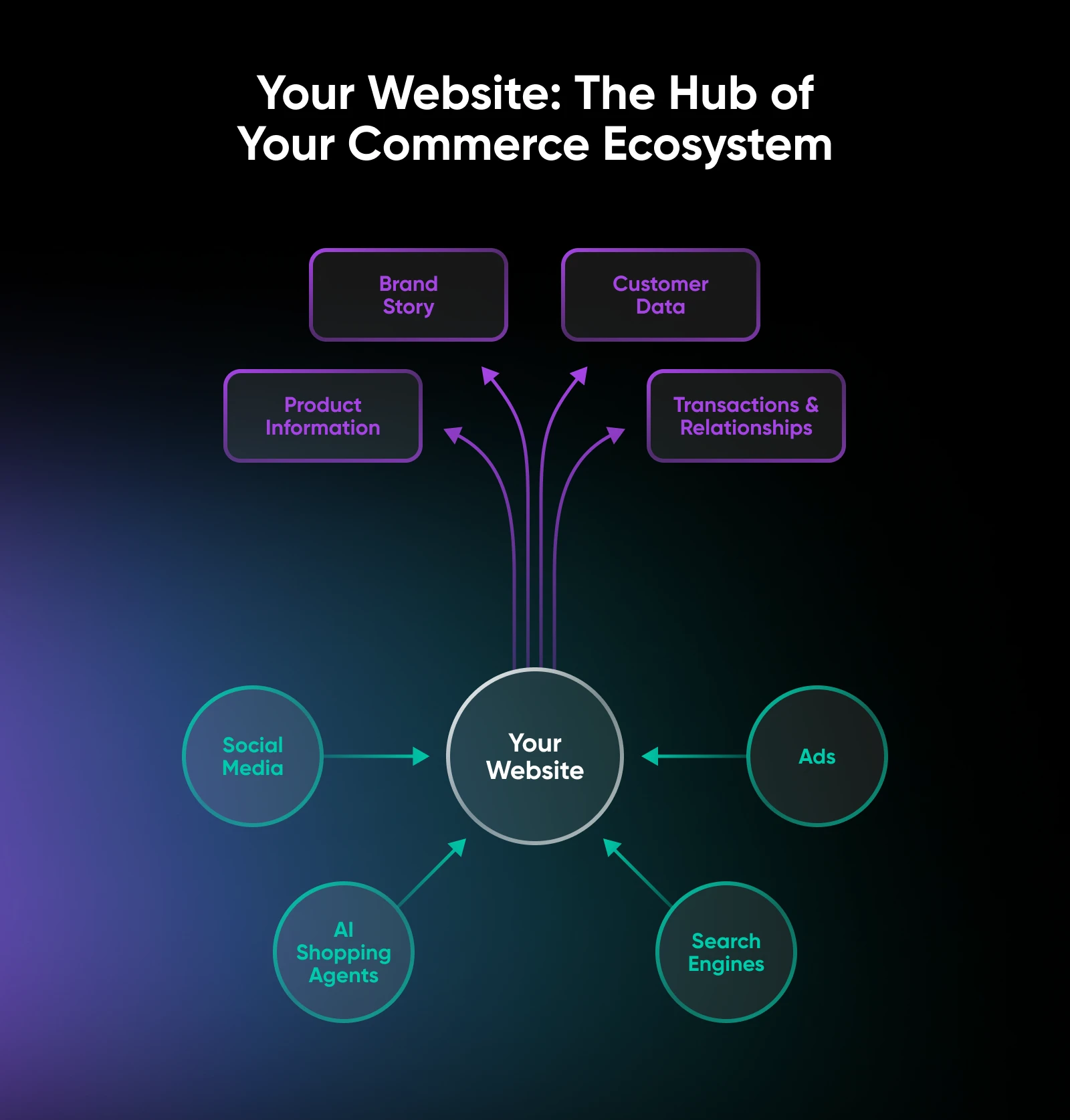
Product Information and Policies
Your website is the authoritative answer to every question an AI agent, comparison shopper, or cautious buyer might ask.
Materials? Dimensions? Return window? Warranty? When an AI is deciding whether to recommend your product, it’s pulling from your product pages. When a customer is deciding whether $200 is worth it, they’re checking your site for reassurance.
Brand Story and Social Proof
Social platforms and AI agents can introduce people to your brand. Your website is where they come to validate what they discovered.
Customer reviews, testimonials, your origin story, your values — these live on your site.
Owned Customer Data
This might be the most important function of all. When someone buys through TikTok Shop or an AI agent’s recommendation, you get a transaction. When they buy through your website, you get a relationship: email addresses, purchase history, preferences, and browsing behavior.
This is data no platform can take away, and no algorithm change can erase.
Big-ticket purchases and long-term relationships still consolidate on websites. Social and AI channels are discovery mechanisms; your site is where commitment happens, and you can map the entire customer journey.
At DreamHost, we’ve been championing website ownership for over 27 years. Owning your site is how you maintain control of your brand, data, and margins while the rest of the internet experiments with new ways to shop, and while the internet becomes increasingly subscription-based, we’re advocating more than ever for the open web.
A Framework for E-Commerce Merchants in the AI Age
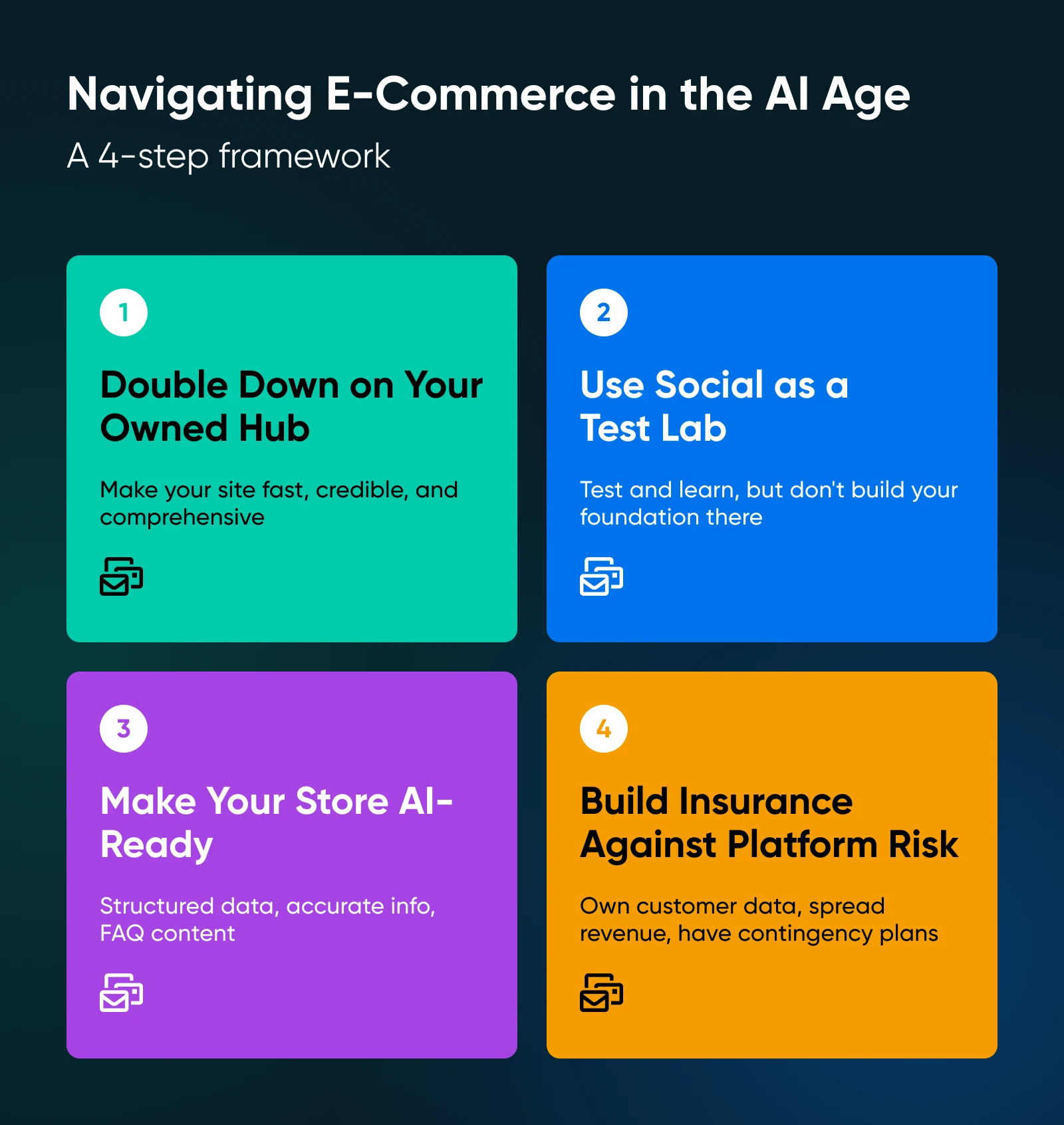
So how should e-commerce merchants navigate this new landscape as it emerges? Here’s a four-step framework you can use.
1. Double Down on Your Owned Hub
Before chasing new channels, make sure your foundation is solid. Make your site the strongest version of itself: fast, mobile-friendly, and clear. Add reviews. Publish detailed policies. Provide content that answers questions before shoppers ask them.
Each improvement compounds your trust advantage, and helps both humans and algorithms see your store as credible.
2. Use Social as a Test Lab, Not Your Foundation
The fear of missing out on TikTok Shop or Instagram Shopping is real. But the merchants who succeed with social commerce treat it strategically.
Pick one or two platforms where your audience already lives. Test product angles, creator partnerships, bundles, and price points. Let social give you rapid consumer insight, but don’t rely on it for long-term stability.
3. Make Your Store AI-Ready
Preparing your store for AI shopping agents doesn’t require technical expertise. It requires discipline and consistency.
- Fill in product attributes consistently: Materials, sizing, compatibility, care instructions.
- Use descriptive, honest product titles: No keyword stuffing, no misleading descriptions.
- Add structured data and schema markup: Product schema, review schema, and FAQ schema — all help AI tools recommend your products.
- Keep inventory and pricing accurate: Update in real-time if possible, or daily at a minimum.
- Include FAQ content on product pages: This gives AI agents content to quote when making recommendations.
Think of it as giving AI a clean transcript of your store, so agents can understand and represent your products accurately.
4. Build Insurance Against Platform Risk
If you’ve been in e-commerce for more than a few years, you’ve seen platforms change their rules overnight. Algorithm updates, policy shifts, regulatory uncertainty — any single channel can become unreliable with little warning.
Here’s how to protect yourself:
- Always collect email and SMS on your own site: This is customer data you own.
- Spread revenue across multiple channels: If more than 40% of your revenue comes from any single external channel, you’re exposed.
- Document channel performance rigorously: Know your metrics by channel so you can pull back quickly if something changes.
- Have a contingency plan: What happens if TikTok gets banned tomorrow? Know your moves before you need to make them.
Guardrails for Evaluating “The Next Big Thing”
Every few months, there’s a new platform, a new AI integration, a new commerce channel that everyone insists you need to be on immediately or risk irrelevance. Here’s a checklist for cutting through the hype.
Before jumping on any new platform or tool, ask yourself:
- Does this help me reach my actual customers? Not just “people,” your people. The ones who actually buy what you sell.
- Can I get data out of it and bring people back to my site? If you can’t capture emails or re-target visitors, you’re building on rented land with no deed.
- What happens if this platform disappears tomorrow? Ask Vine creators how that worked out.
- Do I understand how it handles my customers’ data? Privacy concerns translate directly to trust concerns.
- Can I run this as a time-boxed experiment? Every new channel should have a hypothesis, a budget, and a deadline — not a forever commitment based on FOMO.
The merchants who thrive in rapidly changing environments aren’t the ones who chase every trend. They’re the ones who test intelligently, measure honestly, and know when to double down versus when to walk away.
The Future of E-Commerce Isn’t Site vs. Platform: It’s How You Orchestrate Both
AI agents and social commerce will increasingly handle discovery and low-friction purchases. That’s not a threat — it’s a distribution opportunity. New channels mean new ways for customers to find you, new moments to capture attention, and new paths to purchase.
But websites remain the trust anchor, the data source, and the place where real customer relationships live. When someone’s deciding whether to spend $200, they’re not doing it in a TikTok comment section. When they want to understand your brand, read reviews from people like them, or know exactly what they’re getting — they come to your site.
Owning your site isn’t about resisting change. It’s about having a home base while you explore what’s next — keeping control of your brand, data, and margins while the rest of the internet experiments with new ways to shop.

Set Your Store Up For Success
Sell anything, anywhere, anytime on the world’s biggest online store platform.
See More