
Ever feel like your business is stuck in a rut, no matter how hard you push forward? Like you’re driving with one foot on the gas and the other on the brake?
That’s the moment for a SWOT analysis. A SWOT analysis is a strategic planning exercise where you map your business’s internal strengths and weaknesses against the external opportunities and threats in your market, then use what you find to decide what to do next.
Done well, a SWOT is a working document, not a whiteboard ritual. It turns “something feels off” into a short list of concrete moves: double down here, fix this, watch out for that.
Thinking about launching a new product? Staring down a new competitor? Ready to freshen up your brand? This guide walks you through how to conduct a SWOT analysis in 5 steps, with examples for every quadrant and a free template you can copy at the end.
What Is a SWOT Analysis?
A SWOT analysis is a strategic planning tool that helps businesses identify their internal strengths and weaknesses and their external opportunities and threats. Strengths and weaknesses are factors inside your business; opportunities and threats are conditions in your market that you respond to.
By working through these four components systematically, you get a clear picture of where your business stands right now, so you can build on your strengths, shore up your weaknesses, act on your opportunities, and guard against your threats.
The reason SWOT has stuck around while flashier tools come and go: it’s simple, it works at any scale, and it forces an honest, structured conversation about the factors that decide whether your business succeeds.
What Is a SWOT Analysis Used For?
You can use a SWOT for many different purposes. It can help businesses or their stakeholders:
- Make informed decisions
- Guide planning sessions
- Start a new business
- Develop strategies to sharpen their competitive advantage
- Identify areas for improvement and growth
- Understand market trends and potential challenges
- Decide where to put limited time and money
- Create contingency plans to address potential risks
A SWOT analysis earns its keep whenever you’re stepping into a period of change or uncertainty: launching a new product, entering a new market, or rethinking how your business operates.
Components of a SWOT Analysis
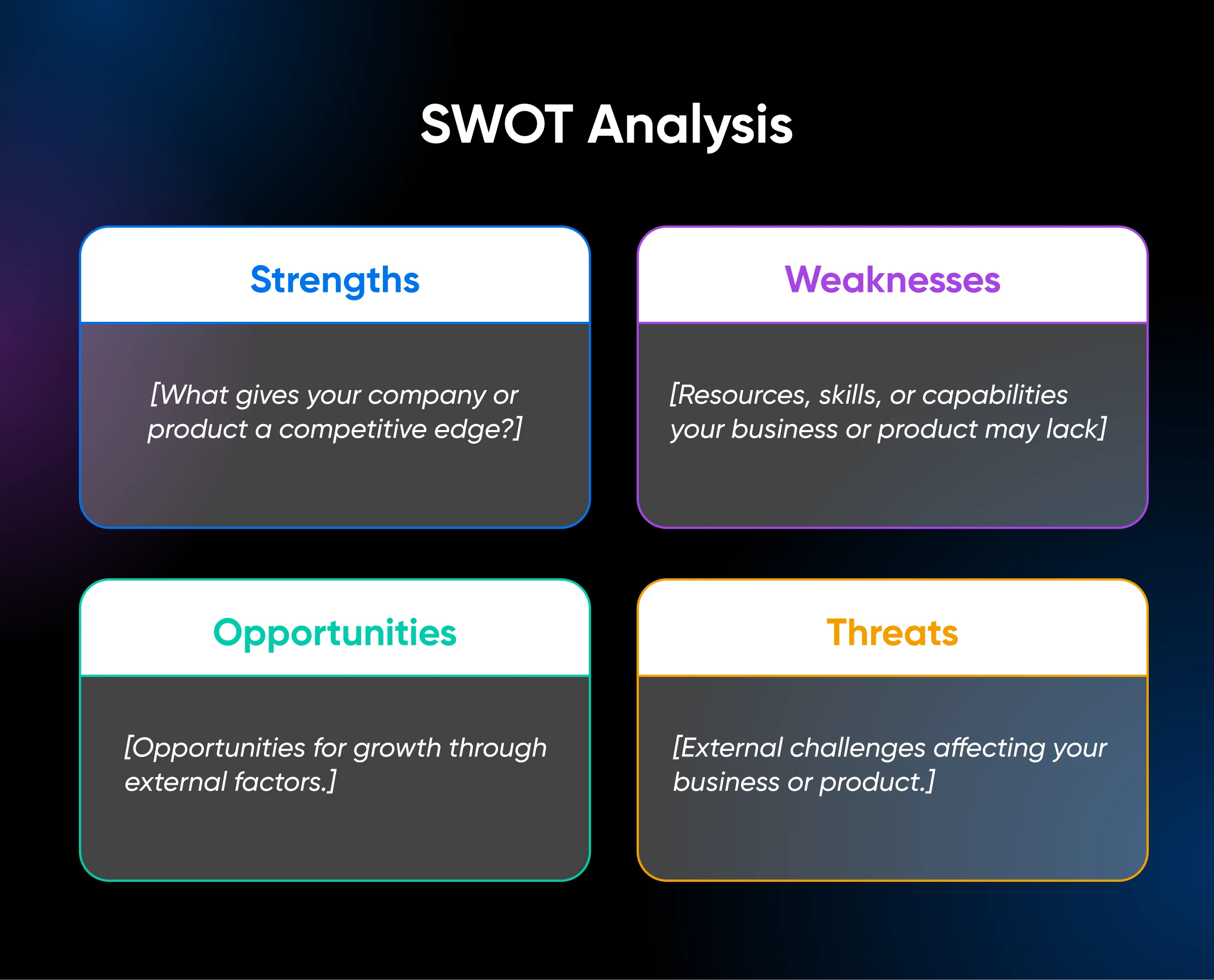
The SWOT matrix gives you a structured way to assess both the internal and external factors that affect your business. Let’s break it down into its four components.
Strengths
Strengths are the internal attributes and resources that give your business a competitive edge. Think: unique selling propositions, specialized skills, strong brand reputation, or efficient processes. Comparing a strength with competitors can help you judge how much advantage it provides.
Example: A local bakery’s strength might be its use of high-quality, locally sourced ingredients, which sets it apart from larger chains.
Weaknesses
Weaknesses are internal factors that hinder your business’s ability to compete effectively. These can be areas where your business lacks resources, skills, or capabilities.
Example: The same bakery might identify a weakness in its website and limited online presence, which restricts its ability to reach a broad audience. That’s a fixable weakness: a simple site on DreamHost web hosting covers the basics.
Opportunities
Opportunities are external factors your business can capitalize on to grow or improve. These can include market trends, changes in consumer behavior, technological advancements, or regulatory changes, to name a few.
Example: An opportunity for the bakery could be the growing trend of consumers seeking out gluten-free and vegan options, presenting the chance to expand its menu and try new flavors and offerings.
Threats
Threats are external challenges that could negatively impact your business, like economic downturns, increased competition, changes in regulations, or shifts in consumer preferences.
Example: A threat to the bakery could be a new, well-loved competitor opening a second location just down the street, which could draw away customers.
The SWOT Table
A SWOT table is a visual representation of the analysis, organized into a grid format. This is the most common way of presenting the SWOT structure. It looks like this:
| Strengths | Weaknesses |
| Opportunities | Threats |
Examples of Opportunities and Threats
Opportunities and threats trip people up more than strengths and weaknesses because both live outside your business. The test is simple: an opportunity is an external change you could act on to grow; a threat is an external change that could hurt you if you do nothing.
Common examples of opportunities:
- A growing customer trend you could serve (new diets, new habits, new tech)
- A new sales channel, like online ordering, marketplaces, or wholesale
- A competitor closing, retreating, or leaving a gap in the market
- A regulatory change that favors your business model
- A partnership or local event that puts you in front of new customers
Common examples of threats:
- A new competitor entering your market
- Rising supplier or materials costs
- Customer preferences shifting away from what you offer
- A regulatory change that raises your costs
- An economic downturn cutting customer spending
One external trend can create separate opportunities and threats. Growing demand for online ordering is an opportunity to reach more customers; a competitor adopting it first may threaten your sales. Classify each factor by its likely effect on your objective.
When To Conduct a SWOT Analysis
A SWOT analysis is useful at many stages of a business’s lifecycle. Here are the moments when running one pays off most:
- When doing quarterly or annual planning: Regularly incorporating SWOT into your planning processes helps you stay aware of your business’s current strengths and weaknesses, make key decisions, and adapt to changing market conditions.
- When launching a new product or service: Before introducing a new product or service, use a SWOT analysis to understand the internal and external factors that could impact its success.
- When entering a new market: When expanding into a new market, use SWOT to identify potential opportunities and threats facing your business in uncharted waters.
- When facing increased competition: When new competitors enter the market, or existing ones become more aggressive, a SWOT analysis helps you identify ways to strengthen your competitive position.
- When experiencing business challenges: If your business is facing declining sales, operational inefficiencies, or other significant challenges, use a SWOT analysis to narrow down the root causes. If the diagnosis points to your website, start with our small business guide to website conversions.
- When seeking investment or partnership: Create a SWOT analysis to gain a fuller picture of your business’s position, making it easier to communicate your business plan and value proposition to potential investors or partners.
How To Know You Should Perform a SWOT Analysis
Deciding when to use SWOT can be challenging. Here are some indicators that it might be the right time for your business or team:
- You’re uncertain about which direction to go: If you’re unsure about the next steps for your business, a SWOT analysis can provide clarity by identifying areas of strength and opportunities for growth, as well as threats and weaknesses to address.
- You’re seeing significant changes in the market: A SWOT analysis reveals how industry changes, like new regulations or technological advancements, impact your business environment.
- Your growth has stagnated: If your company has hit a plateau, use SWOT analysis to identify strengths, opportunities for expansion, and areas that need improvement.
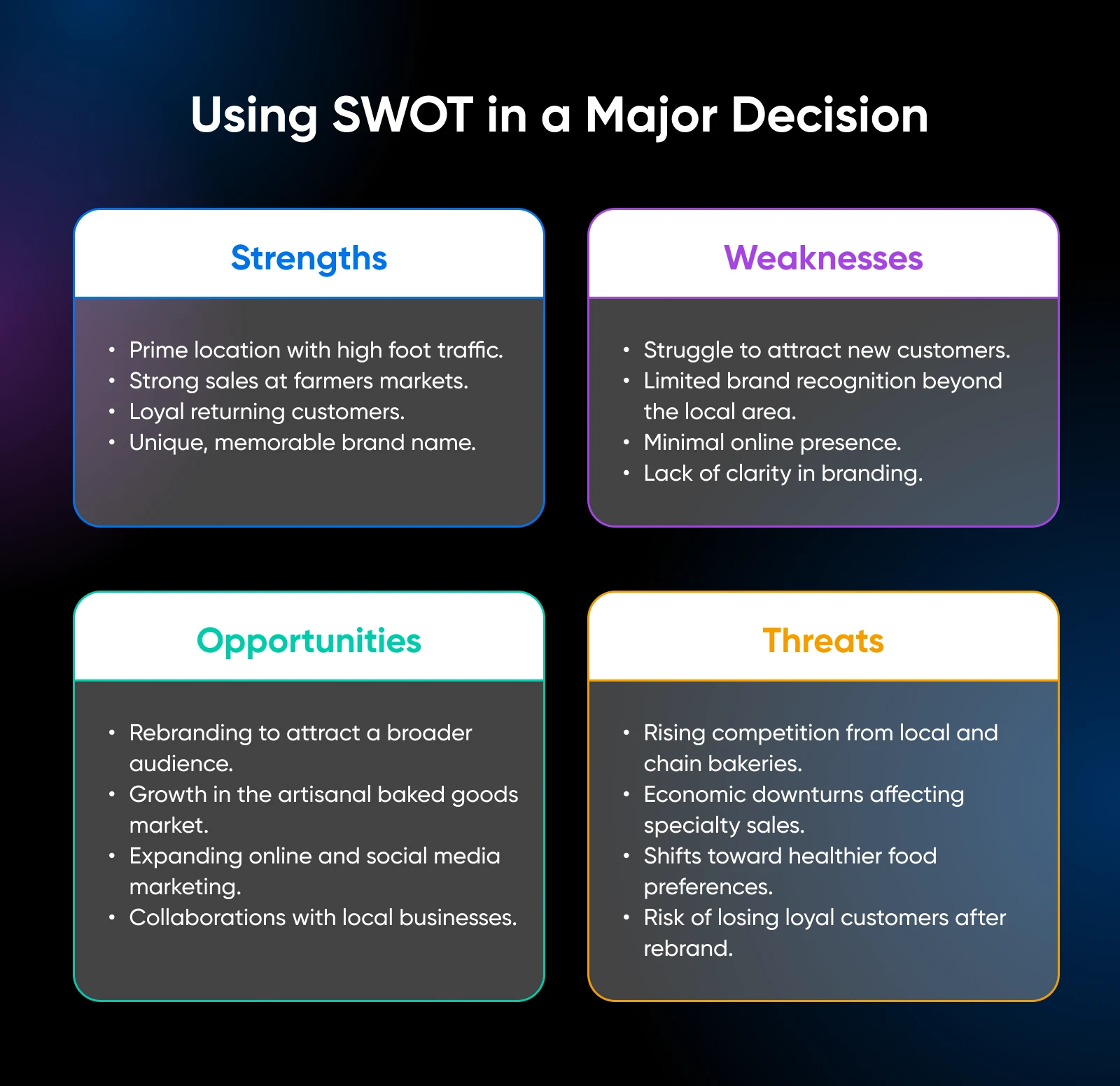
- You’re preparing for a major decision: Before a merger, acquisition, or rebrand, a good SWOT analysis helps you consider all the necessary angles. And if the rebrand includes a new name, read up on how a domain change affects SEO before you commit.
For example, let’s say our hypothetical bakery, Bread Zeppelin is considering rebranding. Here’s what their SWOT may look like:
A simple litmus test for determining whether your business would benefit from conducting a SWOT is to ask: “Are we fully aware of our internal capabilities, external threats, and environment?”
If the answer is no (or if there are any doubts), you’ll likely benefit from a SWOT.
How To Conduct a SWOT Analysis in 5 Steps
Conducting a useful SWOT analysis requires more than filling out the matrix. You need to examine your business and its environment honestly, then turn what you find into a plan.
Use this step-by-step guide to get started, and stick around for some extra tips and a free SWOT analysis template at the end.
1. Determine Your Objective or Goals
Begin by clearly defining the objective of your SWOT analysis. What specific goal or decision do you want to inform? “Should we open a second location?” produces a sharper analysis than “How are we doing?” Having a clear objective guides the process and helps you identify success metrics.
2. Gather Data and Other Resources
Next, gather relevant data and resources for your analysis. This can include:
- Financial reports
- Customer feedback
- Market research
- Competitive analysis
- Human resources and other internal data
- Personal SWOT analyses done by participating team members
Real data keeps the exercise honest. Without it, a SWOT session drifts toward wishful thinking: strengths get inflated, weaknesses get politely ignored, and the analysis tells you what you wanted to hear.
3. Start Brainstorming
Engage your team in brainstorming sessions to identify internal and external factors that impact your business. Find some explanations and questions to guide your brainstorming in the SWOT analysis example below:
| Strengths: Strengths are things your business does well that give you an advantage over your competitors. Questions to Ask: What unique resources do we have that our competitors lack? What positive feedback do we consistently receive from our customers? | Weaknesses: Weaknesses are inherent features of your organization that are likely to hold you back. Questions to Ask: Where do we receive the most customer complaints? What internal processes cause delays or inefficiencies? |
| Opportunities: Opportunities are chances for your business to grow or succeed, but you’ll have to take advantage of them. Questions to Ask: Are there emerging trends that we can take advantage of? What new market segments can we target with our existing products? | Threats: Threats are external factors that can negatively impact your business from the outside. Questions to Ask: What external factors could negatively impact our sales? Are there potential regulatory changes that could affect our business model? |
4. Refine Your Findings
After your brainstorming session, refine your findings to focus on the most impactful elements. A long list feels productive, but a SWOT with 30 items per box is a SWOT nobody acts on. Cut each quadrant down to the handful of items most relevant to the objective you set in Step 1.
Further refining your findings may mean performing a gap analysis to find discrepancies between your current state and desired outcomes. Your SWOT analysis may also uncover other areas that warrant further investigation.
5. Convert Your SWOT Into a Strategic Plan
The final step is to convert your SWOT insights into a plan aligned with your goals from Step 1. This step is easy to skip, but it’s what turns the exercise into a plan.
Pair the quadrants against each other: which strengths help you capture which opportunities? Which weaknesses leave you exposed to which threats? Every item in the grid should end up attached to an action, an owner, and a date.
Integrate your SWOT findings into a business case that outlines clear, actionable steps toward your strategic objectives. If you want help turning those findings into a full written plan, DreamHost’s Business Planner builds one through guided, interview-style questions, and it’s currently free to all DreamHost customers.
How To Use SWOT Analysis To Size Up Your Competition
Competition does not get its own box in the SWOT grid. Competitor behavior is external, so it usually appears under opportunities or threats. Comparing your business with competitors can also help you evaluate the importance of your internal strengths and weaknesses.
To make your SWOT competition-aware, do a quick competitive pass before you fill in the grid:
- Name your top 3 to 5 direct competitors. Not every business in your industry, just the ones your customers actually compare you against.
- Note what each does better and worse than you. Look at their offer, pricing, service, reviews, and online presence.
- Write your strengths and weaknesses relative to that list. Compare customer service with competitors to judge whether it gives you a meaningful advantage.
- Put competitor moves in opportunities and threats. A rival raising prices or closing a location is an opportunity; a rival expanding into your niche is a threat.
Back to Bread Zeppelin: the new bakery down the street is a threat, but the competitive pass might also reveal that the rival doesn’t take online orders or open before 8 a.m. Those two gaps are opportunities the bakery can act on this month, which is exactly the kind of specific, dated action a SWOT should produce.
How Can a SWOT Analysis Benefit a Company or Team?
A SWOT analysis benefits a company or team by giving everyone the same clear-eyed picture of where the business stands, so decisions get made on shared facts instead of competing hunches. It surfaces areas for growth and improvement, and it flags risks while there’s still time to prepare for them.
You can draft a SWOT without specialized software. Set aside a focused team session for the first draft, then revisit it when your objective, business, or market changes.
What Are Some Common SWOT Analysis Mistakes?
While a SWOT can be incredibly beneficial, there are common pitfalls to avoid:
- Leaving out the right people: A SWOT written by one person reflects one person’s blind spots. Involve the stakeholders who see the business from different angles.
- Vague entries: “Good reputation” isn’t actionable. “4.8-star average across 200 reviews, but no reviews mention our catering” is.
- Never updating it: Markets move. A SWOT from two years ago may no longer reflect your current business or market.
- Analysis paralysis: Overanalyzing leads to indecision. If the session ends without assigned actions, the analysis failed at its job.
Know SWOT’s limits, too. It won’t capture broad external forces as thoroughly as a PEST analysis, a separate exercise that examines political, economic, social, and technological factors in your macro-environment. If regulation or the wider economy is your main worry, run both.
Other SWOT Analysis Tips and Best Practices
- Make sure your SWOT analysis covers all relevant business areas and involves input from key team members. This will help maximize opportunities and provide a well-rounded perspective.
- Regularly update your SWOT to reflect changes in your business environment and internal dynamics.
- Use your SWOT findings to inform planning and decision-making, build on your strengths, and address your weaknesses.
SWOT Analysis FAQs
What Are the 4 Components of a SWOT Analysis?
The four components of a SWOT analysis are strengths, weaknesses, opportunities, and threats. Strengths and weaknesses are internal factors, meaning resources, capabilities, and limitations inside your business. Opportunities and threats are external factors, meaning market conditions you respond to but don’t control.
What Are Examples of Opportunities and Threats in a SWOT Analysis?
Common opportunities include a growing customer trend you could serve, a new sales channel, a competitor leaving a gap in the market, or a favorable regulatory change. Common threats include a new competitor, rising supplier costs, shifting customer preferences, an economic downturn, or a regulatory change that raises your costs. Both are external: they happen whether or not you act.
What Can I Write in the Opportunities Section of a SWOT Analysis?
Write down external changes you could act on but haven’t yet. A useful prompt: “What’s changing outside our business that we could move on before our competitors do?” Look at customer trends, new technology, underserved customer segments, potential partnerships, and regulatory shifts. If an item is something you already do well, it belongs under strengths instead.
Is a SWOT Analysis Outdated?
No. SWOT’s simplicity is the reason it survives: it forces a structured, honest conversation you can finish in one session. Its real limitation isn’t age, but depth. A SWOT won’t quantify anything or rank your options for you, so treat it as the first step in planning, and pair it with deeper analysis when the decision is big enough to warrant one.
Can You Do a SWOT Analysis for a Product or a Sales Team?
Yes. SWOT works at any scope as long as you define the objective first. A product SWOT weighs the product’s features and pricing against rival products and category trends. A sales SWOT looks at team skills, pipeline health, and tools internally, and at new territories or channels externally. The University of Kansas Community Tool Box notes the method was originally developed for business and industry but is equally useful in community health and development work, education, and even personal growth.
Download: SWOT Analysis Template
Now that you’ve read our guide to SWOT analysis, you’re ready to start your own.
Download our free template to make sure your SWOT analysis includes all the right components, and refer back to the SWOT examples in this article to see how to apply the analysis in different contexts.
Download our SWOT template (it’s a Google Doc, so you’ll be prompted to save your own copy) to start uncovering insights and driving your business forward.

Get More Visitors, Grow Your Business
The best-designed site is worthless if no one can find it. Leverage proven online marketing strategies and techniques to help more of your target audience find you.
See More