Search “PHP is dead” on Reddit, and you’ll find hundreds of threads declaring it outdated, a relic from the Web 2.0 era.
WordPress, built on PHP, powers 43% of the entire web. Wikipedia processes 24 billion page views monthly on PHP backends. Three out of every four websites you visit process your request with the same language the internet calls “dead.”
But what keeps PHP alive when Node, Python, Go, and Rust all promised to replace it? And what does its survival reveal about how the web actually works?
A Brief History of “Personal Home Page Tools”
PHP started by accident. In 1994, Rasmus Lerdorf wrote a set of Common Gateway Interface (CGI) binaries in C to track who was looking at his online resume.
He called it “Personal Home Page Tools,” short for PHP Toolset.
Lerdorf didn’t design it with a grand philosophy like Python’s readability or Java’s portability. He built a hammer for a specific nail: putting dynamic content on static web pages.
By 1997, it evolved into PHP 3, and the acronym changed to “PHP: Hypertext Preprocessor.” The best part? PHP just worked. You uploaded a file, and the server rendered it. That pragmatic DNA never left the language.
From the object-oriented revolution of PHP 5 to the performance leaps of PHP 7 and 8, the language stayed focused on the web. It avoided becoming a systems language or mobile development tool. It stayed in its lane and eventually paved that lane with gold.
How Much Influence Does PHP Really Have?
According to W3Techs, PHP powers 72.6% of all websites for which we have server-side programming language data. Three out of every four websites you visit likely process your request with PHP.
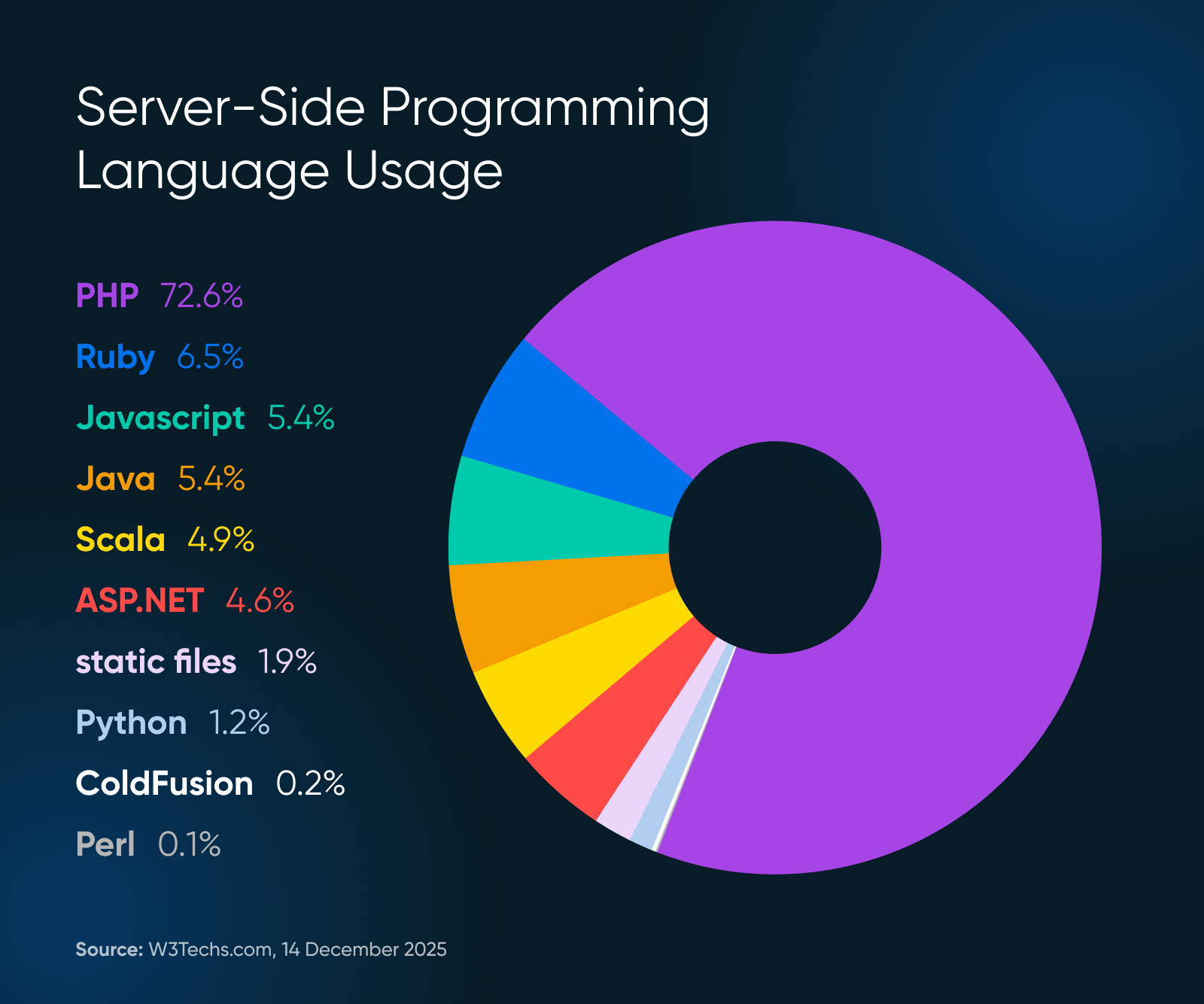
A massive chunk comes from WordPress, which powers 43% of the web. In fact, most of the websites on our shared hosting use PHP.
But it’s not just blogs. PHP runs Wikipedia and countless e-commerce platforms that process billions in transactions annually.
When you look at the “dead” language, you see the engine of the web. Most businesses don’t need microservice architectures. They need to put text on a screen, capture a lead form, and process a credit card.
PHP does this natively.
Why Do People Declare PHP “Dead” So Often?
Despite dominating the market, the “PHP is dead” narrative persists.
Why? Because the tech world confuses “boring” with “dead.”
We’re addicted to novelty. A new framework launches on Hacker News, and developers rush to rewrite their stacks. This perspective ignores what robust infrastructure actually means.
The plumbing in your house isn’t exciting. It hasn’t changed much in fifty years. But you don’t tear out your pipes every time a new alloy is invented. You rely on pipes because they work, and because plumbers know exactly how to fix them.
Yet every few years, a new challenger appears to try to dethrone PHP. Ruby on Rails promised developer happiness. Node.js promised one language for frontend and backend. Go promised raw speed.
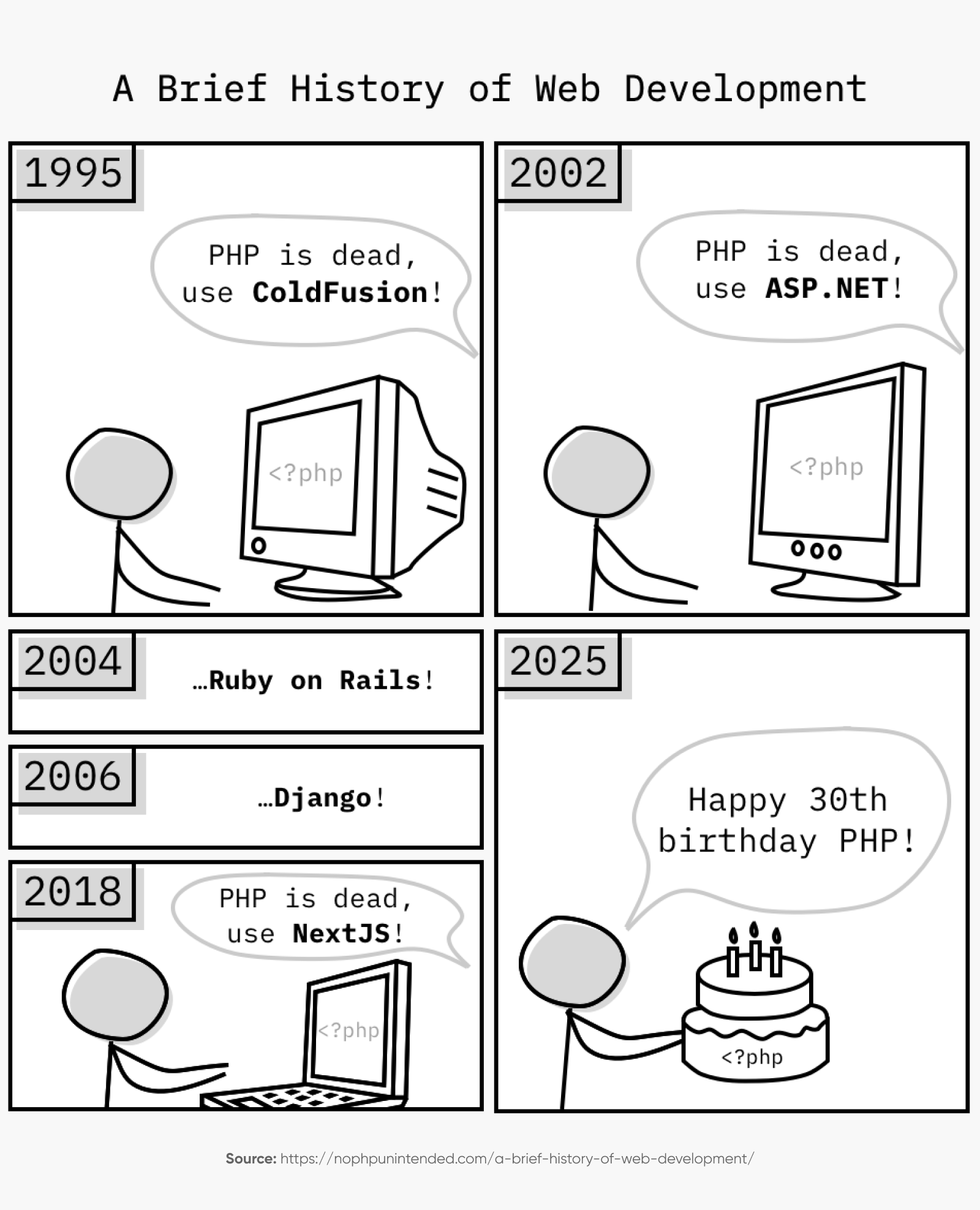
Each time, the tech press declared PHP’s reign was over. And each time, the usage numbers refused to drop.
Why Haven’t We Seen Another Web Language Like PHP in 30+ Years?
In over three decades of reinventing databases, frontends, and servers, no one has successfully replicated the PHP model. We’ve seen better languages and faster runtimes, but we haven’t seen another tool that works like PHP.
1. It Embeds Logic Directly Into Your HTML
PHP was designed to embed directly into HTML. In almost every other stack, the “program” and “output” are strictly separated.
For example, with Python (Django) or Ruby (Rails), you write a program that processes data, then push that data into a templating engine to generate HTML.
PHP lets you open a file, write standard HTML, and then open a <?php tag right inside a <div> to run a loop or fetch a database row. This feels like a natural extension of your pages. A beginner can copy a snippet, paste it into an HTML file, and see dynamic results immediately.
This ease of implementation created the massive ecosystem of themes and plugins that powers WordPress today.
2. The “Born to Die” Architecture Improves Language Stability
In long-running process languages like Node.js, Java, or Python, the application loads into memory and stays there, handling thousands of requests over hours or days.
This is efficient, but fragile. A developer’s mistake with an open variable grows into a memory leak until the server crashes. One request with an unhandled exception can bring down the entire process for everyone.
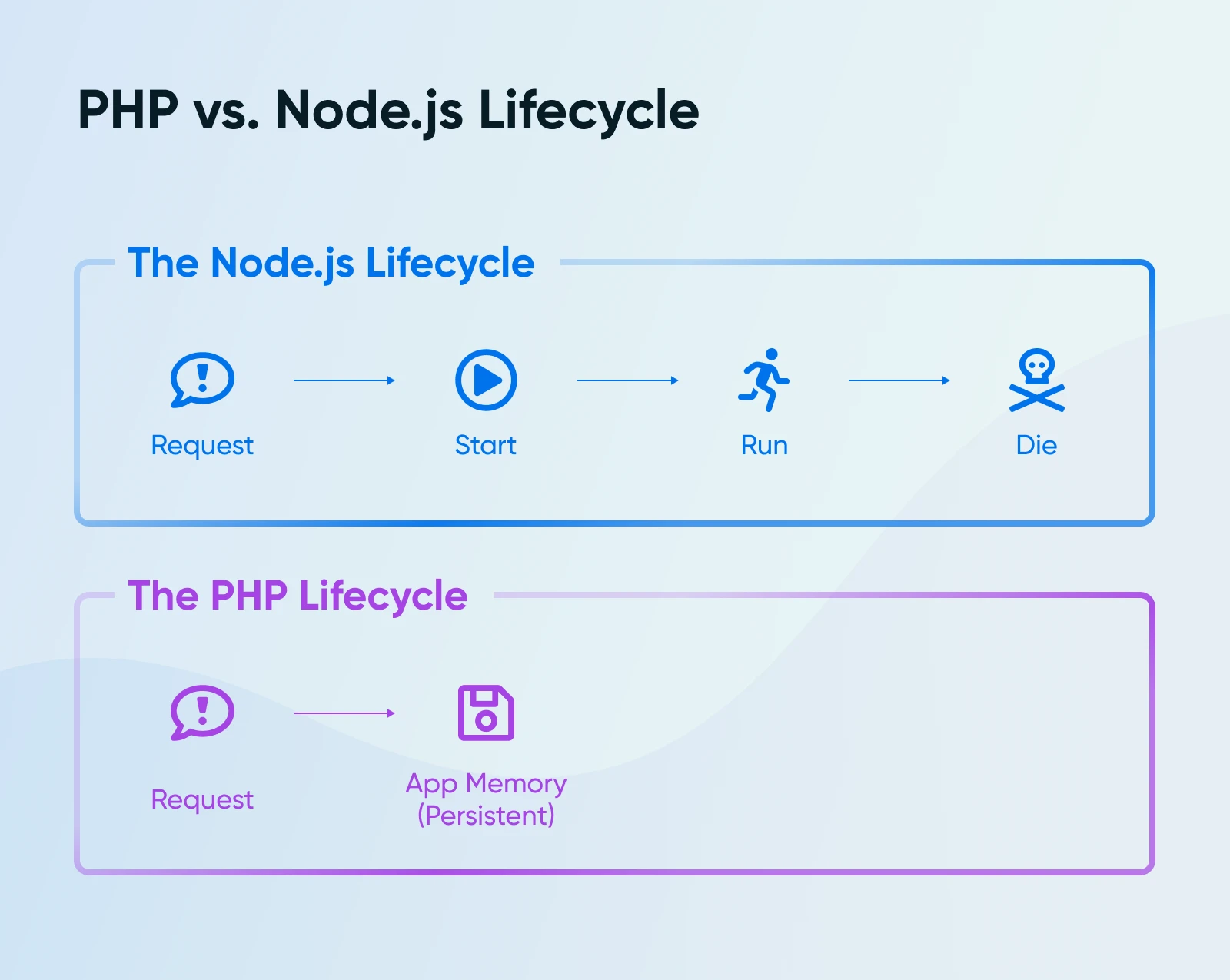
PHP takes a different approach. It kills the process after every single request. A user visits a page, PHP starts up, loads necessary resources, runs the code, sends HTML, and then dies. Memory gets wiped clean.
This “born to die” lifecycle means memory leaks are nearly impossible to sustain. A sloppy script can only hurt itself. It can’t destabilize the server.
This resilience makes PHP perfect for shared hosting environments and massive deployments where reliability matters more than raw speed.
3. Deployment Is Instant Because There Is No Build Step
Modern deployment pipelines are complex. To launch a JavaScript application, you could need a build step (Webpack/Vite), a container registry (Docker), an orchestration service (Kubernetes), and a reverse proxy (NGINX).
But PHP deployment remains refreshingly primitive even today. You copy a file to a server, that’s it.
Because servers treat PHP files as executable assets rather than compiled applications, the “build step” often doesn’t exist. You change a line of code, save the file, and the change is live.
The feedback loop is addictive. It allows rapid iteration that compiled languages can’t match.
4. The Massive Standard Library Prevents “Dependency Hell”
In the JavaScript ecosystem, simple tasks require external packages.
Format a date? Install a library.
Parse a form? Install middleware.
This is dependency hell.
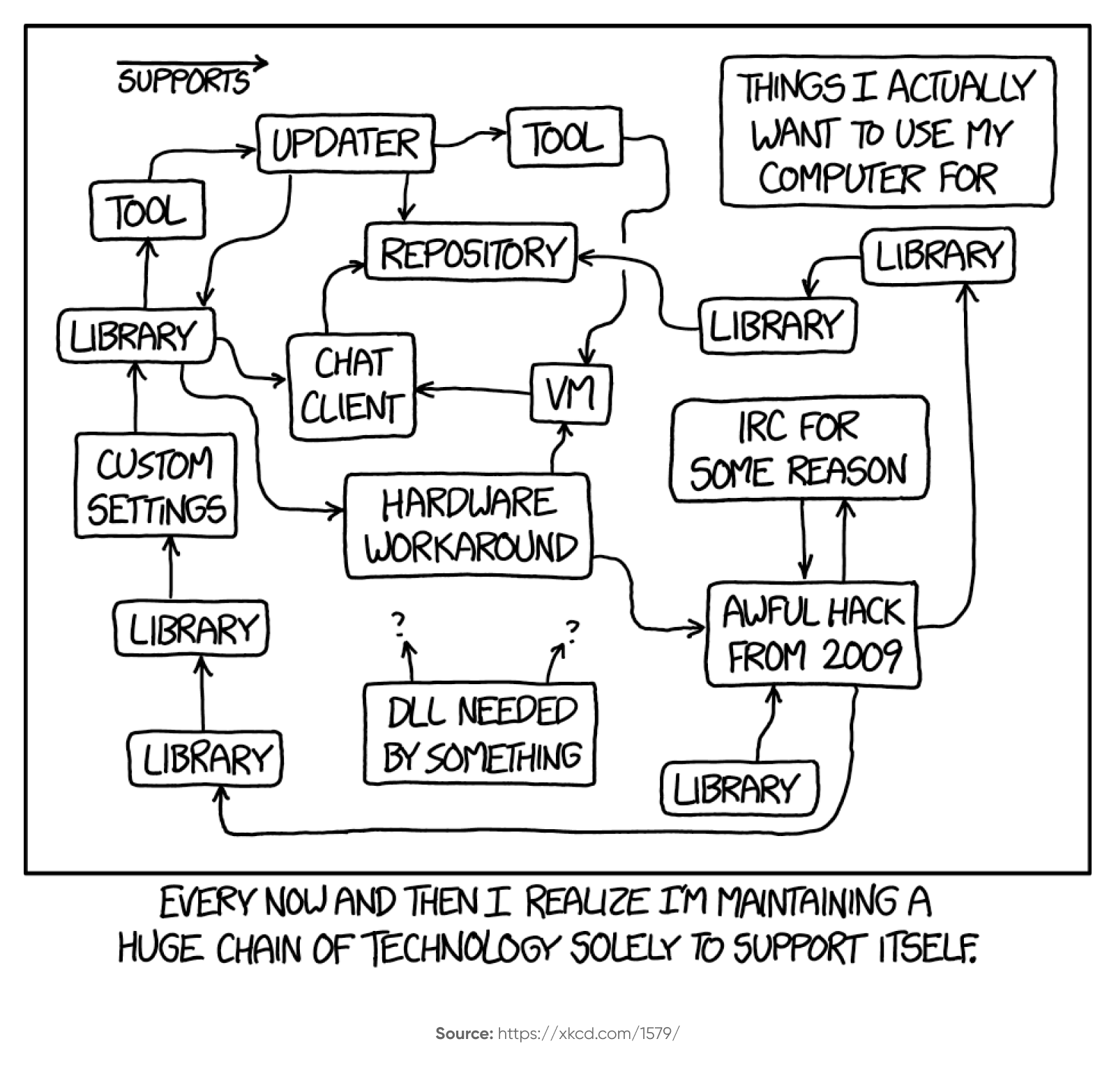
PHP takes a “batteries included” philosophy. The standard library includes native support for database connections, JSON parsing, file manipulation, image processing, and email transmission.
PHP developers can build complex applications with near-zero external dependencies. Because of this approach, code written in vanilla PHP in PHP 7 runs just as well today. That’s because all dependencies are updated along with the language, and there’s no chain of third-party packages that were abandoned.
5. It Prioritizes Shipping Working Code Over Purity
PHP never pretended to be academic. It never claimed to be the “smartest” language in the room. PHP positioned itself as the language for getting work done.
This attracted a specific type of developer: the pragmatist. The freelancer who builds a store for a local bakery in a week. The agency that ships ten sites monthly. The startup that validates an idea before running out of cash.
These developers don’t care about monads or memory pointers. They need to ship working software fast. And because they could ship, they made money. And because they made money, they kept using PHP.
Technical Improvements in Modern PHP
Simply “getting it done” isn’t enough if the tool is slow or insecure.
While old complaints about performance were valid in 2015, modern versions have solved the problems like inconsistent function naming, poor performance, and security vulnerabilities that made PHP a meme.
1. Static Typing Is Now An Option
PHP had loose typing. It tried too hard to be helpful, automatically converting strings to numbers or nulls to zeros, leading to untraceable bugs.
Modern PHP (8.0+) allows dynamic typing, which means the language decides what the type of a variable should be based on how it’s used. It also gives you the freedom to choose between strict typing and loose typing for those who want to specifically go for one or the other. With typed properties, union types, and return type declarations, developers can enforce data integrity as rigorously as Java or C#.
You no longer guess what a function returns.
2. The Speed Has Improved Significantly
For years, developers accepted that PHP was slow. That trade-off ended with PHP 7.
The team rewrote the Zend Engine for better memory management. Benchmarks from Phoronix showed PHP 7 handled twice as many requests per second as PHP 5.6.
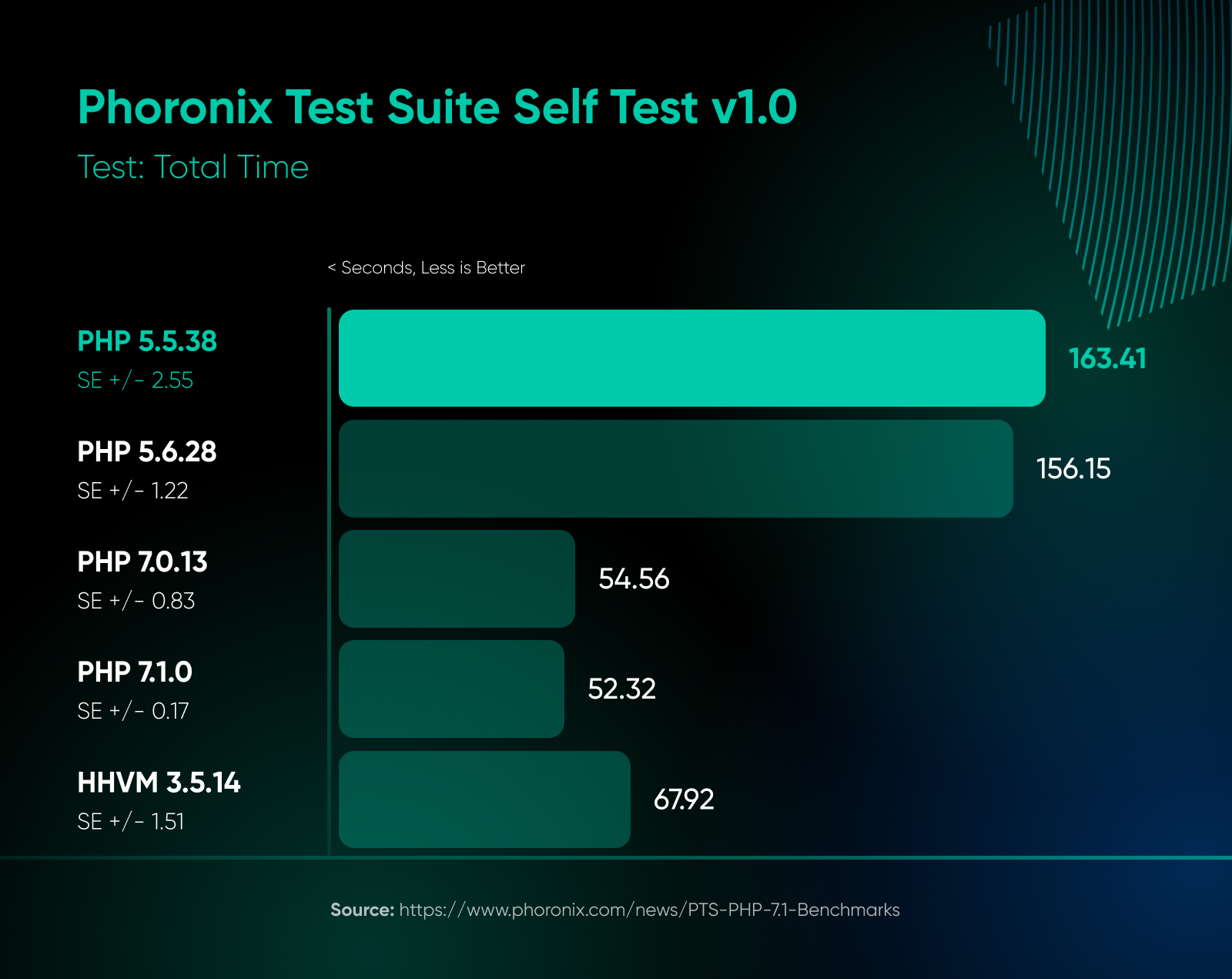
PHP 8 added a JIT (Just In Time) compiler, which outpaced Python and Ruby for standard web tasks. While it won’t match systems languages like Rust or C for raw computation, it’s become faster than the database queries it usually waits for.
3. Insecure Defaults Are Gone
In the early 2000s, PHP tutorials taught bad habits. They showed developers sanitizing inputs manually using clunky functions like mysql_real_escape_string. This led to the SQL injection epidemic of the mid-2000s.
PHP 7 took a daring step to break backward compatibility by deleting old mysql_ functions entirely. If you try running that insecure code today, the application crashes.
Modern PHP development relies on PDO (PHP Data Objects) and prepared statements by default. This separates data from the query before hitting the database, making common attacks impossible by default. You now have to work hard to write insecure code.
What Are the Threats to PHP?
If better languages, faster runtimes, and ridicule couldn’t kill PHP, what can?
It won’t be replaced by a “better” version of itself. It will only be replaced if the fundamental architecture of the web moves in a direction where PHP no longer fits.
Teams Benefit From Using a Single Language
Context switching is expensive. The strongest argument against PHP today isn’t about syntax but about Universal JavaScript efficiency.
When a team unifies on Node.js, they remove friction from maintaining two separate developer groups. You stop having “PHP folks” and “React folks” and just have engineers.
Reddit user, kavacska, explains the business logic:
“One of the most important assets in a project is people who understand your whole codebase completely. Once you start fragmenting your software with different languages, you have to deal with extra planning and communication. It makes complete sense to use the same language for everything, so frontend devs won’t need to learn a new language to touch the backend.”
Companies can hire JavaScript developers who work on the entire stack. This efficiency is the single strongest argument against PHP. As frontend logic becomes more complex, the pull to use the same language on the server increases.
It Wasn’t Built for Serverless
PHP relies on a “shared-nothing” architecture. Every request starts a fresh process and dies immediately after. This design fights against modern serverless principles.
Serverless platforms favor applications that stay warm and share state between requests. PHP forces the runtime to restart every time.
Reddit user, donatj highlights the technical friction:
“A big simple advantage of Go is just cross-request state. In standard server setups, every request PHP handles comes up cold and has to pull its state in from session, cache servers, and databases.”
While tools like Bref exist, they force a persistent model onto a language built to die. Native serverless languages handle this naturally. PHP requires hacking the runtime to avoid latency.
If the web moves entirely to event-driven serverless functions, PHP will need a complete revamp or risk becoming irrelevant.
The AI Ecosystem Is Built on Python
The biggest threat to PHP is that the next decade of the web is being written in Python.
Python is the standard for AI development. Because heavy lifting happens there, the entire tooling ecosystem is condensing around it.
Reddit user, tei187, explains:
“Python is the go-to when AI development is the subject… people who started AI [development] wrapped their standards, processes, and environment around Python. An equivalent team of people would be required to do the same in PHP for this language to be a viable option.”
If your application becomes a wrapper for AI agents, running a PHP server that constantly calls Python microservices adds complexity. A pure Python stack avoids this API latency entirely.
PHP Stays Secure Long After Official Support Ends
PHP’s longevity isn’t accidental. It’s supported by an intuitive maintenance ecosystem designed to keep websites stable as businesses evolve at their own pace.
For most websites, upgrading PHP isn’t a one-click decision. It involves testing themes, plugins, integrations, and even custom code while keeping sites online and secure. Many hosting providers respond to this complexity by forcing upgrades as soon as official PHP support ends.
DreamHost takes a different approach. As one of the few independent web hosts left, we don’t need to answer to investors demanding quarterly growth.
We offer PHP Extended Support, a service designed to keep legacy PHP versions secure after their official end of life. This gives customers the time they need to plan, test and upgrade responsibly.
When a PHP version reaches the end of support, our engineering team continues maintaining it by:
- Ongoing security maintenance for legacy PHP versions
- Ensuring continued compatibility with common website platforms
- Protecting live sites from emerging risks without forcing immediate upgrades
- Giving customers time to plan and test updates responsibly
This work allows sites running versions 5.6 through 8.1 to remain protected while upgrades roll out on a timeline that makes sense for the business.
PHP Extended Support reflects a core reality of the web: stability matters.
Software doesn’t need to be rewritten every time a new version is released. It just needs to be secure, predictable, and well supported.
With every new software release, PHP remains consistent, demonstrating its reliability and stability.
This is what keeps millions of PHP-powered sites running smoothly today and what allows customers to modernize without disruption.
What’s the Verdict?
PHP doesn’t chase trends and that’s precisely why it lasts.
The web isn’t built on novelty. It’s built on technologies that balance performance, security and cost while supporting real businesses at scale. PHP has quietly refined that balance for decades.
Almost three-fourths of the web continues to run on PHP not because companies are stuck, but because rewriting stable, profitable software doesn’t make sense. What makes sense is reliability, predictable behavior and practicality, and an ecosystem that supports change without forcing it.
As long as the web relies on HTML, databases, and servers responding to requests, PHP remains a natural fit. It has evolved where it matters, it’s stayed simple where it counts, and has proven that longevity is not a flaw but a feature!
PHP is not dead, it’s foundational.

Unbeatable WordPress Hosting
Reliable, lightning-fast hosting solutions specifically optimized for WordPress.
See More