![[STUDY] Young Consumers Say Websites Matter Most — Even As AI and Social Commerce Boom thumbnail](https://www.dreamhost.com/blog/wp-content/uploads/2026/01/1460x1095_blog_hero_2026_study_website_credibility-730x548.webp)
Key findings at a glance:
- Websites deliver a 41% trust lift: They’re the strongest credibility signal outside of online reviews.
- Consumers use social media for discovery, but websites are where real money is spent: Consumers are 7x more comfortable making $100+ purchases on websites versus social platforms, with average spend comfort at $36 on social compared to $177 on websites.
- Gen Z is the most website-dependent generation: 72% of 18-24-year-olds say a website is essential for credibility.
- Your industry matters: Restaurants, contractors, and retailers all see double-digit trust gains when they have a website.
- Consumers use websites for verification: 58% check a business website to confirm info they see on social or Google.
- AI recommendations without a website still feel risky: Only 35% of consumers say they’d consider working with a company recommended by an AI that doesn’t have a website.
- Website quality is also a trust signal: Outdated information, unclear details, and poor design harm credibility.
Imagine scrolling your Instagram and finding a furniture maker whose work is genuinely stunning: handcrafted walnut dining tables with gorgeous live edges, priced somewhere between IKEA and “please schedule a consultation with our design concierge.” You’re ready to buy, but when you try to learn more, they don’t have a link to their website — just an Instagram bio with “DM for pricing” and a vague reference to “select showrooms.”
Do you DM? Do you make a potentially risky purchase? Or do you go to a competitor with a functioning website, transparent pricing, and a checkout button?
In 2026, plenty of consumers make purchases on social media, use AI search tools, and trust algorithm-driven shopping recommendations. But when it comes time to spend real money on purchases that matter, the absence of a website is something that gives many pause.
DreamHost’s 2026 Local Business Trust Index — a survey of over 1,200 U.S. consumers conducted in November 2025 — reveals that websites remain the single most powerful trust signal a business can deploy, even as discovery increasingly happens everywhere else.
Consumers find businesses on TikTok, Google, and AI. But when it’s time to verify, evaluate, or actually spend money, they still go to the website.
At DreamHost, we’ve long believed your website is your home base on the open web, and this survey set out to understand whether everyday consumers feel the same.
The short version: websites still matter, but the reasons why are more interesting, more surprising, and more urgent than ever.
Let’s get into it.
Websites Are Now the Baseline for Local Business Credibility
69% of consumers say a website is essential for a local business to be credible.
For consumers under 25, a cohort supposedly raised on Instagram shops and TikTok storefronts, it’s a staggering 72%.
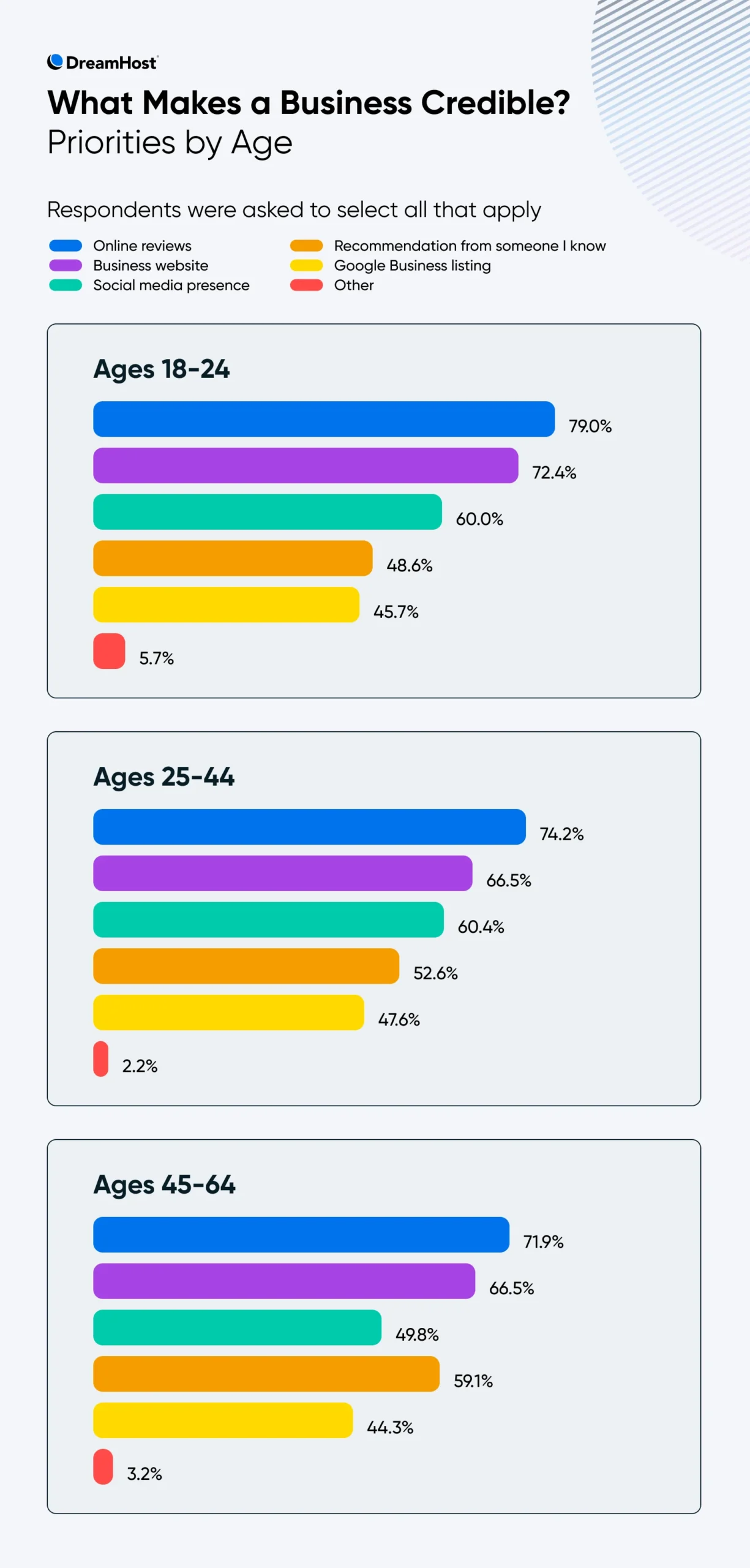
This finding means that websites rank as the second-most important trust factor consumers consider, trailing only online reviews (74%).
In other words, having a website is roughly as important to consumer trust as having positive customer feedback — and significantly more important than being active on social media, having a verified Google Business Profile, or appearing in local search results.
On the other hand, not having a website doesn’t just fail to build trust. It actively erodes it:
- 45% of consumers say businesses without websites feel less “real.”
- 46% say they seem more temporary than a company that does have a website.
- 39% report they have declined to visit or buy from a business specifically because it lacked a website; a figure that rises to 45% among consumers ages 18-44.
The flip side is equally revealing:
- 70% of consumers say they’re more likely to do business with a company if it has a website.
- Among younger shoppers, that sentiment is even stronger: 74% for ages 18-24 and 76% for ages 25-44.
So, what the data shows is this isn’t a generational divide where older consumers cling to “old-fashioned” expectations while younger shoppers embrace platform-native commerce. The consumers most comfortable with social shopping, AI tools, and algorithmically curated discovery are also the ones most likely to demand a website as proof of legitimacy.
Businesses without websites are actively turning customers away before the first interaction even happens.
Different Industries, Different Stakes: Where Websites Matter Most
Not all industries feel the website credibility gap equally. The data reveals meaningful differences in how consumers evaluate businesses based on what they’re buying.
For home services and contractors, websites are nearly non-negotiable:
- When asked whether they’d be more likely to hire a contractor or home service provider with a website, 66% of consumers said yes.
- That number climbs to 68% for ages 18-24 and 69% for ages 25-44.
Restaurants face a different but equally urgent credibility test:
- Among consumers who say they’d be more likely to visit a restaurant if it has a website, 57% say it’s a deciding factor, but that climbs to 66% for ages 18-24 and 63% for ages 25-44.
- For younger diners, who often research menus, check hours, and verify allergen information before leaving the house, the absence of a website is a dealbreaker.
Retail businesses also see a significant trust boost from having a website:
- This is particularly true for new or unfamiliar stores. When asked about trusting a new retail store, 62% of consumers overall said a website makes them more likely to shop there.
- The numbers skew slightly younger (61% for ages 18-24 and 67% for ages 25-44), but the pattern holds across demographics.
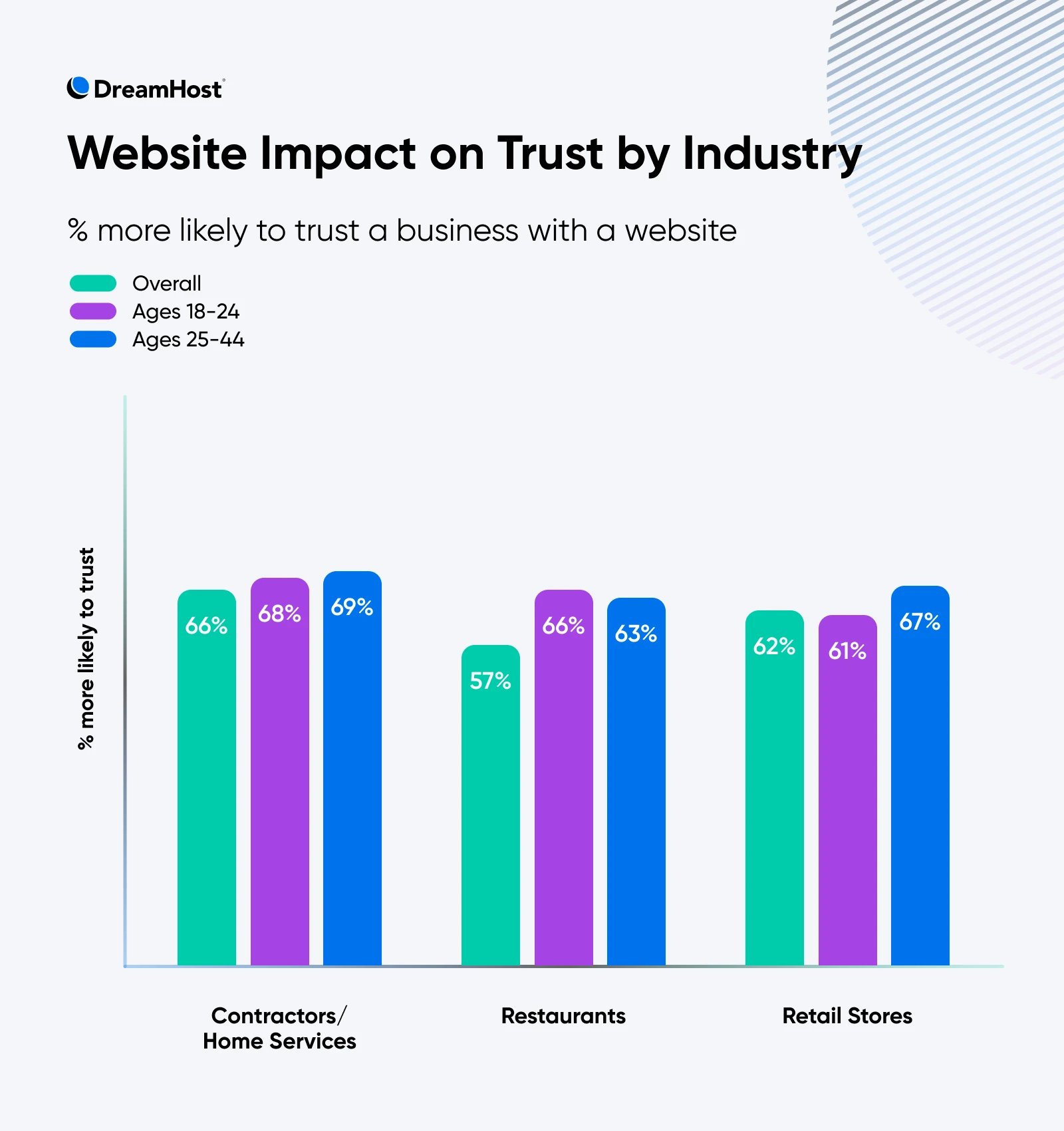
The through-line across all three industries is simple: websites reduce perceived risk.
Consumers use websites to verify that a business is legitimate, stable, and capable of delivering what it promises. The industries where websites matter most are the ones where consumers have the most to lose. And in 2026, that includes just about everyone.
“Trust, but Verify”: Websites As Consumers’ Fact-Check Layer
58% of consumers say they “often” or “always” check a business website to confirm information they’ve encountered on social media, Google Business Profiles, or AI tools.
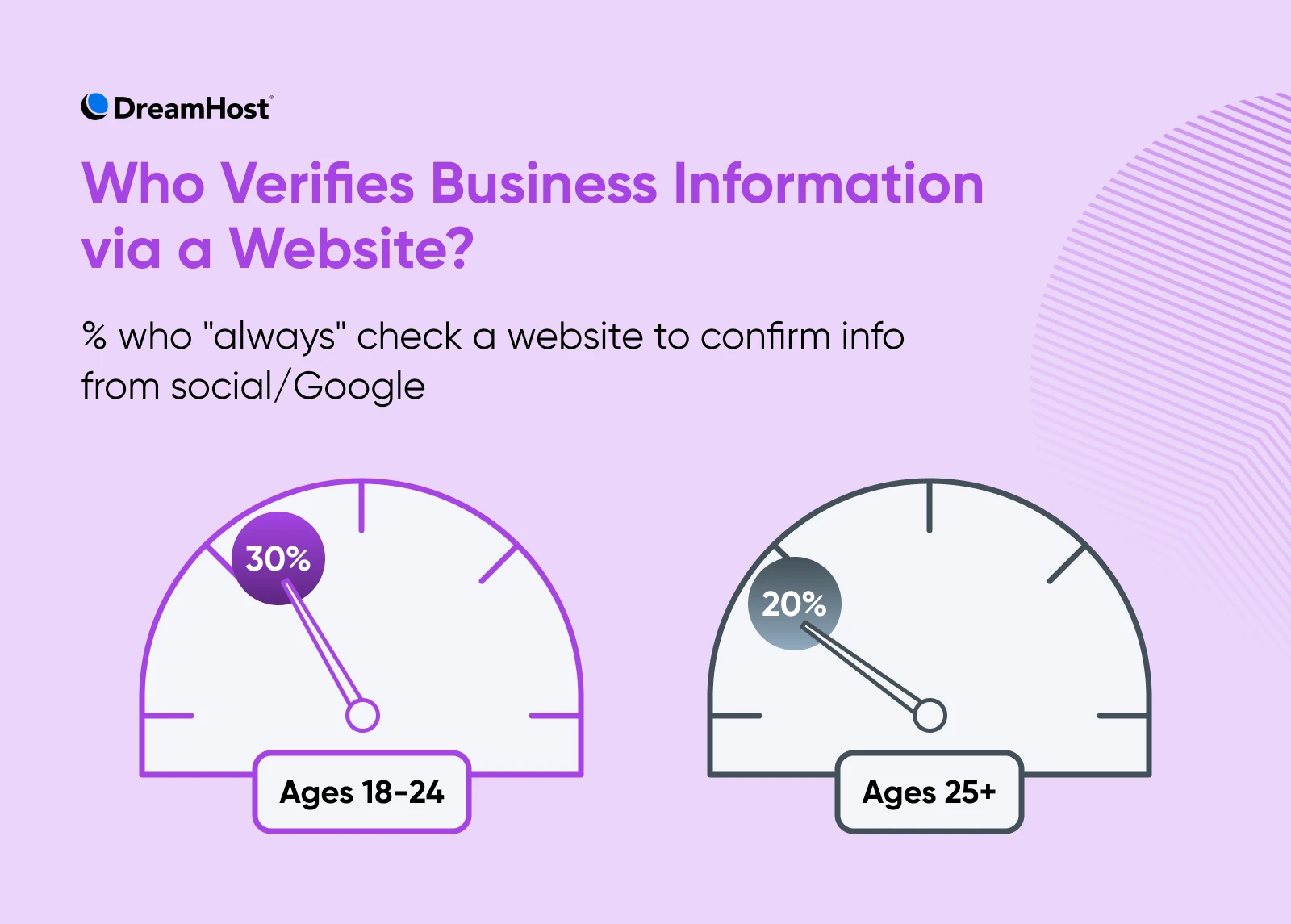
Among younger consumers, that behavior is even more pronounced: 30% of 18-24-year-olds say they “always” verify via website, compared to just 20% of consumers 25 and older.
Consider what happens when a consumer encounters a business through AI search — a tool that’s supposed to make websites obsolete by surfacing answers directly. Do they trust the AI and move on? Not really.
After receiving an AI recommendation, 45% of consumers say they go to Google to search for more information, and another 34% go directly to the business website. The website, in other words, is the destination for verification, even when the discovery happened somewhere else entirely.
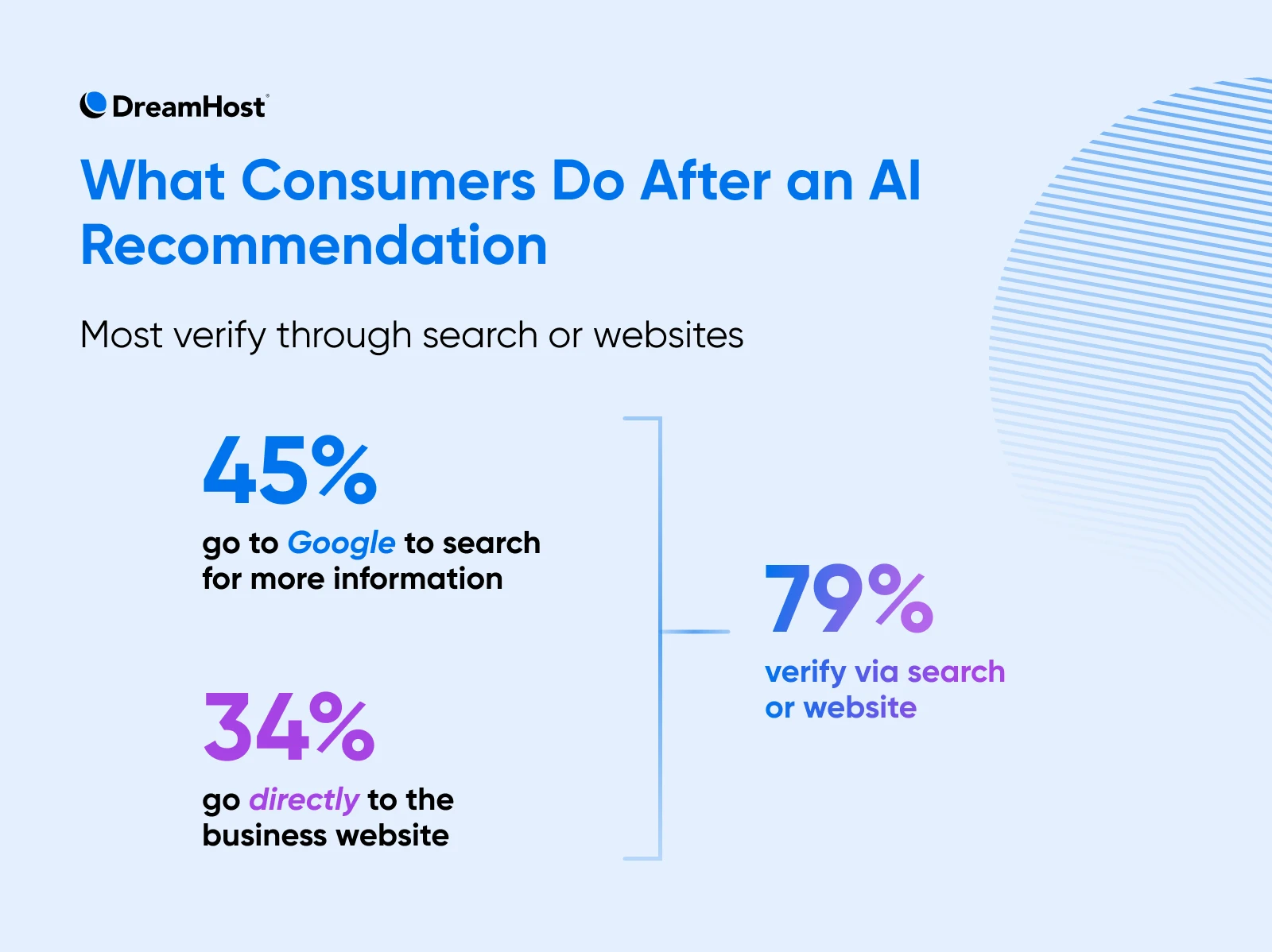
This behavior makes sense once you understand what websites offer that other digital channels don’t: completeness, control, and permanence.
Social media profiles are curated highlight reels. Google Business Profiles are often outdated. AI tools pull from a patchwork of sources that may or may not be current.
But a website — especially one that’s well-maintained — is the business’s own authoritative record of what it offers, where it’s located, how much it costs, and how to get in touch. That’s why consumers treat websites as the source of truth, even when other channels are faster or more convenient.
Young, AI-Native Shoppers Are Even More Website-Obsessed
Gen Z and younger millennials are more dependent on business websites than any other demographic.
You’d expect the opposite, wouldn’t you? These are the consumers who grew up buying clothes through Instagram ads, discovering restaurants on TikTok, and booking services through DMs. They’re fluent in platform-native commerce.
And yet, 72% of consumers under 25 say a website is essential for a local business to be credible, compared to 69% overall and just 66% for adults 45 and older.
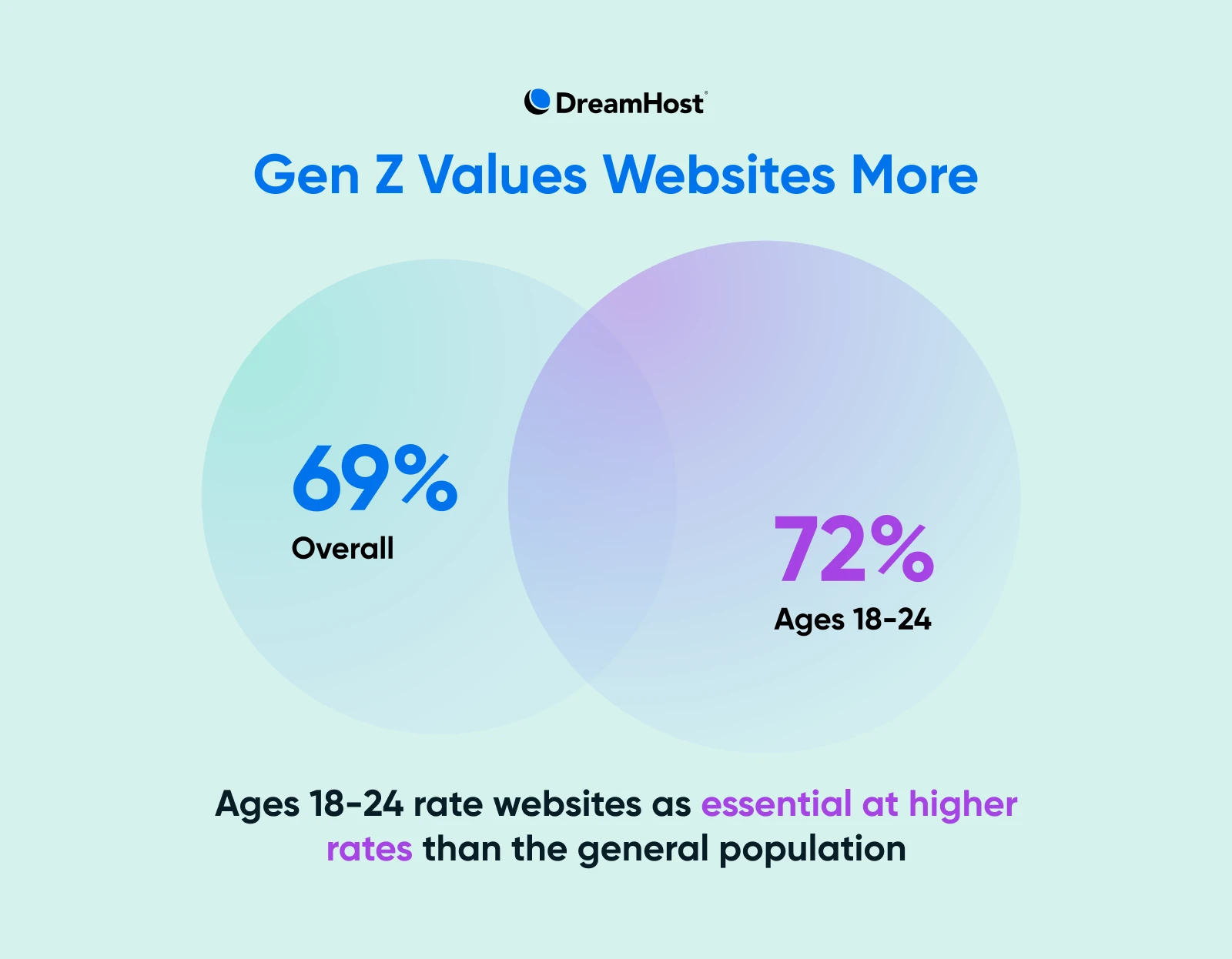
Here’s what the numbers say:
- 74% of 18-24-year-olds say they’re more likely to do business with a company if it has a website — the highest rate of any age group.
- 30% of younger consumers say they “always” check a business website to confirm information they’ve seen on social media or Google, compared to just 20% of consumers 25 and older.
Why might this be the case?
Younger consumers have spent their entire online lives navigating misinformation, scams, and algorithmically optimized content designed to manipulate behavior. They’ve watched friends get burned by Fyre Festival-style Instagram accounts. They’ve ordered products from social ads that never arrived. They’ve seen businesses disappear overnight, taking hard-earned cash with them.
So they’ve learned to verify. And despite the impermanence of the web, they treat business websites as a trustworthy verification layer.
Embracing AI Without Embracing Risk
The generational data gets even more interesting when you look at how younger consumers are responding to AI-driven recommendations. You’d expect Gen Z, digital natives who came of age during the ChatGPT explosion, to be the most enthusiastic adopters of AI search and discovery tools.
Instead, they’re pulling back.
- 35% of consumers ages 18–24 report using AI for recommendations or research “way less” or “a little less” than they used to, compared to 17% of consumers 25 and older.
- At the same time, only 3% of consumers across all age groups say they start with AI when searching for a local business; a percentage that stays consistent across age demographics.
The resistance to AI recommendations is particularly pronounced when those recommendations come without a website to back them up:
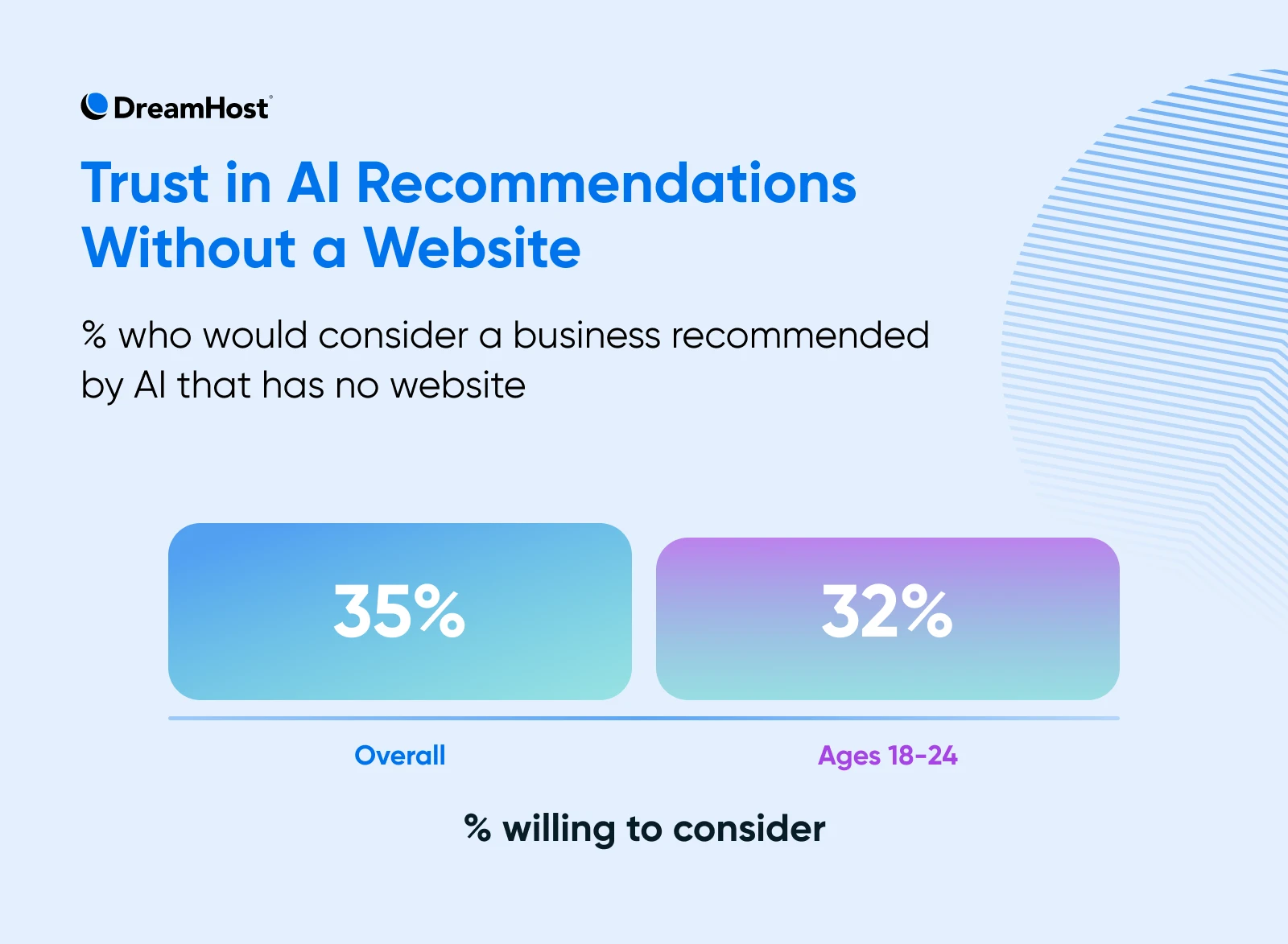
- Only 35% of consumers overall would consider doing business with a company recommended by AI if it doesn’t have a website.
- Among Gen Z, that number drops to 32% — the lowest of any age group.
So what’s going on? Why are younger consumers,who theoretically have the least reason to distrust AI,the most skeptical of AI-driven business recommendations?
There are a few plausible explanations.
First, younger consumers have been the first generation to experience AI saturation in high-stakes environments, particularly in education. They’ve seen AI-generated essays get flagged by plagiarism detectors, watched professors ban ChatGPT in blanket policies, and navigated an academic culture that treats AI use as somewhere between cheating and laziness. That experience has likely created a social pressure to distance themselves from AI tools, even in contexts where the stigma doesn’t apply.
Second, younger consumers have more experience with AI’s limitations. They’ve seen chatbots hallucinate facts, generate confident-sounding nonsense, and fail to distinguish between authoritative sources and random Reddit threads. They know AI recommendations are only as reliable as the data they’re trained on — and that data often includes incomplete or outright false information about small businesses.
This dynamic helps explain why younger consumers are simultaneously comfortable with AI tools and skeptical of simply taking AI’s word for it when looking for business or product recommendations. They’re not anti-AI, they’re anti-risk.
Social Media Is Discovery, but Websites Are Where Real Money Changes Hands
Here’s the spending behavior data that should make every “go social first” strategist rethink their approach:
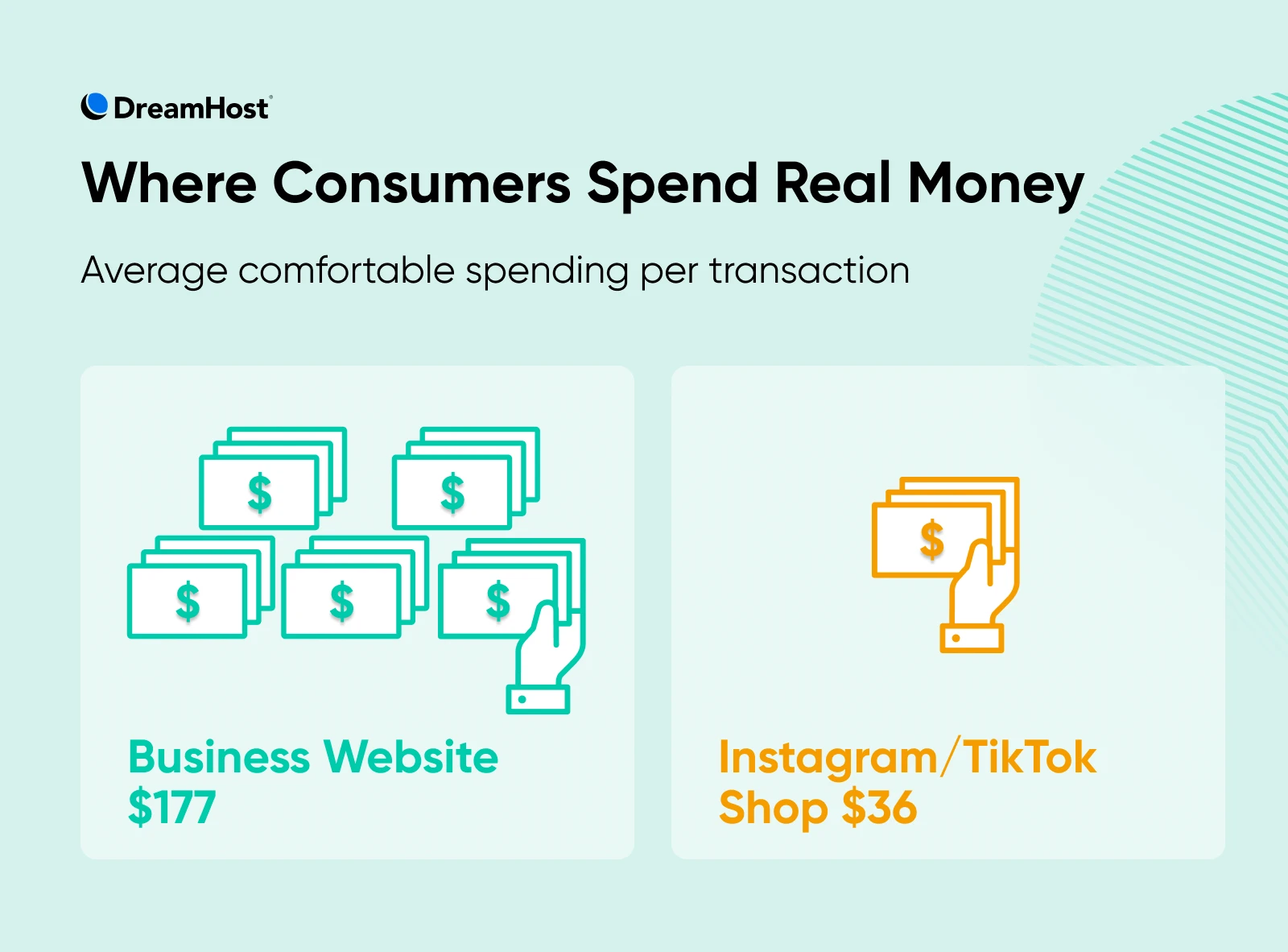
- Consumers report being comfortable spending an average of $177 on a business website, but only $36 on Instagram or TikTok shops.
- Consumers report a 7x difference in spending comfort for purchases over $100 on a website vs. social media.
- Consumers are 6x more likely to be unwilling to spend anything at all on social platforms (33% on social vs. 6% on websites).
- They’re 14x more likely to spend $500 or more on a website (14% on websites vs. 1% on social).
- Only 8% of consumers are comfortable spending $200+ on social media shops, compared to 35% on websites.
| Spending Comfort Level | Business Website | Instagram/TikTok Shop |
| Average comfortable spend | $177 | $36 |
| $0 | 6% | 33% |
| Up to $20 | 15% | 31% |
| Up to $100 | 46% | 30% |
| Up to $500 | 20% | 4% |
| Over $500 | 14% | 1% |
The pattern is consistent across demographics, but it’s particularly pronounced among the consumers most likely to make repeat purchases and become long-term customers. Younger consumers (ages 18-44) are more willing to make large purchases on websites than any other group, while simultaneously being the most skeptical of social commerce for anything beyond impulse buys.
Additionally:
- 67% of consumers say they start with Google when searching for a local business.
- Another 19% of 18-24-year-olds start on social media, but starting on social media doesn’t mean finishing there.
- Only 3% of consumers across all age groups report starting with AI tools, despite the hype around AI-driven search.
Social media is where discovery happens. Google is where intent begins, but websites are where transactions actually occur.
The implication for small business owners is clear: social media is a discovery channel, not a sales channel.
You can build an audience on TikTok, you can run ads on Instagram, but if you want people to actually spend money — particularly amounts that matter — you need a website where transactions feel legitimate, secure, and permanent.
The businesses that treat social media as their only digital presence aren’t just leaving money on the table. They’re capping their revenue potential at $36 per transaction.
Your Website Might Be Hurting You: The Hidden Cost of Outdated or Poor Design
Having a website is necessary. But having a bad website might be worse than having no website at all. 60% of consumers say an outdated-looking website negatively affects their perception of a business’s quality or trustworthiness.
When asked what frustrates them most about business websites:
- 34% of consumers cited outdated or inaccurate information as the top problem, more than any other issue.
- Another 23% said hard-to-find information was the most frustrating experience, which often correlates with poor site structure, unclear navigation, or designs that prioritize aesthetics over usability.
On the flip side, the elements that build trust are straightforward and achievable for even the smallest businesses:
- 67% of consumers say clear contact information (phone number, email, address) is the most trust-building element on a website.
- 51% value a secure website (HTTPS), particularly for any transactions involving payment or personal information.
- 47% want to see real photos of the team or business location, not stock images or generic graphics.
- 40% value online booking or contact forms that make it easy to reach out or schedule services without having to call.
Consumers value clarity, recency, and authenticity over polish. They don’t need your website to be beautiful (though it helps). They need it to be accurate, navigable, and current. They need to trust that the information they’re seeing reflects the business as it exists today, not as it existed when the site was launched five years ago.
What This All Means: Websites As the Trust Anchor of the Open Web
So, where does this leave us?
Websites remain the single most important credibility signal a business can deploy, even as consumers discover businesses through Instagram ads, TikTok videos, Google Business Profiles, and AI-generated recommendations.
The businesses that understand this — and that invest in maintaining accurate, accessible, well-designed websites — aren’t just checking a box. They’re building infrastructure for trust in an era when trust is increasingly hard to earn and easy to lose.
At DreamHost, we’ve always believed that owning your digital presence is essential to maintaining your credibility in a world run by platforms and algorithms. The 2026 Local Business Trust Index confirms what we’ve seen for years: your website is your home base on the open web.
The businesses that win in 2026 and beyond won’t be the ones that abandon websites for social media. They’ll be the ones that treat their websites as what they’ve always been: the one place on the internet they actually control, and the signal consumers trust the most.

Unbeatable WordPress Hosting
Reliable, lightning-fast hosting solutions specifically optimized for WordPress.
See MoreMethodology
This article is based on a nationwide survey conducted in November 2025, in which we collected responses from 1,201 Americans ages 18-64 to better understand how consumers perceive, evaluate, and trust local businesses in an era dominated by social media, AI recommendations, and platform-based shopping.
Participants represented a diverse cross-section of industries and professional backgrounds, offering a well-rounded snapshot of public sentiment and real-world impacts. Respondents were asked a series of questions about local business credibility, website expectations, trust signals, spending comfort across different channels (web, social, AI), and how they verify information. These responses provide a detailed look at how consumers in 2026 navigate the increasingly complex digital landscape — and where websites still play a critical role.
Fair Use
Users are welcome to use the insights and findings from this study for non-commercial purposes, such as academic research, educational presentations, and personal reference. When referencing or citing this article, please ensure proper attribution to maintain the integrity of the research. Direct linking to this article is permissible, and access to the original source of information is encouraged.
For commercial use or publication purposes — including but not limited to media outlets, websites, and promotional materials — please contact our Corporate Communications team for permission and licensing details.
We appreciate your respect for intellectual property rights and adherence to ethical citation practices. Thank you for your interest in our research.