
Transparency.
Innovation.
Genuine support.
And most of all — stability.
If you’re anything like me, these are key elements you shop for when choosing a service partner, like, say, a web hosting company for your own small business website or the ones you manage for your clients.
Why does it seem like these features are getting harder and harder to find, no matter the industry?
Consolidation.
While the corporatization and aggregation of services certainly has its upsides — lots of funding means quicker pivots and often lower pricing — there are, naturally, some trade-offs.
At DreamHost, we’re one of the few independent web hosting companies left.
Because we’re self-owned and self-directed, we can tell you the truth about what that really means: the good and the bad.
Keep reading to learn the differences between independent and corporate hosting providers and the benefits and drawbacks of both, so you can make an informed decision for your own projects or help your clients choose their best hosting partner.
Independent Web Hosting Company vs. Corporate vs. Aggregator
Not all web hosting companies are created equal. Here’s how ownership and structure impact how each type of host operates.
What Is an Independent Web Hosting Company?
Independent web hosting companies are privately owned, so they operate their own management. They don’t belong to a “family of brands,” and don’t have a “parent” company calling the shots.
Typically, these businesses do everything, all the way down to running their own servers. That means they have the freedom to set their own pricing and make informed decisions about services and policies. Their primary focus is to meet the needs of their customers and not “create shareholder value.”
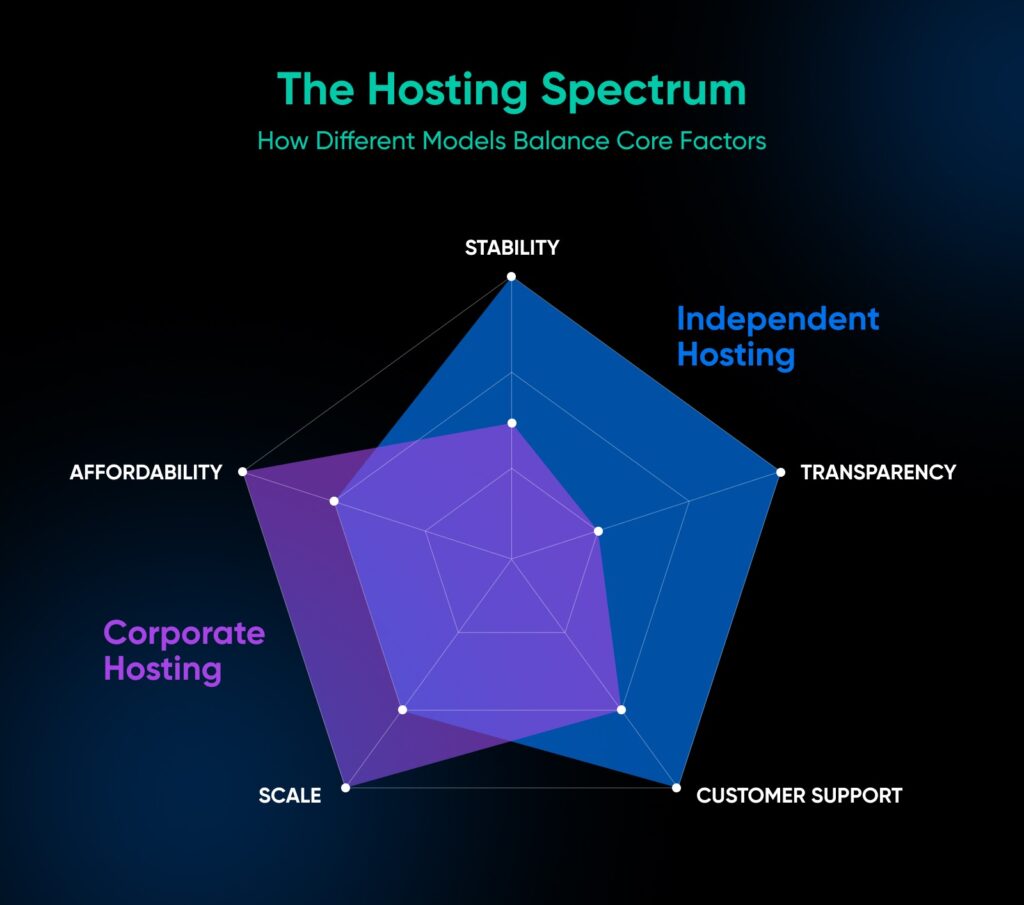
Because scale isn’t necessarily on their side, ultra-low pricing isn’t typically a selling point for independent hosts. Instead, they usually focus on transparency, personalization, and community values, like being open source, sustainable, and so on.
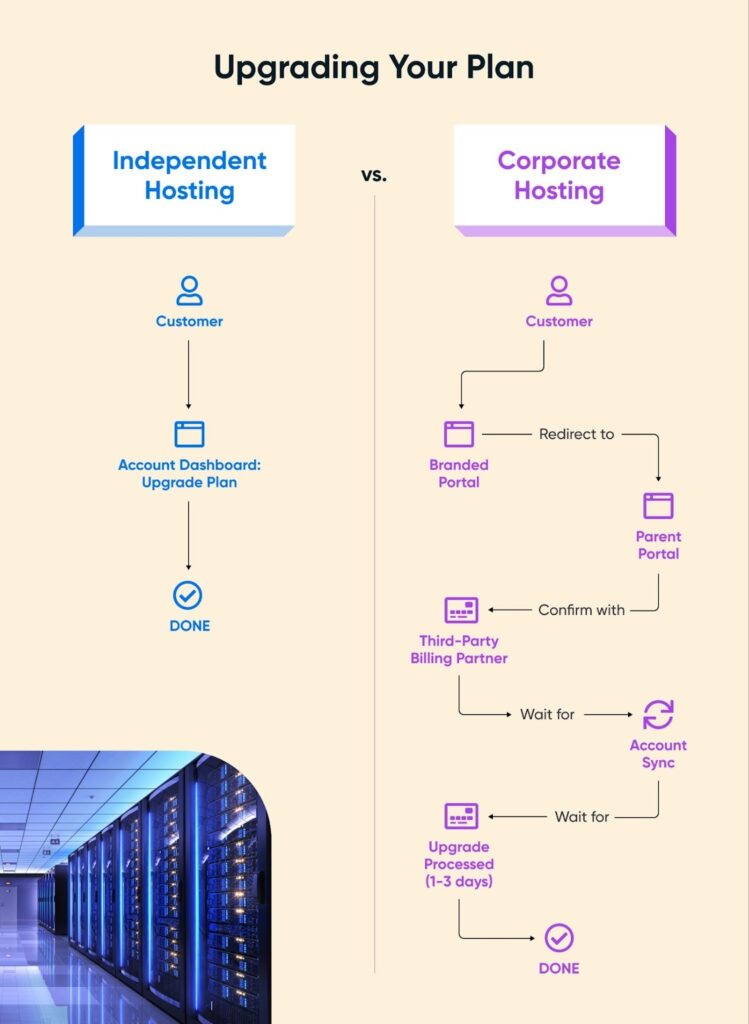
At DreamHost, we’re proud to say we fall into this category — and have for three decades now!
What Is a Corporate Web Hosting Company?
Usually, when people refer to a web hosting company, they’re still talking about a single organization. The difference is that a corporate web host is much larger, has a lot more structure, and is probably funded in part by investments outside of sales. These businesses may also have multiple divisions and product lines.
Because of these characteristics, there may be more bureaucracy involved in their decision-making. So, while they ironically often have enough money to move more quickly and act more boldly, agility is often bogged down by having too many cooks in the kitchen.
With extensive resources, corporate hosts may have more server power, advanced technologies, and lower pricing. This makes them a good fit for some enterprise businesses, but can also make them feel less personal thanks to centralized and standardized policies and customer service offerings.
GoDaddy is an example of a large corporate hosting company.
What Is a Web Hosting Aggregator?
A web hosting aggregator company is a parent, or umbrella, company that has one purpose: acquiring and managing multiple separate hosting brands.
Typically, a company like this will operate all of its brands under a single corporate structure, but let each brand maintain its identity, marketing style, some staffing, etc.
Behind the scenes, things like server infrastructure, customer support systems, governing policies, and of course, revenue, are shared.
The interesting thing here is that many aggregator-owned hosts still feel small, yet their backing means they take a more corporate-style approach to service — rigid policies, impersonal support, very competitive pricing, etc.
Newfold Digital (formerly EIG) is a huge aggregator that has acquired many web hosting companies you’ve heard of, including HostGator, BlueHost, and dozens more.
The industry consolidation over the last few decades has created an illusion of choice when it comes to web hosting. Nowadays, it can be difficult to find hosting companies that are actually independent.
Why should that matter to you?
Let’s cover some of the biggest benefits of supporting indie hosting.
“There aren’t that many independent web hosts around anymore. And the fact that we can still wear that badge must mean that we’re doing something right. It’s not like we haven’t been approached. It’s just that we prefer our independence.” — Me, Brett Dunst, VP of Communications
What Are the Benefits of an Independent Web Hosting Company?
What’s a spider’s favorite profession?
Web designer.

^One of the lesser-known benefits of being an independent host is the freedom to make corny dad jokes like that any time we want!
But enough about us. Here are some consumer-facing benefits of working with a truly independent web hosting company, like DreamHost.
Consistent Service
Ever had your mortgage sold? That same system of fast and seemingly endless acquisitions is also prevalent in the hosting space.
And it can be disruptive to your business.
When a hosting company is acquired, your website may be migrated to an entirely new platform. That means settings could stop working the way they used to, and performance standards could shift overnight.
Here’s an example of how repeated acquisitions can ripple down to customers: turning what started as a stable hosting experience into a series of service disruptions.
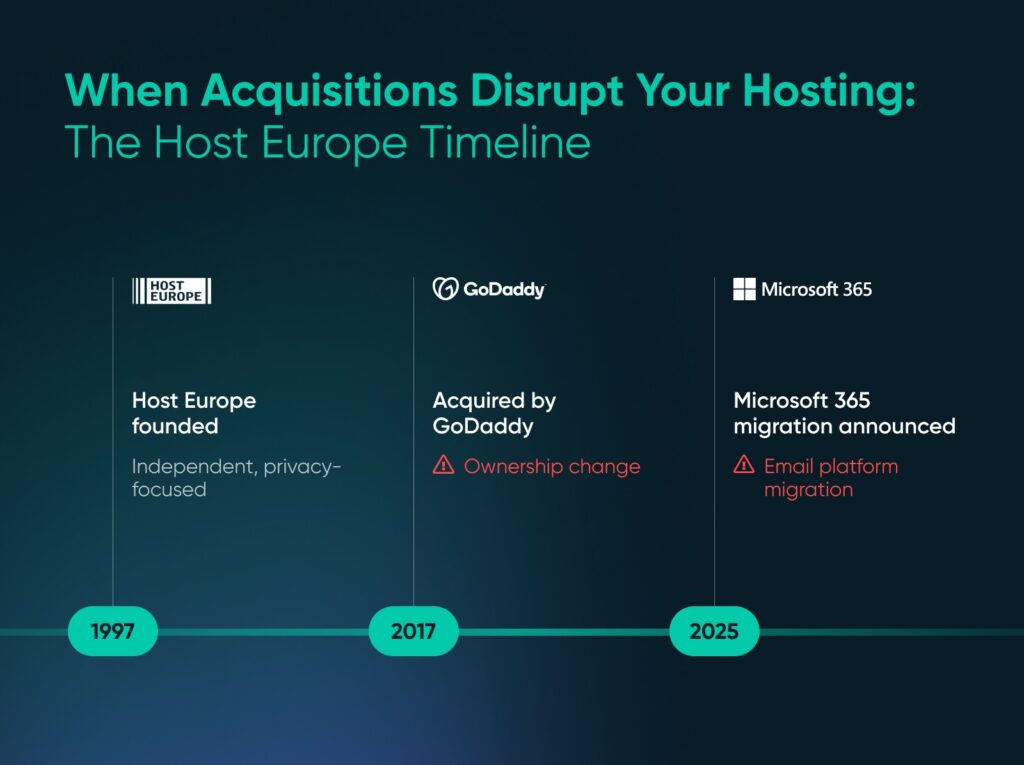
With a web host that’s committed to independence, that problem simply doesn’t exist.
When you sign up with a website hosting company that’s proud of its independence, you sign up for stability and consistency, without ever having to worry about what’s happening behind the curtain in an investor’s meeting somewhere.
Customer-Centric Decision Making
Independent hosting companies have the freedom to chart their own course.
Decisions are made based on what’s best for their customers over the long term, not just what will boost next quarter’s earnings report. This focus allows them to invest in sustainable improvements, better support, and thoughtful policies that put people first.
When your host isn’t accountable to shareholders, it can be accountable to you.
Predictable Pricing
Obviously no one likes surprise fees, upsells, or renewal price hikes. Unfortunately, however, that’s become the norm for a lot of investor-backed technology companies, including hosting providers.
Because they’re not under pressure to meet aggressive profit targets at every turn, independent web hosts can focus on transparent, fair pricing that aligns with value provided.
That peace of mind is practically priceless.
Innovation as a Priority
In a corporate setting, there are layers of decision-makers, committees, and approval chains that can influence even the most simple updates.
Independent hosts, on the other hand, are much closer to the service and its users.
That empowers indie hosts to be more innovative, rolling out features they want to offer and that their users actually care about.
When there’s less bureaucracy to navigate, creativity and improvement have freedom to flow.
Support That Knows What You’re Talking About
One of the biggest frustrations with corporatized hosting companies is impersonal, outsourced support.
Especially for less tech-savvy individuals who just need a little help when it comes to keeping their websites fast, functional, and secure.
It’s easy to find yourself talking to a chatbot or an outsourced agent who will never fully understand your setup or really solve your problem.
Independent hosts typically keep support in-house, so you’re always speaking with someone on a small team of real experts who know the platform inside and out.
At DreamHost, for example, every support team member actually works for us, not a third-party call center. This makes a huge difference when you need quick, knowledgeable help.
💡Bonus: Surprisingly-Stable Uptime
Here’s a fun perk you might not expect: independent web hosts keep your site online even when the “big guys” go down.
When major providers experience outages, large portions of the web can go dark. But independents that run their own infrastructure aren’t tied to those same blackouts.
Of course, this doesn’t mean independent hosts are magically immune to downtime, but it does mean your site might stay up and running when others don’t, delighting your visitors while the rest of the internet scrambles.
The Hard Truths: Drawbacks of Choosing an Independent Web Hosting Company
Without the deep pockets of the corporate hosting giants, independent providers naturally operate differently.
That’s not necessarily a bad thing, but it’s worth understanding the following trade-offs before you decide which type of host is right for you.
Every Move Must be Measured
For independent hosts, every business decision carries real weight.
There isn’t a multimillion-dollar safety net or a board of investors ready to pour in extra cash if things get tough. Big corporate or aggregated hosting brands can often afford to take risks, and can recover quickly when they make mistakes.
But independent hosts have to be extremely thoughtful about which projects to pursue and challenges to take on. So the next time you wonder why your small, indie hosting company isn’t adopting the latest tech as quickly as the international conglomerate that’s running 24/7 social media ads — that’s why.
Growth Is Slow and Steady
For the most part, independent hosting companies can’t rely on massive ad campaigns or tons of acquisitions to grow. The money typically just isn’t there for these kinds of things.
Instead, these companies have to build their businesses and customer bases the old-fashioned way: through quality service.
For customers, the good news is that means your host is probably more focused on reliability than chasing market share! However, it also means growth happens deliberately slower.
Why should this growth pattern matter to you, the end user? Because of our next point…
Volume Benefits Are Limited
Economy of scale means that as a company grows, it’s able to leverage bulk deals and pass those savings down to you in the form of cheaper services.
Well, independent web hosts that don’t grow huge don’t usually enjoy bulk, discounted infrastructure, hardware, or advertising. Thus they aren’t privy to discounts and are less able to match the rock-bottom pricing of larger competitors.
While it’s not the lowest, independent hosts do tend to keep pricing transparent and consistent. So you might pay a little more upfront, but is that really so bad compared to a giant host locking you into a five-year contract that suddenly skyrockets after the first month?
6 Steps to Choosing the Best Web Host for the Job
So, does a giant host or a smaller indie fit your needs (or your clients’ needs) better?
The following framework will help you evaluate which approach to take.
1. Assess Your Priorities
What matters most for your website, or the sites you set up for your customers?
These are some of the top considerations we suggest running through so you can set your priorities and choose a host accordingly:
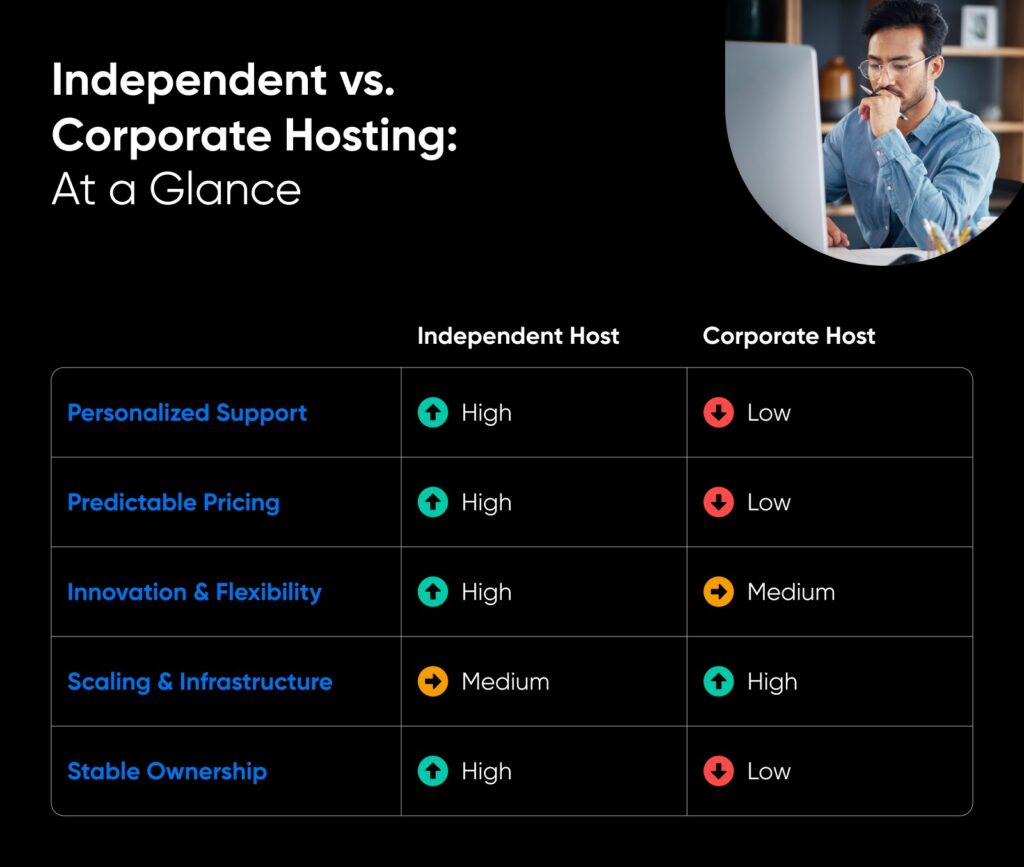
- Uptime: Can any downtime at all be tolerated? For the vast majority of smaller and even medium-sized businesses, reasonably the answer is yes. Most hosts have pretty reliable uptime. Larger hosts may offer a slight edge, but it’s up to you to decide whether that’s worth the sacrifice in terms of customer centricity.
- Support quality: Will you ever need personalized, expert help that you can actually get on the phone easily? If that’s a yes, an indie is certainly your best bet.
- Pricing: Are low costs a must, or is predictable, transparent pricing more important? If pricing is your number one priority, you may want to shop around with the bigger corporate providers. (Watch out for hidden fees, though!)
- Reliability: Is it important to you that your host is focused on long-term, stable service? Typically, independently-owned and operated hosting companies that aren’t looking to be acquired are better for this.
- Innovation: Hey, who doesn’t love exciting new features? While corporate and investor-backed hosts might be able to come out with more of them, independent web hosting companies are actually better equipped to quickly come out with hot new capabilities their users actually want.
2. Consider Your Scale and Growth Needs
If your site will remain relatively small/medium and you don’t predict massive traffic spikes, an independent host may offer all the resources you need with more attention to your account.
But if it is high traffic you’re going for, or enterprise-level features, a corporate host may have the infrastructure advantage, as well as the bulk pricing you need to afford it.
No design skills. No builders. No hassle. Just results.
Get Started
3. Compare Support and Customer Experience
Is support in-house or outsourced? How responsive is the team? Do they understand your platform and business?
Independent hosts usually provide more personalized, knowledgeable support since the agents actually work directly for the company. Corporatized hosts may have larger teams but less personalized help. They can get back to you quickly, but resolving issues of any complexity may ultimately take a long time.
Suppose you’re tech-savvy but primarily creating websites for smaller businesses that will go on to manage them themselves. In that case, we highly recommend you choose a more independent hosting company and set them up for success.
4. Look at Total Lifetime Costs
Investor-backed hosts are often cheaper upfront, but, watch for hidden fees, renewal increases, or aggressive upselling.
Independent hosts are often slightly higher in pricing because they don’t enjoy economies of scale. Because of this, they tend to be more transparent and consistent in their pricing. So, you might end up paying the same or even less over time.
5. Check Innovation and Flexibility
Independent hosts can adapt quickly, implement user-requested features, and maintain flexibility.
And while they can innovate quickly in some areas, conglomerates or corporate hosting companies usually prioritize features that drive the most revenue rather than your specific needs.
6. Test Before You Commit
Many hosts offer trial periods or money-back guarantees.
No matter what route you go, consider signing up for a short-term plan.
Why? You want to really try out those things you prioritized earlier, like uptime, support, and user-first features, before committing long-term.
It’s Time To Choose Your Web Host
Independent hosting, like DreamHost, has offers that come with long-term stability, innovation, and personalized support.
The downside? There really isn’t one. You’ll be working with a smaller company that’s as dedicated to finding success online as you are – and that can give you the time and attention you deserve. You’ll get access to a trusted online partner who’s walked the walk.
While corporate or aggregator-backed hosts may be able to dip into investor money to undercut prices, it can come at the expense of personalized, customer-focused support and feature building.
Ultimately, the right host will be the one that aligns with your priorities, or those of the small businesses for which you create or manage websites.

Build the Website You’ve Always Wanted
From first idea to full launch, get everything you need to succeed online.
See MoreFAQs: Independent Web Hosting Companies
What exactly makes a web host independent?
An independent web host is privately owned and self-directed. It operates its own infrastructure, sets its own policies, and isn’t part of a corporate conglomerate or aggregator.
Are independent web hosting companies more expensive than corporate ones?
They can be slightly higher priced than large, investor-backed hosts, mainly because they don’t benefit from large-scale discounts. However, their pricing tends to be transparent and consistent, without surprise fees.
Why choose an independent web hosting company over a larger corporate provider?
If you value personalized support, long-term stability, predictable pricing, and customer-focused innovation, independent hosting is often the better choice.
When does a corporate host or aggregator make more sense than an independent?
If you need massive scalability, low pricing, and are totally comfortable with more standardized support, a corporate or aggregator-backed host may suit your needs.
